
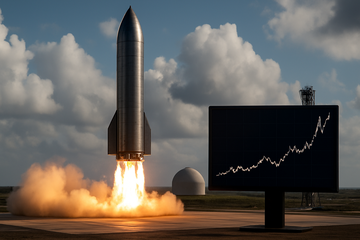
Starship Flight 14 launch
Sept 28, 2026, 7:48 a.m. CT
Starbase, Texas — Booster 21 / Ship 41, first orbital insertion
Starlink V3 satellites deployed
26 of 26
All operational at ~269 km altitude, per Musk statement
Capacity added per Starship launch
~26 Tbps (full V3 manifest: 60+ Tbps)
Reported as ~20× a Falcon 9 V2 Mini launch
Mission duration
Cut from ~10 h to ~3 h of objectives
After one of three Raptor vacuum engines shut down prematurely
SpaceX 2026 launch share
~47% of228 global orbital attempts
Rocket Lab second at ~7%, per Space Foundation
SpaceX market value
~$1.95–2.0 trillion
SPCX closed Sept 28 at $149.80, up0.75% on the day
Flight 14 readout
What Starship actually proved on Sept 28 — and what the engine shutdown does and doesn't undo
SpaceX's Starship flew its 14th test on Sept 28, 2026 from Starbase, Texas. Booster 21 dropped Ship 41 into orbit for the first time in the program, and the ship carried 26 next-generation Starlink V3 satellites that deployed one-by-one near 269 km altitude. All 26 are operating nominally, SpaceX said — the first revenue-generating payload Starship has ever lifted.
Then the headline risk: a single Raptor vacuum engine on the upper stage shut down early on ascent. SpaceX initially flagged that Starship would skip orbit, before confirming minutes later that the burn could still complete on the remaining engines. The mission plan was reduced from ~10 hours of objectives to roughly three, but the ship still executed the full flight profile to a Pacific splashdown.
- Orbital insertion: Achieved on first orbital attempt — the first time Starship crossed the Kármán line with mission objectives intact, after 13 suborbital tests.
- Payload deployment: 26 of 26 Starlink V3 satellites released; SpaceX characterized the payload as carrying bandwidth equivalent to ~20 Falcon 9 launches of V2 Mini satellites.
- Anomaly: One of three Raptor vacuum engines shut down prematurely; SpaceX shortened the mission but did not abort, and the vehicle still completed a controlled reentry and splashdown.
- Significance: First flight where Starship earned revenue — analysts cited by Reuters pegged the V3 manifest alone at \"hundreds of millions of dollars\" of Starlink customer capacity value.
Valuation re-rate
Why the launch argument flips from $/kg to cadence — and why today was the trigger
The investment thesis on Starship used to be a $/kg story: from roughly $2,700/kg on SpaceX's Falcon 9 down toward a $100/kg target on fully reusable Starship, with extreme cases near $10/kg. That math only matters if Starship flies often enough to matter. With Blue Origin's New Glenn grounded since its April 2026 upper-stage failure and ULA's Vulcan grounded since late August, the binding constraint on the US launch market is no longer price — it's whose rocket actually leaves the pad.
SpaceX flew Falcon 9 more than 90 times in 2026 to date. New Glenn has not flown since March. Vulcan has not flown since its investigation opened. Into that vacuum, a single Starship test that deployed 26 V3 satellites — with the full Starship manifest designed for 60-plus satellites per flight — telegraphs a capacity ramp that competitors will struggle to match even from full operation, never mind a return-to-flight investigation.
Bandwidth math
Starlink V3 is not just more satellites — it is 20× the bandwidth per launch
Per SpaceX's published specifications, each Starlink V3 satellite carries 1 Tbps of downlink capacity (10× a V2 Mini) and 160 Gbps of uplink (22× V2 Mini), supported by 2,048 phased-array beams versus192 on V2. A single Starship launch carrying a full V3 manifest is projected to add roughly 60 Tbps of capacity to the constellation, more than 20× the capacity added by a Falcon 9 launch of V2 Mini satellites. Flight 14 carried 26 of those satellites — about 26 Tbps in one shot — boosting total Starlink constellation capacity by roughly 3%.
Bandwidth added to Starlink per launch, Tbps
Per SpaceX technical specs and post-launch estimates. Starship V3 figure reflects the full 60-satellite manifest design; Flight 14 carried26.
Unit: Tbps
Falcon 9 + V2 Mini
~23 sats × ~96 Gbps downlink
2.6
Starship Flight 14 (26 V3)
1 Tbps per V3 satellite
26
Starship V3 design (60 V3)
Full manifest target
60
For every other operator in low Earth orbit broadband, the comparison point just jumped. AST SpaceMobile's BlueBird constellation — the cleanest public bet on direct-to-cell from space — has a stated target of ~45 satellites by 2027 against SpaceX's single-launch 26-satellite cadence. EchoStar and Viasat play in geostationary and licensed-spectrum segments where the dynamic differs, but the long-run pricing umbrella for satellite broadband just got reset.
Public-market transmission
The four lines from Flight 14 to listed US aerospace and satellite names
Three transmission lines jump out for investors who don't own SPCX: the small-launch peer that just saw its competitor prove orbital reuse; the direct-to-cell peer whose addressable market just widened by 20× per launch; and the defense prime whose space-launch story got pushed another year down the road.
- Rocket Lab: Q2 2026 revenue hit a record $234M (+62% YoY) with backlog up 137% to $2.36B — but Neutron's debut slipped to Q4 2026 or later, and a Starlink-class V3 stack removes the 8-ton payload ceiling as a structural moat. Cadence-vs-cost dynamics still favor RKLB's small-launch niche, but the multiple on $769M TTM revenue already prices that in.
- AST SpaceMobile: Operating loss of ~$253M in Q2 2026 against $31.5M of revenue. A $1.3B backlog anchors the build, but the V3 capacity shock compresses the differentiated-bandwidth argument that underwrites ASTS's 200× sales multiple — the more bandwidth Starlink adds, the harder the wholesale pricing wedge becomes.
- Boeing: Space segment delivered $7.5B of Q2 2026 revenue (+13% YoY), but the more relevant line crossed the same day: NASA confirmed Starliner's next crewed flight is now no earlier than 2028, with an uncrewed test possible by year-end. As SpaceX phases Falcon 9 and Dragon out for Starship, the captive NASA demand for an alternative is wider, not narrower.
- Iridium: The incumbent is shielded by its own L-band architecture and hosted-payload defense contracts, with $884M TTM revenue at 70.4% gross margin — but as Starlink direct-to-cell expands, IoT and narrowband wholesale pricing comes under pressure before broadband does.
Defense primes & suppliers
Why Boeing, Northrop and Lockheed aren't the winners yet — and where the supplier pull sits
Boeing's $7.5B Space segment is real but skewed toward SLS, Starliner and government payloads — categories whose demand is policy-driven, not commercial-launch-driven. The Starliner delay to 2028 (announced the same day as Flight 14) means more NASA dollars flow to SpaceX crew transport in the interim. Northrop Grumman and Lockheed Martin, through their ULA joint venture, are exposed to Vulcan's grounding — a Vulcan return-to-flight in Q1 2027 would be the first material positive for that equity bucket; until then, Vulcan's NSSL backlog risk grows.
On the supplier side, SpaceX builds Raptor engines in-house and welds Starship tanks from proprietary 304L stainless steel, so the upstream beneficiary thesis is weaker than in airliner supply webs. The clearest listed beneficiary of fleet cadence is the avionics and high-temperature alloys corner — Howmet Aerospace and specialty castings suppliers — where shared exposure to high-cadence launch ramps plus commercial-airliner recovery compounds. Hexcel, with its composite exposure to legacy launch and space structures, captures less of the Starship-specific ramp but still reads the cycle.
Synthesis
What changes today — and what still has to go right
Three things changed on Sept 28: Starship proved the orbital-insertion and payload-deployment path works; Starlink V3 became a real, deployed product with a step-function capacity profile; and the US heavy-lift competitive set got visibly narrower, with Blue Origin and ULA both on the ground. Together those put the conversation about SpaceX's ~$2T valuation back on the right axis — cadence, not $/kg — and tighten the squeeze on the public names whose launches or satellites overlap Starlink's addressable market.
Horizons
Short-term catalysts vs structural implications
Short-term (days to quarters): the next two Starship flights — likely targeting late Q4 2026 — are the binary catalysts. A second clean orbital insertion plus a 60-satellite V3 deployment would lock the cadence thesis in; a second Raptor vacuum failure would pull SPCX back to the $/kg-fragmented valuation. Peer-side, Rocket Lab's Neutron debut timing (RKLB targets Q4 2026) and Blue Origin's first post-grounding New Glenn flight are the two most important read-throughs. ASTS's next BlueBird launch and Boeing's uncrewed Starliner test (targeted by year-end) round out the calendar.
Long-term (1–3 years): if Starship flies to its stated cadence, the cost floor for LEO broadband collapses — pulling pricing pressure onto every Ku/Ka-band wholesale contract, including Iridium's narrowband segment, and forcing direct-to-cell peers like ASTS to compete on differentiated spectrum rather than capacity. The Boeing/ULA side benefits only if Vulcan and New Glenn return to flight and ramp — that scenario is plausible by 2027 but not2026. Defense-space suppliers (Howmet, Hexcel) read the launch-side secular tail as additive to commercial-airliner recovery, not a standalone thesis.
Stocks the event actually touches
- Starlink V3 + Starship reach removes the 8-ton payload ceiling as a structural moat for Rocket Lab's Neutron — small-launch niche remains defensible, but at a richer multiple (52× EV/Sales TTM) the cushion is thin.
- Q2 2026 backlog of $2.36B (+137% YoY) anchors near-term revenue; the open variable is whether Neutron debuts in Q4 2026 or slips into 2027, which would re-rate the medium-term margin story.
- Days: read Starship Flight 15 / 16 cadence and any second Raptor anomaly as the binary signal. Years: small-launch and defense-space backlog protect the niche even if SpaceX absorbs more commercial demand.
- Starlink V3 adds 60 Tbps per Starship launch — ~20× a Falcon 9 V2 Mini — compressing the differentiated-bandwidth argument underwriting AST SpaceMobile's 218× price/sales multiple.
- Q2 2026 revenue of $31.5M against $252M operating loss; $1.3B backlog still needs MNO conversion to underwrite the build, and pricing power narrows as supply balloons. Days: next BlueBird launch and any AT&T/Verizon direct-to-cell wholesale contract are the catalyst windows.
- Years: ASTS either proves out a unique licensed-spectrum, low-latency niche by 2027–28 — or its multiple compresses toward the satellite-operator mean as bandwidth becomes commoditized.
- Starliner's next crewed flight is now no earlier than 2028, announced the same day as Flight 14 — that means more crew-transport revenue stays with SpaceX through 2027, but the captive NASA demand for an alternative widens.
- Q2 2026 Space segment revenue of $7.5B (+13% YoY) is policy-driven, not commercial-launch-driven — Boeing/ULA's Vulcan grounding is the bigger swing factor. Days: any Vulcan return-to-flight signal in Q4 2026 reads through to both Boeing and Lockheed Martin.
- Years: if Vulcan returns and ramps, Space Launch System and national-security launch give BA a multi-year backlog buffer; if it doesn't, the Space segment's growth story narrows to defense satellites and SLS.
- Iridium's L-band narrowband architecture and defense hosted-payload contracts ($884M TTM revenue, 70.4% gross margin) insulate it from Starlink's broadband crush — but IoT and wholesale pricing come under pressure as Starlink direct-to-cell expands.
- Watch the next hosted-payload renewal and any announcement on direct-to-device spectrum strategy. Days: any major MNVO contract win or hosted-payload extension; quarter-end Q3 2026 results (late October) will set the read-through.
- Years: Iridium survives as a specialty L-band incumbent, but its growth ceiling moves lower if SpaceX's V3+Starship cadence absorbs more of the marginal IoT/voice wholesale contracts.
- Northrop Grumman holds the half of the ULA joint venture (alongside Lockheed Martin) that owns Vulcan — Vulcan's late-August 2026 grounding and open investigation is a direct read-through; Q2 2026 revenue of $10.9B and operating income of $1.1B keep the rest of the portfolio insulated.
- Days: a Vulcan return-to-flight timeline is the binary catalyst for NOC; quarterly NSSL award activity is the lead indicator. Years: if Vulcan returns to flight and ramps, NSSL backlog flows back to NOC/LMT; if it doesn't, national-security launch share migrates toward SpaceX and eventually Starship.
- Howmet Aerospace's nickel-superalloy and titanium exposure reads the Starship cadence plus the broader launch ramp — every successful V3 deployment and Vulcan-return-to-flight candidate flows through high-temperature castings and fasteners.
- Backlog and order book already benefit from commercial-airliner recovery (737 MAX, 787); adding launch-side demand tightens capacity utilization. Days: read Q3 2026 results (late October) and any disclosed commercial-space contract wins.
- Years: structural thesis on aerospace-alloys demand becomes a launch + airliner + defense story instead of airliner-only — multiple expansion case if Vulcan ramps.
- EchoStar's relationship with SpaceX is now cooperative, not competitive — its spectrum assets are part of the direct-to-cell regulatory solution that has Starlink using (not replacing) ECHO's holdings.
- TTM revenue of $14.7B against a $0.6B net loss shows the squeeze from wireless competition; broadband-satellite capex stays light. Days: any new direct-to-cell wholesale agreement with a major US carrier; Q3 2026 results (early November) read the spectrum-monetization narrative.
- Years: EchoStar pivots toward spectrum-licensing and wholesale partnerships — its equity story becomes more about the value of its spectrum portfolio than retail-wireless or satellite services.