
Suncatcher target cluster
81 satellites · 1 km radius · 650 km SSO
Dawn–dusk sun-synchronous; nearest-neighbor spacing oscillates 100–200 m (Google Research blog, Nov 4, 2025).
Inter-satellite link target
10 Tbps aggregate per link
1.6 Tbps (800 Gbps each way) already demonstrated on a single transceiver pair (Google Research blog, Nov 4, 2025).
Google Suncatcher radiation test
Trillium TPU survived 15 krad(Si)
67 MeV proton beam, 5-year mission dose; HBM most sensitive after2 krad(Si) (Google Research blog, Nov 4, 2025).
Economic breakeven Google cites
$200/kg to LEO
US data-center power cost runs $570–3,000/kW/year; launch-cost parity unlocks orbital TCO (Data Center Dynamics, Nov 4, 2025).
Starcloud Series A + extension
$450M raised · $2.3B valuation
$170M Series A March 2026 led by Benchmark/EQT; $250M extension August 2026 led by Manhattan West, with NVIDIA joining (Data Center Dynamics, Aug 25, 2026).
SpaceX FCC filing
Up to 1,000,000 satellites
Filed Jan 30, 2026 for 500–2,000 km orbits; first Starship flight from Starbase Louisiana targeted 2029 (FCC DA26-113; BBC, Aug 25, 2026).
Alphabet 2026 capex guidance
$195B–$205B
Raised from $180B–$190B after Q2 2026; Cloud revenue +82% YoY to $24.8B, backlog $514B (Alphabet Q2 2026 release; Reuters, Jul 22, 2026).
NVIDIA orbital module
Space-1 Vera Rubin — 25x H100
Compute per watt vs. H100 for space-grade inferencing; IGX Thor and Jetson Orin shipping today (NVIDIA press release, Mar 16, 2026).
Suncatcher reframes orbital compute from side project into category
Alphabet unveiled Project Suncatcher on November 4, 2025 — a research moonshot to fly clusters of solar-powered satellites carrying the company's own Trillium (v6e) TPUs, networked by free-space optical links at tens of terabits per second. The announcement landed with a designed-in hardware partner (Planet Labs) and a concrete milestone: two prototype satellites in orbit by early 2027. That single move converts orbital compute from a sub-$200M venture-funded curiosity into a hyperscaler-validated engineering category, and the rest of the field has been scrambling to price it in ever since.
The math that makes a 1-km orbital compute cluster work
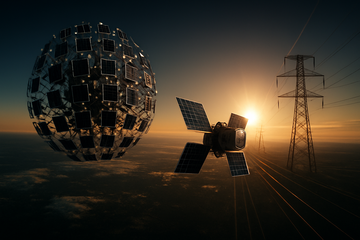
Google's pre-print lays out an aggressive but specific target: 81 satellites flying in formation within a1-km-radius cluster at ~650 km altitude in a dawn–dusk sun-synchronous orbit, with next-nearest-neighbor spacing oscillating between 100 m and 200 m. The bench-scale demonstrator already hit 1.6 Tbps (800 Gbps each way) on a single transceiver pair; the paper argues that multi-channel DWDM and spatial multiplexing can push aggregate per-link bandwidth to roughly 10 Tbps — enough to behave, in aggregate, like a data-center fabric.
| Parameter | Target (Suncatcher) | Demonstrated today |
|---|---|---|
| Cluster size | 81 satellites | 2 prototype satellites (early 2027) |
| Cluster radius | 1 km | Single-spacecraft lab demo |
| Inter-satellite link | ~10 Tbps aggregate | 1.6 Tbps (800 Gbps × 2) |
| Altitude | ~650 km SSO | TBD |
| Compute chip | Trillium (v6e) TPU | 67 MeV proton beam pass at 15 krad(Si) |
Radiation testing is the load-bearing engineering claim. Google's Trillium chips were zapped with a 67 MeV proton beam to simulate a five-year mission: no hard failures attributable to total ionizing dose up to 15 krad(Si) on a single chip, while high-bandwidth memory started showing irregularities after 2 krad(Si) — inside the 750 rad(Si) shielded envelope Google assumes for a real spacecraft. That's a credible five-year survival envelope for a compute payload, not a lab curiosity.
The competitive field Google just validated
Starcloud beat Google to orbit by two days. On November 2, 2025, Starcloud-1 launched aboard a SpaceX rocket carrying an NVIDIA H100 — the first data-center-grade GPU in space — and used it to train Google's open-weight Gemma model in orbit. By August 2026, Starcloud had closed a $250M Series A extension at a $2.3B post-money valuation led by Manhattan West, with NVIDIA joining existing backers Benchmark and EQT. The company's FCC filing asks for 88,000 orbital computing satellites at 20 GW of capacity. Total raised since 2024 founding: $450M.
SpaceX filed with the FCC on January 30, 2026 for up to one million solar-powered satellites at 500–2,000 km altitude — the same Shell FCC application that backs its reported IPO thesis. The orbital data-center tie-in was made explicit at Starbase Louisiana's August 25–26, 2026 unveiling: a $100B, 125,000-acre second spaceport whose first Starship flight is targeted for 2029, sized to support \"thousands of Starship flights a year.\" Orbital compute has become a documented IPO narrative.
NVIDIA hedged both ways. CEO Jensen Huang publicly called orbital data-center economics \"not compelling yet\" in February 2026, then launched the NVIDIA Space-1 Vera Rubin Module on March 16, 2026, claiming up to 25x more AI compute per watt than the H100 for space-grade inferencing. IGX Thor and Jetson Orin are available today; the Vera Rubin module ships later. NVIDIA is now selling silicon into the same category Google just legitimized — and funding the most credible startup in it.
Orbital compute players — capital raised or committed
Cumulative dollars deployed to the orbital-AI category, 2024–2026 (announced amounts)
Unit: USD
SpaceX Starbase Louisiana (Aug 2026)
$100B second spaceport; first Starship flight 2029
100,000,000,000
SpaceX FCC filing envelope (Jan 2026)
Up to 1M satellites in 500–2,000 km orbits
1,000,000,000
Starcloud total raise (2024–Aug 2026)
$170M Series A + $250M extension at $2.3B post-money
450,000,000
Alphabet 2026 capex guide (raised Jul 2026)
$195–205B FY26 capex, includes Suncatcher R&D
205,000,000,000
NVIDIA space module R&D (undisclosed)
Space-1 Vera Rubin Module; capex not separately disclosed
0
What it does to Nvidia's power-bound AI thesis
Jensen Huang's repeated refrain has been that \"every data center of the future will be power-limited.\" That thesis is the bedrock of NVIDIA's $5.46T market cap: as long as the world's AI compute growth runs into a U.S. grid that Gartner expects to power-constrain 40% of AI data centers by 2027, every incremental training and inference dollar flows to GPU suppliers. Project Suncatcher threatens the demand side of that thesis — not by replacing GPUs tomorrow, but by offering Alphabet a non-grid-bound scaling lane with a five-year radiation envelope already validated.
Google Cloud revenue grew 82% year-over-year to $24.8B in Q2 2026, with a $514B contracted backlog — the demand that justifies the spend. Roughly 78% of AI servers shipped to Alphabet in 2026 carry TPUs, not NVIDIA GPUs, by analyst tally. Suncatcher extends that mix into orbit. For NVIDIA, the read-through is mixed: orbital compute is still decades from meaningful share, but the marginal hyperscaler is now publicly demonstrating a non-GPU scaling option with Google-branded silicon at the core.
The more immediate pressure is on the on-ground buildout. If Alphabet believes even a fraction of post-2027 AI workloads can run in space, the capex that funds U.S. utility buildouts, transformers, and gas turbines slows — directly. NVIDIA's power-bound thesis assumes that constraint binds for at least another decade; Suncatcher is now a public option to bypass it.
The supply chain that wins regardless of who flies first
Three listed names have a designed-in seat at the orbital-compute table, and the evidence for each is concrete.
Short and long horizons — what moves first
Days to quarters (through 2027): The two Suncatcher prototype satellites fly with Planet Labs by early 2027, validating — or refuting — the Trillium TPU's radiation envelope under real mission conditions. Alphabet's Q3 2026 earnings (October) and full-year 2027 capex guide will be the next read on whether Suncatcher draws material spend. Rocket Lab's Neutron first flight is the catalyst for non-SpaceX orbital-launch credibility. Starcloud's 88,000-satellite FCC application and any pre-IPO disclosure from SpaceX are the timing risks to watch.
One to three years (2027–2029): The path to a 1-km, 81-satellite cluster runs through Starship's $/kg to LEO, currently estimated in the low-thousands. If SpaceX hits the implied $200/kg target and Alphabet executes on the 1.6 Tbps inter-satellite link in volume, orbital compute could approach ground-cost parity on inference workloads that tolerate latency — a small share of total AI today, but the fastest-growing share. Watch the NVIDIA Space-1 Vera Rubin module ship date, Broadcom's TPU mix disclosures, and any utility-company (e.g., AES, Vistra) revision to data-center load forecasts as the second-order signals. The structural risk to the entire on-ground capex stack isn't that orbital compute wins — it's that hyperscalers now have a publicly disclosed option to bypass U.S. grid constraints, which changes how much on-ground capex they commit to first.
Where this lands in a portfolio
- TPU mix at ~78% of AI servers shipped in 2026 buys Alphabet a non-GPU scaling lane that Suncatcher now extends into orbit, reducing supplier concentration risk over a five-year horizon.
- Q2 2026 capex of $44.9B drove free cash flow negative for the first time (–$5.9B), and the 2026 envelope is now $195–205B; Suncatcher capex is embedded, not incremental — execution on the 2027 prototype is the binary near-term catalyst.
- Cloud backlog of $514B at Q2 2026 underwrites the spend; if Suncatcher proves radiation-viable at scale, it opens an uncapped energy lane outside the U.S. grid, reframing the bull case from capex-constrained to capex-alternative.
- NVIDIA hedges the orbital-DC category it just legitimized: the H100 already flew on Starcloud-1 in November 2025, and the Space-1 Vera Rubin Module claims 25x compute per watt vs H100 for orbital inferencing, with IGX Thor and Jetson Orin shipping today.
- The longer-term threat is structural: Suncatcher makes Alphabet's 78%-TPU mix viable in orbit, eroding the GPU-as-default assumption that anchors the power-bound AI thesis; $5.46T market cap prices in continued ground-side GPU dominance through at least 2028.
- Near-term, NVIDIA's exposure to ground-side capex ($725B 2026 hyperscaler spend) is unchanged; the risk is a slower2027 capex step-up if hyperscalers route any incremental dollars to orbital pilots instead.
- Broadcom is the structural pick-and-shovel on every Google TPU, terrestrial or orbital; the April 2026 long-term extension locks in co-design through the Suncatcher era.
- Q4 FY2026 AI semiconductor revenue guidance of $21.7B (+93% YoY) reflects TPU pull, with every orbital compute payload adding incremental ASIC and networking demand at high incremental margin.
- If Alphabet successfully fields an 81-satellite cluster at scale, Broadcom's networking switch content per satellite scales the addressable market beyond the chip itself.
- Planet Labs is the designed-in satellite platform partner for the first two Suncatcher prototypes launching early 2027 — a contract that converts Planet from a pure Earth-observation franchise into the reference builder for hyperscaler orbital compute.
- Q3 FY2026 revenue of $81M (+33% YoY) and Q2 FY2027 revenue of $116M show a business already compounding before any Suncatcher revenue; incremental prototype and follow-on contracts are incremental alpha, not a binary bet.
- Q3 FY2027 guidance of $101–105M at 56–58% non-GAAP gross margin implies the core franchise absorbs Suncatcher R&D without margin dilution, removing the principal bear case on near-term execution.
- Rocket Lab is the credible non-SpaceX launch path for orbital compute payloads; Q2 2026 revenue of $234M (+62% YoY) and a $2.36B backlog (+137% YoY) show the franchise is no longer dependent on any single customer.
- Neutron first flight, now targeted for late 2026/early 2027 after prior delays, is the binary catalyst: a successful debut opens the 13-tonne-class market that orbital-DC rideshare missions require.
- SpaceX likely captures the bulk of Starship-class orbital-DC demand; Rocket Lab's upside is the long tail of bespoke and rideshare missions plus defense and science contracts that prefer launch diversity.