
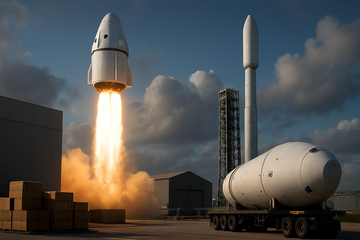
New SpaceX CCtCap modification
$946M
Three flights: Crew-15, -16, -17; period of performance through 2030
Total SpaceX CCtCap value
$5.92B
17 crewed NASA missions, awarded Sept 18, 2026
Boeing CCtCap value cut
~$500M
Six guaranteed missions reduced to four per NASA OIG, June 2026
Boeing Starliner charges to date
$2B+
Cumulative write-downs on the fixed-price program
Boeing BDS Q2 2026
$7.48B revenue / ($15M) operating
Q2 2026, reported Jul 28, 2026; includes $280M VC-25B charge
Three more flights, and the ceiling nobody saw coming
On Sept 18, 2026, NASA exercised a sole-source modification under the Commercial Crew Transportation Capability (CCtCap) contract to award SpaceX three additional ISS crew rotation missions — Crew-15, Crew-16, and Crew-17 — for $946 million through 2030. The award lifts SpaceX's cumulative CCtCap contract value to $5.92 billion across 17 crewed flights, roughly double the $2.6 billion SpaceX won in the program's 2014 fixed-price competition.
The scope of each SpaceX mission is wider than the headline figure suggests: it covers preparing astronauts and the Dragon on the ground, launch, in-orbit operations, return, capsule recovery, supply delivery, and keeping the vehicle docked at the ISS as an emergency escape lifeboat. NASA framed the sole-source award by noting that SpaceX is \"the only Crew Transportation System certified by NASA,\" a phrasing that leaves no room for a second provider before 2030.
| Provider | Original 2014 contract | Total dev/certification funding | Missions awarded (lifetime) | Status |
|---|---|---|---|---|
| SpaceX | $2.6B fixed-price | ~$3.1B | 17 | Default U.S. crew transport through 2030 |
| Boeing | $4.2B fixed-price | ~$5.1B | 4 (down from 6) | Uncrewed since 2024; certification slipped to 2027 |
Boeing's $500M math problem and the cost of being second
Boeing's Starliner was originally meant to be America's backup ride. Twelve years after winning the bigger 2014 contract ($4.2B vs. SpaceX's $2.6B), it has flown one crewed test flight, lost two of its six guaranteed missions, and now has its first operational mission — Starliner-1 — demoted to a cargo-only shakedown. The NASA Office of Inspector General, in a June 30, 2026 audit, questioned $127.9M in payments to Boeing on top of $43M flagged in 2019, and explicitly tied the slip to NASA having \"accepted unrealistic launch and flight test schedules\" without exercising its contractual rights over simulator data.
The hit lands inside a Defense, Space & Security segment that was already on a knife edge. BDS posted $7.48B of Q2 2026 revenue — but a $280M charge on the VC-25B presidential aircraft program flipped what would have been a $110M segment operating profit into a $15M operating loss. The Starliner re-baseline is the next $200–500M question mark sitting on that same segment's backlog. With Boeing's TTM revenue at $94.0B, Starliner is a single-digit-percent slice of the topline, but it is a margin story, not a revenue story.
Boeing Defense, Space & Security — quarterly revenue vs. operating result
Q2 2026 absorbed a $280M VC-25B charge. Starliner re-baseline adds the next cost line.
Unit: USD millions
Q3 2025
Includes $2B+ in fixed-price charges (Commercial Crew)
6,960
Q4 2025
7,140
Q1 2026
6,830
Q2 2026
Operating loss $15M after $280M VC-25B charge
7,483
The supply chain reconfigures around one crewed ride
- L3Harris owns the Starliner propulsion stack via its 2023 acquisition of Aerojet Rocketdyne. The June 2024 crewed flight test failure — a propulsion system \"design vulnerability\" traced to the L3Harris Reaction Control thrusters — is the root cause NASA classified as a Type A mishap (most serious). Continued Starliner-1 redesign and any future Starliner crewed work keeps L3Harris as the sole supplier.
- Lockheed Martin is the 50% partner in United Launch Alliance (ULA), which provides the Atlas V N22 crew-rated launcher for Starliner. Only six Atlas V rockets remain — one earmarked for Starliner-1 — and ULA has publicly said it is studying whether Vulcan can be human-rated, or whether Blue Origin's New Glenn (which uses the same BE-4 engine as Vulcan) becomes the alternative.
- SpaceX builds Crew Dragon and Falcon 9 largely in-house; its principal US-listed inputs are commodity avionics and structural alloys. The contract therefore extracts margin from the prime (SpaceX) and concentrates sub-system risk at L3Harris on the Boeing side.
- Downstream demand is concentrated: NASA is essentially the only US anchor customer for ISS crew transport through 2030, with international seat-buyers (ESA, JAXA, CSA) purchasing NASA-brokered seats rather than contracting directly. ISS deorbit is targeted for 2030, which caps the addressable mission pool.
What this does — and doesn't — change through 2030
The deal locks in the structural picture for the rest of the decade's ISS operations, but it does not end the program. NASA, in parallel with the SpaceX modification, signaled it will order two additional Starliner crewed missions and help Boeing recertify Starliner on a successor to the retiring Atlas V. That keeps the dissimilar-redundancy policy on paper — the program still nominally has two providers — but the operating reality through 2030 is one certified ride. Crew Dragon itself is earmarked for retirement by 2030 or earlier as SpaceX pivots capacity to Starship; the Crew-15 to Crew-17 stretch is essentially the spacecraft's final commercial NASA manifest.
- Near term (days to quarters): Boeing faces the Starliner-1 cargo-only mission in 2026, a possible 2027 human-rating certification decision, and the next round of fixed-price charge disclosures in Q3 and Q4 2026 earnings — the most likely catalysts for stock-level reactions.
- Mid term (1–2 years): If Boeing does not win human rating in 2027, NASA buys more SpaceX flights to bridge to ISS retirement. Boeing's CCtCap backlog erodes further; L3Harris thruster work stays limited to modifications.
- Long term (to 2030): ISS deorbit caps the addressable market. The next-generation US crew transport (likely commercial LEO destinations plus a post-Crew-Dragon vehicle) becomes the next contract battlefield; SpaceX's head start there is a real option, not just a current one.
Stocks this contract actually moves
- Boeing loses ~$500M in CCtCap revenue from the six-to-four mission downgrade and absorbs ~$300M of extra Starliner-1 cargo-only rework on top of $2B+ in cumulative program charges.
- BDS posted a $15M operating loss in Q2 2026 after a $280M VC-25B charge — any 2026/2027 Starliner re-baseline is the next line item that turns the segment margin story.
- Long term, Starliner recertification on a non-Atlas V launcher must land before 2030 ISS deorbit or Boeing's commercial-crew backlog evaporates entirely.
- L3Harris owns the Starliner propulsion stack via Aerojet Rocketdyne — the root cause of the 2024 Type A mishap — so any continued Starliner work is both sole-source revenue and a continuing liability for design reviews.
- Each future Starliner crewed mission (NASA is ordering two more) keeps L3Harris as the only qualified thruster supplier; longer-term, the 2030 ISS ceiling caps that upside.
- Diversification across missile defense, radios and space electronics softens the Starliner concentration, but the propulsion incident still drives free-cash-flow risk in the Space segment.
- Lockheed Martin is the 50% ULA partner; ULA owns Atlas V, the certified launcher for Starliner, but only six vehicles remain and ULA has signaled it may need Vulcan or a New Glenn partnership to keep Starliner flying.
- A successful human-rating of Vulcan (or an equivalent) for Starliner would turn Lockheed Martin's launcher exposure into a Boeing-supplier tailwind; failure pushes the program back to SpaceX-only.
- Lockheed Martin's $124B market cap means any ULA outcome is small in dollar terms — this is a watch item for any Vulcan / human-rating newsflow, not a thesis driver.
- Northrop Grumman supplies ISS structural and habitable modules; the 2030 ISS deorbit caps the addressable demand and pushes the next opportunity toward commercial LEO destinations.
- Indirect upside if NASA extends ISS operations beyond 2030 (a push is active in Congress) keeps more ISS logistics work flowing to Northrop Grumman; a hard 2030 retirement caps it.
- Starliner recertification does not directly touch Northrop Grumman revenue, but a Boeing-only failure mode increases SpaceX's leverage across all US crew and cargo tasks.