%22%2F%3E%0A%20%20%3Ccircle%20cx%3D%22220%22%20cy%3D%22150%22%20r%3D%22180%22%20fill%3D%22%2322d3ee%22%20fill-opacity%3D%220.12%22%2F%3E%0A%20%20%3Ccircle%20cx%3D%221010%22%20cy%3D%22130%22%20r%3D%22220%22%20fill%3D%22%2338bdf8%22%20fill-opacity%3D%220.08%22%2F%3E%0A%20%20%3Ccircle%20cx%3D%22920%22%20cy%3D%22520%22%20r%3D%22170%22%20fill%3D%22%2322d3ee%22%20fill-opacity%3D%220.06%22%2F%3E%0A%20%20%3Cpath%20d%3D%22M140%20430h920%22%20stroke%3D%22url(%23line)%22%20stroke-width%3D%2212%22%20stroke-linecap%3D%22round%22%2F%3E%0A%20%20%3Cpath%20d%3D%22M220%20360c120-150%20260-220%20380-220s260%2070%20380%20220%22%20fill%3D%22none%22%20stroke%3D%22%2367e8f9%22%20stroke-opacity%3D%220.5%22%20stroke-width%3D%2216%22%20stroke-linecap%3D%22round%22%20stroke-linejoin%3D%22round%22%2F%3E%0A%20%20%3Cpath%20d%3D%22M300%20398h600%22%20stroke%3D%22%2394a3b8%22%20stroke-opacity%3D%220.24%22%20stroke-width%3D%228%22%20stroke-linecap%3D%22round%22%2F%3E%0A%20%20%3Ctext%20x%3D%22220%22%20y%3D%22510%22%20fill%3D%22%23e2e8f0%22%20fill-opacity%3D%220.7%22%20font-family%3D%22Arial%2C%20Helvetica%2C%20sans-serif%22%20font-size%3D%2238%22%20letter-spacing%3D%228%22%3EINSIGHTS%3C%2Ftext%3E%0A%3C%2Fsvg%3E)
Bottom line
NASA is not buying a one-off moonshot. It is buying cadence.
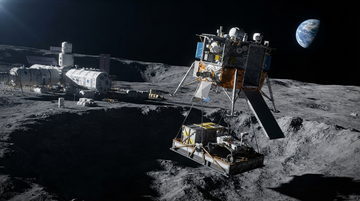
NASA's new Moon Base awards are important because they turn lunar delivery into a repeatable service market. Firefly is one of the winners, but the real point is that NASA is now structuring the space economy around mission cadence, not just around single headline landings.
That matters for public investors because a repeat-service contract can support manufacturing scale, launch cadence, and cash-flow visibility even if the company is still reporting losses.
What NASA bought
The new awards reinforce a multi-vendor lunar supply chain.
NASA said it awarded Astrobotic $297.9 million for two deliveries, Firefly Aerospace $144.2 million for one delivery, and Intuitive Machines $148.3 million for one delivery as part of the Commercial Lunar Payload Services program. The agency framed the awards as part of the Moon Base architecture, which is supposed to support future Artemis surface operations.
CLPS award sizes
The chart uses NASA's published award values. It shows that Firefly is smaller than Astrobotic's two-delivery package but still has a meaningful contracted role.
Unit: USD millions
Astrobotic
Two deliveries
297.9
Intuitive Machines
One delivery
148.3
Firefly
One delivery
144.2
| Company | Award value | Program role |
|---|---|---|
| Astrobotic | $297.9M | Two CLPS deliveries |
| Firefly | $144.2M | One CLPS delivery |
| Intuitive Machines | $148.3M | One CLPS delivery |
Financial read-through
The balance sheet is not the story, but it is good enough to keep scaling.
Firefly reported record Q1 2026 revenue of $80.9 million, up 40% from the prior quarter. Management also guided 2026 full-year revenue to $420 million to $450 million. On the liquidity side, the company disclosed $326.2 million of cash and cash equivalents plus $225.4 million of short-term time deposits at March 31, 2026, or $551.6 million combined.
That matters because the company is still losing money: Q1 2026 net loss was $96.7 million, operating cash flow was negative $62.5 million, and the accumulated deficit remained large. So the bull case is not that Firefly is profitable today. It is that it has enough cash to keep scaling into a recurring mission backlog.
| Metric | Latest published figure | Why it matters |
|---|---|---|
| Q1 2026 revenue | $80.9M | Quarterly revenue hit a record. |
| Q1 2026 net loss | $96.7M | The company is still burning cash while scaling. |
| Operating cash flow | ($62.5M) | Cash conversion remains negative. |
| Cash + time deposits | $551.6M | Liquidity gives the company room to execute. |
| 2026 guidance | $420M-$450M | A high revenue target relative to current run rate. |
| Backlog | ~$1.3B | A large book of work helps support cadence expectations. |
Market impact
Public space equities are being ranked by execution, not just by narrative.
The new NASA award matters for Firefly, but it also matters for the rest of the public space stack. Investors are moving away from generic moon optimism and toward companies that can show repeat missions, better manufacturing rhythm, and contract visibility.
- Firefly benefits if the market starts to value recurring lunar delivery as a service business rather than as a one-off engineering event.
- Intuitive Machines benefits if mission cadence improves and the company can stop being judged only by single-mission execution risk.
- Astrobotic benefits from scale, but the two-delivery package also puts pressure on operational reliability.
- Voyager, which is tied to Astrobotic, gains read-through if the award strengthens the broader lunar franchise.
| Risk factor | What to watch | Why it matters |
|---|---|---|
| Mission execution | Landed payloads, launch timing, and reliability | Space stocks can rerate quickly on failure or success. |
| Margin conversion | Gross margin and program mix | Revenue without margin is just scale with more risk. |
| Cash burn | Operating cash flow and capital deployment | The market will punish dilution if execution slips. |
| NASA cadence | How often CLPS awards repeat | A steady cadence is what turns the story into a business. |