%22%2F%3E%0A%20%20%3Ccircle%20cx%3D%22220%22%20cy%3D%22150%22%20r%3D%22180%22%20fill%3D%22%2322d3ee%22%20fill-opacity%3D%220.12%22%2F%3E%0A%20%20%3Ccircle%20cx%3D%221010%22%20cy%3D%22130%22%20r%3D%22220%22%20fill%3D%22%2338bdf8%22%20fill-opacity%3D%220.08%22%2F%3E%0A%20%20%3Ccircle%20cx%3D%22920%22%20cy%3D%22520%22%20r%3D%22170%22%20fill%3D%22%2322d3ee%22%20fill-opacity%3D%220.06%22%2F%3E%0A%20%20%3Cpath%20d%3D%22M140%20430h920%22%20stroke%3D%22url(%23line)%22%20stroke-width%3D%2212%22%20stroke-linecap%3D%22round%22%2F%3E%0A%20%20%3Cpath%20d%3D%22M220%20360c120-150%20260-220%20380-220s260%2070%20380%20220%22%20fill%3D%22none%22%20stroke%3D%22%2367e8f9%22%20stroke-opacity%3D%220.5%22%20stroke-width%3D%2216%22%20stroke-linecap%3D%22round%22%20stroke-linejoin%3D%22round%22%2F%3E%0A%20%20%3Cpath%20d%3D%22M300%20398h600%22%20stroke%3D%22%2394a3b8%22%20stroke-opacity%3D%220.24%22%20stroke-width%3D%228%22%20stroke-linecap%3D%22round%22%2F%3E%0A%20%20%3Ctext%20x%3D%22220%22%20y%3D%22510%22%20fill%3D%22%23e2e8f0%22%20fill-opacity%3D%220.7%22%20font-family%3D%22Arial%2C%20Helvetica%2C%20sans-serif%22%20font-size%3D%2238%22%20letter-spacing%3D%228%22%3EINSIGHTS%3C%2Ftext%3E%0A%3C%2Fsvg%3E)
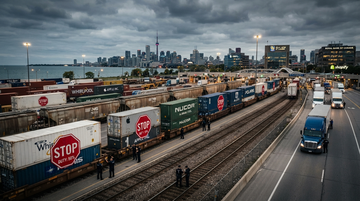
The tariff escalation O'Leary is buying against is real and quantified. On July 20, 2026, President Trump signed three Presidential Proclamations imposing additional 50% tariffs on a broad range of Canadian goods, effective August 22. On August 24 he escalated again, threatening 50% tariffs on all Canadian cars, trucks, and auto parts effective January 1, 2027. Canada retaliated on August 25 with its own counter-tariff schedule—15%, 25%, and 50% rates across 629 HS codes—covering C$27.6 billion (US$20 billion) of US imports, effective September 8. O'Leary's read: \"Carney cannot sustain 50% tariffs on the Canadian economy.\" His read on the US side: \"26 states in the US can[not] sustain 50% tariffs with their biggest trading partner.\" His timeline: 60 to 90 days. His bet: invest at the bottom, ride a \"ridiculously fantastic return\" over five years.
Canadian counter-tariff scope
C$27.6B
US imports affected, effective Sept 8, 2026; 629 HS codes at 15% / 25% / 50% rates
US tariff coverage on Canada
50%
Trump proclamation of Jul 20, 2026, effective Aug 22; another 50% on autos starting Jan 1, 2027
Smartphone line-item tariff
50%
HS 8517.13.00 on Canada's counter list—direct hit to iPhone exports into Canada
US-Canada bilateral trade
US$409B
Canadian goods exports to US in 2025, per UN COMTRADE
Apple sits in the 50% line of fire, and the September quarter is already underway
Apple's Americas segment posted $44,192 million in Q4 FY2025 (ended September 27, 2025), the largest geographic bucket on the income statement and the only one whose internal mix includes Canada. Canada's counter-list singles out smartphones (HS 8517.13.00) for the full 50% rate—a line item aimed squarely at iPhone. With iPhones driving roughly half of Apple's total revenue and the Americas segment representing 42.86% of the FY2025 base ($178.35 billion of $416.16 billion), even a modest Canada share inside that bucket translates into a multi-billion-dollar hit at retail.
There is a partial offset already visible in the most recent print. Apple reported Q3 FY2026 (ended June 27, 2026) revenue of $109.4 billion, up 16% year over year, with company gross margin of 50.1%—including approximately 2 percentage points of favorable impact from tariff refunds. That margin lift came from US-side tariff recoupments on prior imports. The September 8 Canadian counter-tariffs hit the opposite leg: iPhones already in Canadian warehouses will face a 50% duty if cleared after the effective date, and Apple will either eat the duty or pass it through, either of which compresses the gross margin that the US-side refunds just rebuilt.
| Metric | Value | Period / source |
|---|---|---|
| Total revenue | $416.16B | FY2025, 10-K filed Oct 31, 2025 |
| Americas revenue | $178.35B (42.86%) | FY2025 segment table |
| Q4 FY2025 Americas | $44,192M | Three months ended Sept 27, 2025 |
| Q3 FY2026 total revenue | $109.4B (+16% YoY) | Three months ended June 27, 2026 |
| Q3 FY2026 gross margin | 50.1% (incl. ~2pp tariff refunds) | Earnings release Jul 30, 2026 |
Whirlpool's North America segment is the cleanest appliance loser
Whirlpool reports its home-market results under \"MDA North America,\" a segment that delivered $2,573 million in net sales in Q4 2025 and accounts for roughly two-thirds of the company's $15.5 billion in 2025 revenue. Canada's counter-list imposes a 25% rate on washing machines, dryers, and dishwashers; 25% on refrigerators and freezers of most household sizes; 50% on refrigerators of certain commercial capacities; and 25% on ranges, ovens, and parts. The geographic concentration is the punchline—MDA North America is the segment that absorbs 25% to 50% counter-tariffs on products that make up 83% of Whirlpool's category mix.
| Segment / category | % of FY2025 sales | Canada counter-tariff rate |
|---|---|---|
| MDA North America | 66% | Includes Canada exposure |
| MDA Latin America | 21% | Limited direct impact |
| MDA Asia | 6% | Limited direct impact |
| Small Domestic Appliances Global | 7% | Various (15% / 25%) |
| Refrigeration* | 31% | 25% (some 50%) |
| Cooking Appliances* | 24% | 25% (ranges, ovens) |
| Laundry Appliances* | 28% | 25% (washers, dryers) |
| Dishwashing and Other* | 17% | 25% |
Q4 2025's 2.8% segment EBIT margin—already down 3.9 points year-over-year—prices in the cost base Whirlpool is fighting from. The Canada counter-tariffs now layer an additional demand-side shock on top: Canadian retailers and consumers will either pay 25% more for American-built appliances or pivot to substitutes. Whirlpool's annual report explicitly notes its Americas concentration (\"close to 90% of [which] were in the Americas\"), making Canada a meaningful slice inside that geographic dependency.
The US metals complex wins on the US side but bleeds on the Canadian retaliation
Trump's 50% tariff on Canadian steel and aluminum—effective August 22, 2026—closes off Canadian supply into the US, which had been running roughly 80% of its volume into the US in 2025. The marginal beneficiary is US-domiciled capacity, and the early read from Nucor's Q2 2026 results is unambiguous: steel mills segment earnings of $1,556 million on 7.1 million tons of total shipments, with external average sales price per ton at $1,145—up from $1,041 in Q2 2025.
Nucor steel-mills earnings and price per ton are accelerating into the tariff wall
Steel mills segment EBIT (USD millions) and external sales price per ton (USD) — Nucor quarterly
Unit: USD
Q2 2025 EBIT
Pre-tariff baseline
843
Q1 2026 EBIT
Tariff anticipation begins
1,128
Q2 2026 EBIT
Post-July 20 proclamation; +84.6% YoY
1,556
Q2 2025 price/ton
External avg
1,041
Q1 2026 price/ton
External avg
1,074
Q2 2026 price/ton
External avg; +10.0% YoY
1,145
But the win is one-sided. Canada's counter-list imposes a 50% rate on virtually every aluminum heading (unwrought aluminum, bars, rods, profiles, wire, plates, sheets, strip, foil, tubes, pipes, structures) and on the long tail of steel articles—bridges, towers, doors, windows, scaffolding, reservoirs, tanks, drums, wire ropes, chains, nails, screws, bolts, nuts, washers, springs, cast articles. Alcoa and Cleveland-Cliffs get the windfall on the import side; their own US-produced exports into Canada face the matching 50% wall on the way out.
Alcoa's FY2025 picture tells the other half: $12.83 billion in revenue (up from $12.18 billion in FY2024) with net income of $1.16 billion—a 19× swing from FY2024's $60 million. That recovery was already underway from aluminum pricing before Trump's proclamation. Now the same 50% Canada wall that helps Alcoa's domestic share gives back on the export book, where Canadian customers (and US customers shipping through Canada) will source elsewhere.
Polaris, Microsoft, Deere: the niche exporters caught in the line items
Canada's counter-tariff list is granular, and three US-listed names hit specific line items they cannot easily reroute around. Polaris sells motorcycles with engine displacement above 800 cc—classified under HS 8711.50.00—at the maximum 50% rate. Microsoft's Xbox consoles (HS 9504.50.00) sit at 50% alongside the rest of the video-game console category, which also covers Sony and Nintendo. Deere and AGCO face 25% on most agricultural machinery and 15% on selected equipment parts—lines that cover planters, combines, hay tools, and replacement components. These aren't tariff lines aimed at theoretical exporters; they target finished goods that already ship to Canada today.
- Polaris: HS 8711.50.00 (motorcycles >800 cc) at 50%; an entire Indian Motorcycle and Slingshot product line facing the maximum Canadian rate.
- Microsoft: HS 9504.50.00 (video game consoles) at 50%; Xbox hardware sold into Canada takes the duty on the imported unit, with software and services unaffected.
- Deere and AGCO: HS 8433 (mowers, agricultural machinery, parts) at 15% to 25%; a meaningful tariff wedge on US-built farm equipment sold to Canadian growers already operating under retaliatory-fertilizer duties.
- Ford and General Motors: direct exposure to the August 24 threat of 50% auto tariffs effective January 1, 2027—the proximate cause Canada cited when suspending trade talks.
The asymmetric structure matters. None of these companies can quickly shift manufacturing to Canada—Polaris's motorcycle platform is US-built, Microsoft's consoles come out of Asian contract manufacturers that route through US distribution, and farm-equipment production is concentrated in the US Midwest. They will absorb the duty, raise prices, or lose Canadian volume. The O'Leary thesis of a 60-to-90-day resolution is the bet that absorbs the price.
The Canadian pivot: Royal Bank just printed a record quarter into the chaos
Royal Bank of Canada reported record Q3 FY2026 net income of C$6.0 billion for the quarter ended July 31, 2026—up 11% year over year—with diluted EPS of C$4.23 and revenue up 9% YoY. The Commercial Banking segment alone delivered record net income of C$936 million (+12% YoY) on pre-provision, pre-tax earnings of C$1.5 billion and 9% deposit growth. That print was filed August 27, 2026, four trading days before the O'Leary comments and roughly two weeks before Canada's counter-tariffs took effect.
RBC Q3 FY2026 net income
C$6.0B
Record; +11% YoY; quarter ended July 31, 2026
RBC Q3 FY2026 revenue
+9% YoY
TTM revenue C$142.9B through July 31, 2026
RBC Q3 FY2026 diluted EPS
C$4.23
Quarterly earnings release, Aug 27, 2026
RBC Commercial Banking
C$936M net income
Record; +12% YoY; 9% deposit growth
The Canadian beneficiary stack runs deeper than the banks. Shopify—Canadian-headquartered commerce platform—posted Q2 FY2026 (ended June 30, 2026) revenue of $3.58 billion with net income of $1.5 billion. Algoma Steel, the only remaining Canadian-owned integrated steelmaker, sits inside the protected domestic market on the back of the 50% US tariff wall and is one of the rare North American steel names whose exposure is purely domestic. The two Class I Canadian railroads—Canadian National Railway and Canadian Pacific Kansas City—process the rerouted Canadian commodity and intermodal volumes that used to flow through US ports.
What O'Leary is implicitly buying is a Canadian-domestic repricing. With Canada importing roughly 70% of its goods from the US and Carney's retaliation forcing a deliberate rotation toward domestic and non-US suppliers, Canadian financials benefit twice: first from the trade-flow rerating (banks carry the working-capital float), and second from a currency-asset story that only works if Canadian interest-rate policy can stay independent of US Federal Reserve pressure. The Q3 print suggests both legs are firing.
Synthesis: short the US-Canada exporters, long the Canadian pivot — but watch the 60-90 day window
O'Leary's \"ridiculously fantastic\" thesis has a clear data trail. The asymmetry is real: Canadian counter-tariffs hit Apple, Whirlpool, Polaris, Microsoft, Deere, and AGCO on finished-goods lines they cannot easily reroute, while US steel and aluminum producers (Nucor, Alcoa, Cleveland-Cliffs) collect a domestic-pricing windfall from the same proclamation. On the Canadian side, Royal Bank of Canada, Shopify, Algoma Steel, Canadian National Railway, and Canadian Pacific Kansas City are the cleanest expressions of the buy-Canadian rerating.
The short-term catalyst calendar is concrete. The Canadian counter-tariffs take effect September 8, 2026—48 hours after this article runs. Trump's 50% auto tariffs are scheduled for January 1, 2027, and any further escalation could land before then. The O'Leary-defined dispute window is 60 to 90 days, which means an exit-or-cover decision point sits somewhere in mid-November to mid-December 2026 if the trade is to be tactical rather than the five-year buy he is pitching.
What is fact vs. inference vs. speculation: the tariff schedule, the counter-list line items, and the Q3 FY2026 corporate prints are fact, drawn from primary disclosures. The directional read—that Apple's Americas quarter will absorb a Canada-specific 50% smartphone hit, that Whirlpool's North America segment faces incremental demand destruction beyond its already-negative 2.8% Q4 margin—is a defensible inference based on the line-item rate and the segment concentration. The five-year return thesis O'Leary is selling is speculation: it requires either a successful negotiation, a Canadian recession that prices in and clears, or both. The first 60 to 90 days will tell which one the market is paying for.
How to position the O'Leary trade
- Canada's 50% smartphone counter-tariff lands during Apple's fiscal Q4 and hits Americas revenue of $44.2B in the September 2025 quarter alone.
- Q3 FY2026 gross margin already absorbed US-side tariff refunds; Canadian duties reverse that tailwind from the opposite leg of the journey.
- Short-term: gross-margin compression in Q4 FY2026 print and Q1 FY2027 if tariffs persist past O'Leary's 60-90 day window.
- MDA North America (66% of FY2025 sales) sits at 25%-50% Canadian counter-tariff rates across refrigeration, laundry, cooking, and dishwashing categories.
- Q4 2025 segment EBIT margin already collapsed to 2.8% from 6.7% a year earlier—a 3.9-point compression before September 8.
- Short-term: incremental volume and price pressure in the Americas bucket; long-term: a permanent margin ceiling if Canada sourcing persists.
- HS 8711.50.00 puts motorcycles above 800cc at the full 50% Canadian rate—a line aimed directly at Indian Motorcycle and Slingshot.
- Canadian powersports volume is small relative to total but is high-margin, so the duty hits the most profitable bucket.
- Short-term: limited Canadian unit shipments post-September 8; longer term: pricing test or Canadian share loss.
- Steel mills segment earnings nearly doubled to $1,556M in Q2 2026 from $843M a year earlier, on external price/ton of $1,145 (+10.0% YoY).
- Trump's 50% tariff wall on Canadian steel closes off the marginal foreign supplier into the US market.
- Short-term: continued steel-mills margin expansion into Q3 2026; longer-term upside depends on whether the wall holds past 2027.
- FY2025 net income of $1.16B—a 19x swing from $60M in FY2024—was already underway before Trump's proclamation.
- Domestic share gains from the 50% Canadian aluminum tariff are partly offset by Canada's matching 50% on US aluminum exports.
- Short-term: aluminum pricing tailwind persists; longer-term: structural demand mix in autos and packaging is the bigger driver than tariff optics.
- Record Q3 FY2026 net income of C$6.0B (+11% YoY) printed on August 27, 2026—four trading days before the O'Leary comments.
- Commercial Banking segment record net income of C$936M (+12% YoY) and 9% deposit growth confirms the domestic rerating.
- Short-term: the buy-Canada thesis is being confirmed by earnings, not just commentary; longer-term: capital-light Canadian growth is structurally cheaper than US bank peers.
- Q2 FY2026 revenue of $3.58B with $1.5B net income—a Canadian tech platform with no direct exposure to US-Canada goods tariffs.
- Domestic merchant base benefits from the buy-Canadian consumer rotation Carney's counter-tariffs trigger.
- Short-term: multiple expansion if the trade-flow rerating persists; longer-term: AI-commerce roadmap is independent of the tariff path.