%22%2F%3E%0A%20%20%3Ccircle%20cx%3D%22220%22%20cy%3D%22150%22%20r%3D%22180%22%20fill%3D%22%2322d3ee%22%20fill-opacity%3D%220.12%22%2F%3E%0A%20%20%3Ccircle%20cx%3D%221010%22%20cy%3D%22130%22%20r%3D%22220%22%20fill%3D%22%2338bdf8%22%20fill-opacity%3D%220.08%22%2F%3E%0A%20%20%3Ccircle%20cx%3D%22920%22%20cy%3D%22520%22%20r%3D%22170%22%20fill%3D%22%2322d3ee%22%20fill-opacity%3D%220.06%22%2F%3E%0A%20%20%3Cpath%20d%3D%22M140%20430h920%22%20stroke%3D%22url(%23line)%22%20stroke-width%3D%2212%22%20stroke-linecap%3D%22round%22%2F%3E%0A%20%20%3Cpath%20d%3D%22M220%20360c120-150%20260-220%20380-220s260%2070%20380%20220%22%20fill%3D%22none%22%20stroke%3D%22%2367e8f9%22%20stroke-opacity%3D%220.5%22%20stroke-width%3D%2216%22%20stroke-linecap%3D%22round%22%20stroke-linejoin%3D%22round%22%2F%3E%0A%20%20%3Cpath%20d%3D%22M300%20398h600%22%20stroke%3D%22%2394a3b8%22%20stroke-opacity%3D%220.24%22%20stroke-width%3D%228%22%20stroke-linecap%3D%22round%22%2F%3E%0A%20%20%3Ctext%20x%3D%22220%22%20y%3D%22510%22%20fill%3D%22%23e2e8f0%22%20fill-opacity%3D%220.7%22%20font-family%3D%22Arial%2C%20Helvetica%2C%20sans-serif%22%20font-size%3D%2238%22%20letter-spacing%3D%228%22%3EINSIGHTS%3C%2Ftext%3E%0A%3C%2Fsvg%3E)
Energy • Power grid
What happened on Sept. 1—and why it reads like a valuation event, not a utility headline
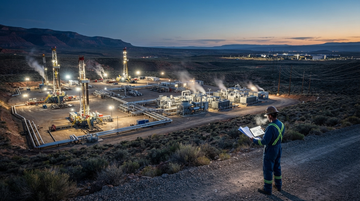
On Sept. 1, Fervo FRVO announced a 396 MW power purchase agreement (PPA) with GOOG tied to its Cape Station GeoCluster in Utah, describing the offtake as “around-the-clock” / “24/7, carbon-free” electricity and saying the facility is expected to come online in 2028. The agreement also includes an option that can expand Google’s offtake by about 600 MW—taking it to nearly 1 GW—by June 2030.
That set of terms matters because it forces geothermal—historically capacity-limited by reservoir uncertainty and project delivery risk—into the same commercial box as “firm” AI power: a contract that hyperscalers can underwrite for reliability, emissions, and scheduling.
Supply chain • Contracting
The margin capture chain: who earns the premium in drill-to-ORC-to-PPA
- If the 24/7 premium is real, it should show up first in PPA terms: the buyer pays more (or offers better credit) when the seller can deliver firm output across day/night cycles.
- But geothermal margin is path-dependent: early projects can look “successful” on megawatts delivered while still destroying cash through drilling/working-capital intensity before scale learning kicks in.
- The most underappreciated margin question is whether Fervo FRVO retains value across the stack (subsurface drilling, ORC/turbine availability, interconnection, and O&M) or whether OEMs and EPC partners capture the reliability upside.
Fervo’s Sept. 1 PPA announcement is a demand-and-capacity proof point for its Cape Station build. However, the investment case for an “AI-grade multiple” hinges on repeatability: delivering firm contracted power at a cost curve that lets the project-specific PPA premium survive drilling variability, equipment lead times, and grid-connection constraints.
That’s why investors often react before the accounting does—because market multiples can move on credibility (a signed PPA with a top-tier buyer), while financials lag until commissioning converts contract megawatts into revenue.
Benchmarking • Firm power competition
How the market is likely comparing geothermal against gas turbines, nuclear PPAs, and grid bottlenecks
The AI-power competition is not just “clean vs. clean.” It’s “firm vs. firm” under the same operational expectations: dispatchability, contractability, and scheduling certainty.
That puts Fervo FRVO in a multi-constraint contest against:
- Dispatchable gas PPAs (price volatility risk, but fast time-to-commission)
- Nuclear (very firm, but long build timelines and different risk allocation)
- Contracted renewables paired with firming or grid access (where grid congestion can become the binding constraint rather than generation).
| Comparator | What the AI buyer is likely optimizing | Where margin can land |
|---|---|---|
| Gas turbines | Reliability + speed | Seller margins can be pressured by fuel and carbon policy; buyers may pay less for fuel-linked risk-sharing. |
| Nuclear PPAs | Extreme firm output | Margins depend on build-risk transfer and long-term cost escalation; buyers often value schedule certainty over unit cost. |
| Grid-constrained renewables | Deliverability under congestion | If congestion is the bottleneck, parties may negotiate higher payments for interconnection capability more than for energy. |
| Geothermal (enhanced) | Reliability + clean firm delivery | The “premium” should show only after drilling success rates and commissioning timelines stabilize—and only if the seller keeps reliability ownership end-to-end. |
Fervo fundamentals • Reality check
The stock’s optimism vs. Fervo’s current economics
Revenue scale (annual)
$0.138B
FY2025, reported figures (revenue $138M)
Operating profitability
-$48.8M
FY2025 operating loss (operating income -$48.8M)
Operating cash flow
-$31.8M
FY2025 operating cash flow (operating cash flow -$31.8M)
Balance sheet equity
-$246.5M
FY2025 total shareholder equity (negative equity -$246.5M)
From a fundamentals perspective, Fervo’s published financials show the company is still early in the value-creation curve: FY2025 revenue is reported at $138M, operating income remains deeply negative, and operating cash flow is also negative.
That means the valuation “translation” investors are making—turning a signed 396 MW PPA into an AI-grade multiple—depends on a belief that future commissioning will convert today’s capital intensity into a higher-margin operating profile, not just larger project headcounts.
Delivery timeline • What moves first after a PPA headline
What to watch next: commissioning milestones that should de-risk the reliability story
- Whether Fervo FRVO hits mechanical completion and commissioning milestones on Cape Station Phase I units fast enough to preserve the “firm power” credibility embedded in hyperscaler contracting.
- Whether the company expands beyond early blocks without reverting to longer outages or schedule slippage—because the market will discount any reliability wobble that breaks the AI buyer’s planning assumptions.
- Whether project-level economics improve as the portfolio scales—because the “AI-grade multiple” only holds if margin capture survives drilling variability.
Fervo’s latest delivery update (Q2 FY2026 results coverage) says mechanical completion was achieved on GeoBlocks 1 and 2, while mechanical completion for GeoBlock 3 is expected “over the coming months,” along with targeted commissioning/power timelines for first power and initial power windows.
In practice, the next catalyst stack is likely to be: (1) mechanical completion confirmations, (2) first power/initial power, (3) steady-state performance and commercial operations, and (4) any follow-on PPAs that validate that demand isn’t one-off.
Investor map • Upstream and downstream transmission
Who else benefits (or gets squeezed) when geothermal becomes “firm power”
If the hyperscaler “24/7” thesis sticks, it doesn’t just reward geothermal developers. It changes contracting dynamics across the supply chain—especially equipment manufacturing, EPC/O&M execution, and grid deliverability.
In public markets, that often shows up as a rotation between:
- Geothermal specialists with operating fleets (more direct leverage to “proven uptime”)
- Grid and regulated utilities (who can either enable firm delivery via upgrades or face cost-recovery friction)
- Dispatchable power incumbents (gas and nuclear compete on firm reliability and price stability).
The market’s early reaction to Fervo FRVO therefore acts like an options market on firm-clean reliability—not unlike how nuclear/gas contract cycles can re-rate winners before earnings.
Listed players with the clearest evidence-backed linkage to the “AI 24/7 power” contracting stack
- The FRVO Google 396 MW PPA supports “firm-clean” credibility, which can sustain an AI-themed valuation premium while commissioning milestones de-risk delivery.
- FY2025 shows negative operating income and operating cash flow, so the multiple can compress if revenue conversion lags contract timelines into 2027–2028.
- The option to expand offtake to nearly 1 GW by June 2030 raises the probability of repeat PPAs—but only if performance metrics match buyer expectations.
- Ormat ORA can benefit if the market prices geothermal as reliably contractable “firm” capacity, which may lift willingness to fund the sector even when Fervo is still ramping.
- Because Ormat’s value depends on operating geothermal performance, any delay in broader geothermal reliability benchmarks can cap near-term re-rating versus pure “growth” stories.
- If more customers demand firm clean power, utilities like Xcel XEL may face incremental grid/connection work, creating a watch-item on regulated cost recovery and timeline execution over 2027.
- Near-term upside is limited unless congestion relief and interconnection approvals accelerate before geothermal supply reaches deliverable capacity.
- Constellation CEG remains a proxy for firm nuclear supply; if geothermal firming credibility rises, it can pressure long-term “firm-clean” price expectations for some contract types.
- But if geothermal delivery risk persists, nuclear can retain bargaining power while buyers seek schedule certainty—especially through 2028.