%22%2F%3E%0A%20%20%3Ccircle%20cx%3D%22220%22%20cy%3D%22150%22%20r%3D%22180%22%20fill%3D%22%2322d3ee%22%20fill-opacity%3D%220.12%22%2F%3E%0A%20%20%3Ccircle%20cx%3D%221010%22%20cy%3D%22130%22%20r%3D%22220%22%20fill%3D%22%2338bdf8%22%20fill-opacity%3D%220.08%22%2F%3E%0A%20%20%3Ccircle%20cx%3D%22920%22%20cy%3D%22520%22%20r%3D%22170%22%20fill%3D%22%2322d3ee%22%20fill-opacity%3D%220.06%22%2F%3E%0A%20%20%3Cpath%20d%3D%22M140%20430h920%22%20stroke%3D%22url(%23line)%22%20stroke-width%3D%2212%22%20stroke-linecap%3D%22round%22%2F%3E%0A%20%20%3Cpath%20d%3D%22M220%20360c120-150%20260-220%20380-220s260%2070%20380%20220%22%20fill%3D%22none%22%20stroke%3D%22%2367e8f9%22%20stroke-opacity%3D%220.5%22%20stroke-width%3D%2216%22%20stroke-linecap%3D%22round%22%20stroke-linejoin%3D%22round%22%2F%3E%0A%20%20%3Cpath%20d%3D%22M300%20398h600%22%20stroke%3D%22%2394a3b8%22%20stroke-opacity%3D%220.24%22%20stroke-width%3D%228%22%20stroke-linecap%3D%22round%22%2F%3E%0A%20%20%3Ctext%20x%3D%22220%22%20y%3D%22510%22%20fill%3D%22%23e2e8f0%22%20fill-opacity%3D%220.7%22%20font-family%3D%22Arial%2C%20Helvetica%2C%20sans-serif%22%20font-size%3D%2238%22%20letter-spacing%3D%228%22%3EINSIGHTS%3C%2Ftext%3E%0A%3C%2Fsvg%3E)
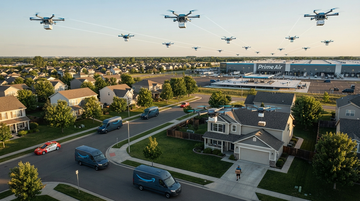
Last-mile economics enters its first true scale test
Amazon turns Prime Air from pilot logistics into a unit-economics experiment across ~500 U.S. locales
Amazon says Prime Air will expand drone delivery to nearly 500 U.S. cities and towns by the end of 2026, up from 11 current U.S. locations. Each Prime Air site covers an area of about 175 square miles, and Amazon is positioning the service as a paid delivery option (not a marketing-only experiment) with delivery fees of $2.99 for Prime on orders under $50 and $4.99 otherwise, with the fee waived at $50+.
Planned U.S. drone locales by end-2026
Nearly 500
Amazon Prime Air expansion target, stated in the company’s transportation update
Current Prime Air operating locations
11
Prime Air currently delivers from 11 U.S. locations across 10 metro areas
Coverage per Prime Air site
~175 sq miles
Approximate service area covered by each delivery hub
Drone delivery fee (Prime, under $50)
$2.99
Fee for Prime members with orders under $50
Drone delivery fee (non-Prime)
$4.99
Fee for customers without a Prime membership
Regulatory authority is becoming the competitive moat layer
FAA Part 135 certification shifts drone delivery from “permission to test” to “permission to operate like an air carrier”
For investors, the key move is that the FAA framework for drone package delivery is not merely “a permit to fly.” The FAA describes Part 135 package delivery as commercial drone package delivery operations under 14 CFR Part 135, requiring operators to obtain a Part 135 certificate and airspace authorization—and the FAA notes this is the operational path when drones carry another’s property for compensation in the National Airspace System. In practice, Part 135 certification also requires an air carrier-style compliance posture (operations specifications, maintenance/airworthiness, safety procedures), which matters when competitors try to scale simultaneously.
| What investors should look for | Why it matters | Evidence |
|---|---|---|
| Certificate + airspace authorization requirement | It turns drone delivery into a governed, repeatable operating system—not one-off experimentation | FAA description of Part 135 package delivery by drone |
| Operator responsibilities (hub siting, NEPA, community engagement) | It limits how fast capacity scales even after certification exists | FAA operator role and NEPA/community requirements |
| Five-phase certification process | It makes regulatory throughput a bottleneck competitor—especially in dense metro areas | FAA notes that applicants go through five phases |
DoorDash moves the regulatory goalposts in local delivery
DoorDash earned its own Part 135 milestone—making Amazon’s next contest partly a compliance contest
DoorDash is building drone delivery inside the same FAA Part 135 mold. DoorDash said its drone program, DoorDash Air, earned FAA Part 135 air carrier certification on Jul 29, 2026, positioning it as a regulated local delivery system, not just a pilot. DoorDash also supplied operational proof points from its drone program: in 2025, drones delivered in an average of 25 minutes, and in at least some pilot contexts, DoorDash reported order volume growth of about 30% sustained over nine weeks after launch.
DoorDash’s reported early operating outcomes for drone delivery
Reported program metrics from DoorDash’s DoorDash Air rollout communication
Unit: minutes / percent
Avg delivery time (2025)
Minutes per drone delivery, DoorDash estimate
25
Order volume lift in pilots
Approximate % increase, DoorDash-reported
30
The last-mile unit-cost question the market actually cares about
Air can win only if “hub density + flight time + handoffs” beats the ground cost curve—especially at scale
Amazon’s expansion to nearly 500 locales changes the debate. The true comparison is not “drone vs truck in a vacuum,” but how the full delivery workflow scales: site capex and operating costs (hub siting, maintenance, operations staffing), per-delivery dispatch economics, and—most importantly—how much last-mile work is displaced versus shifted. Amazon’s pricing provides one anchor: drone delivery is monetized at $2.99–$4.99 per drop with a $50 threshold waiver, implying Amazon believes customers will tolerate fees consistent with a cost structure that survives high utilization.
- Amazon’s nearly-500-locale rollout implicitly assumes hub geometry can stay efficient because each site covers ~175 square miles
- Drone economics must survive variability: weather, battery/throughput constraints, and missed handoffs that revert customers to ground logistics
- The fee structure (Prime vs non-Prime; $50 waiver) is a signal that Amazon expects meaningful contribution margin at repeat purchase frequency
Supply-chain second-order effects: parcels, routes, and duopoly friction
Scaled drone drops can re-shape parcel flows—without replacing UPS/FedEx/USPS overnight
Even if drones reduce the final delivery segment, the supply-chain impact starts upstream: fewer “last mile miles” for the final hop can still increase pressure on upstream throughput (sorting, staging, and feeder transport into drone hub regions). However, Amazon’s communication also suggests a workflow split: drones are inserted into local delivery where geography permits, not a nationwide replacement of the entire parcel network. That means UPS/FedEx/USPS exposure is likely to be uneven: rural/low-density routes might see less disruption than dense suburban corridors where drone hubs can be sited and authorized.
Fundamental context: what Amazon can fund, and why unit economics must eventually show up
Amazon can afford the experimentation—but investors should demand margin math, not headlines
Amazon’s financial capacity matters because drone delivery expansion implies incremental operating and capex needs. For FY2024, Amazon reported $637.959B in revenue and $59.248B in net income, with gross profit of $311.671B. The point is not that drone delivery can be “funded out of profit” (many investments are choiceful), but that the company has the cash-generating scale to keep building until the unit economics becomes demonstrable.
FY2024 revenue
$637.959B
FY2024 income statement figure
FY2024 net income
$59.248B
FY2024 income statement figure
FY2024 gross profit
$311.671B
FY2024 income statement figure
Horizons: what moves first vs what proves the thesis
Short-term: service rollout pace; 1–3 years: the cost crossover that decides winners
- In the next days to quarters, expansion timing and community onboarding will be the first measurable driver—Part 135 plus local constraints decide where capacity lands
- Over the next 1–3 years, the thesis lives or dies on whether drone delivery lowers cost per delivered order net of failures and handoffs relative to ground in the same zip-code tiers
The “DoorDash moat” framing matters for investors because DoorDash’s Part 135 milestone suggests the competitive bar is rising. If DoorDash can use regulatory parity plus marketplace integration to capture consumer preference in local delivery categories, then Amazon’s drone economics must beat not only ground, but also a drone-enabled alternative that can compete on speed.
Listed market impact tied to drone scale, regulatory execution, and last-mile economics
- Prime Air expansion adds a new priced last-mile channel ($2.99–$4.99 fee model) that can scale into measurable contribution margin if utilization holds
- Amazon’s scale lets it absorb regulatory/setup costs without impairing FY2024 profitability (FY2024 net income $59.248B, reported FY2024).
- If unit costs crossover, Amazon can reallocate spend from ground delivery capacity into drone hubs within 1–3 years
- DoorDash’s Jul 29, 2026 Part 135 certification reduces the regulatory gap vs other drone operators, enabling faster local scaling if operational throughput works
- Drone pilots showed ~25-minute average delivery and ~30% order lift (2025 and pilot metrics), but margin durability remains unproven
- Over 1–3 years, DoorDash could win share in drone-eligible neighborhoods while ground competitors experience selective pricing pressure
- If drones reduce last-mile miles in dense suburbs, UPS could face selective volume and route mix headwinds (watch for PR/segment commentary after more drone locales launch)
- UPS’s performance could diverge by lane because Amazon’s hub model targets geography where drones can operate efficiently (Amazon’s ~175 sq mile coverage per hub)
- Scaled drone delivery can compress the economic value of ground last-mile segments in drone-eligible areas, potentially affecting volume mix
- FedEx will likely be most exposed where local delivery is most “route-optimized”, not where parcels already rely on centralized handoffs