Sachem Capital Corp. is a specialized real estate finance company organized as a self-managed real estate investment trust. Company and SEC materials identify 2010 as the beginning of the Sachem Capital business, when Sachem Capital Partners was founded in Branford, Connecticut by John L. Villano after he identified a financing ...Sachem Capital Corp. is a specialized real estate finance company organized as a self-managed real estate investment trust. Company and SEC materials identify 2010 as the beginning of the Sachem Capital business, when Sachem Capital Partners was founded in Branford, Connecticut by John L. Villano after he identified a financing gap for real estate owners and investors. The company later completed an initial public offering in 2017. The supplied market description references January 2016 and founders Jeffrey C. Villano and John L. Villano, which may reflect a later corporate formation or restructuring; 2010 is used here as the operating-company founding year because it is supported by the company's history and SEC disclosures.
The business focuses on short-duration, collateralized real estate loans, principally first-mortgage loans. Borrowers may use the proceeds to purchase, renovate, rehabilitate, develop, or refinance residential and commercial properties. Sachem evaluates the underlying property, borrower experience, project economics, collateral value, loan-to-value characteristics, and anticipated repayment sources. Its services span loan origination, underwriting, funding, servicing, portfolio management, and workout or asset-management activities when borrowers encounter difficulties. Unlike a conventional manufacturer, the company has no traditional bill of materials, factory production, or inventory-based cost structure. Its principal economic inputs are debt and equity capital, employee and professional-services costs, loan-origination expenses, interest expense, servicing and technology expenses, and provisions or realized losses associated with credit performance.
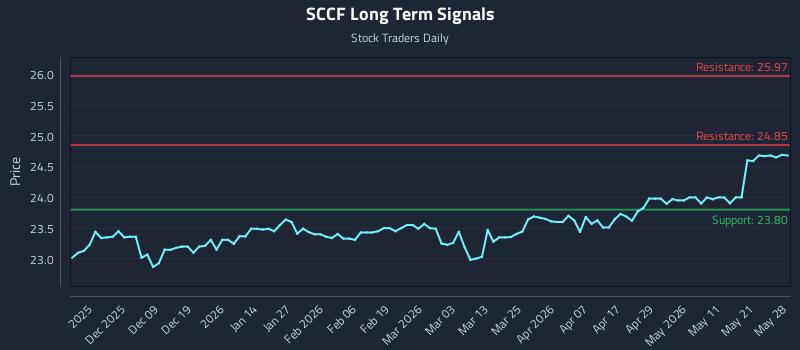
SCCF is not common equity; it is the issuer's 7.125% senior-note security due June 30, 2027. The notes provide investors with contractual interest payments and repayment of principal at maturity, subject to the issuer's creditworthiness and the terms of the indenture. As a mortgage REIT and lender, Sachem's financial results are highly sensitive to interest rates, funding availability, real estate valuations, borrower defaults, foreclosure timelines, property-market liquidity, and the ability to originate loans at attractive risk-adjusted spreads. The supplied trailing data show approximately 26 full-time employees, indicating a relatively lean operating model. The same snapshot reports a market capitalization near $1.17 billion for the quoted security data, a 7.125% coupon, and a price around $24.50, although market values and trading statistics can change and should be verified against current filings and quotations.
John L. Villano has served as chairman and chief executive officer since the company's inception and oversees its strategy, lending platform, financing, and portfolio operations. The company's stated objective is to continue serving real estate investors who may require flexible, short-term financing that banks and other traditional lenders may not provide. Key risks include credit losses, concentration in real estate and geographic markets, refinancing and liquidity risk, interest-rate volatility, regulatory requirements applicable to REITs and lenders, and potential mismatch between loan cash flows and note obligations. Investors evaluating SCCF should distinguish the fixed-income characteristics of the notes from the common-stock and REIT-level risks of Sachem Capital Corp.
YoYYoY means Year-over-Year. It compares the latest annual value with the previous annual value to show long-term trend strength.
QoQQoQ means Quarter-over-Quarter. It compares the latest quarter with the immediately previous quarter to show short-term momentum changes.
RevenueThe total money that came through the front door from selling things, before paying a single bill. Think of it as the grand total of every credit card swipe from customers. (YoY compares this year to last year's performance, while QoQ compares the current three months to the previous three).
$47.1M
-18.2%
-16.1%
Net IncomeThe absolute bottom line. If the company paid every single supplier, employee, banker, and tax collector, this is the actual money left in their pocket at the end of the day.
$6.3M
+115.9%
+11.5%
Gross MarginThe basic markup. If they sell a $100 pair of sneakers, this percentage tells you how much of that price tag is profit right after paying for the rubber and shoelaces, but before paying for things like store rent or TV commercials.
+97.8%
+59.9%
+0.3%
Operating MarginThe 'day job' efficiency score. Out of every dollar a customer spends, this shows how many cents the company keeps after making the product AND paying for all the everyday corporate overhead (like salaries, marketing, and keeping the lights on).
+58.8%
+388.7%
+206.2%
Net MarginThe final take-home percentage. When you strip away every conceivable cost, tax, and interest payment, this is the exact number of cents the company truly gets to keep from every dollar in sales.
+13.4%
+119.5%
-5.5%
Free Cash FlowThe holy grail of corporate cash. It's the spendable, physical money left over after the business pays for its daily operations AND buys the big, expensive upgrades (like new factories or servers) it needs to survive. This is the 'free' money they can use to pay dividends or buy back stock.
$2.5M
-80.5%
-1017.2%
FCF MarginThe ultimate cash conversion rate. It shows how good the company is at turning regular sales directly into cold, hard, spendable cash. A high percentage means the business is an absolute cash-printing machine.
+5.3%
-76.2%
-1193.4%
Debt / EquityThe financial risk gauge. It compares how much of the company's empire was built using borrowed money (loans) versus the owners' own money (shareholders). A high number means they are heavily leveraged and playing a riskier game; a low number means they are playing it safe.
158.8%
+7.6%
+7.1%
Current RatioThe 12-month survival check. It simply compares the cash they have right now (plus things they can quickly turn into cash) against the immediate bills they absolutely must pay this year. A score above 1 means they have enough in the wallet to cover the upcoming bills without panicking.
0.84x
+56.5%
+3.5%
Total AssetsThe absolute size of the company's empire. It bundles together absolutely everything of value they own—from the cash in the register and the inventory in the warehouse, to the software patents in the vault and the factories on the ground.
Operator: Greetings. Welcome to Sachem Capital Corp. and Industrial Realty Group Transaction Call. [Operator Instructions] Please note, this conference is being recorded. I will now turn the conference over to Steve Swett, Investor Relations. Thank you. You may begin.
Stephen Swett: Thank you, operator, and thank you all for joining us today on such short notice. Earlier today, Sachem issued a press release announcing that the company has entered into a definitive contribution agreement with Industrial Realty Group, or IRG, to create a scaled industrial lease-driven public equity REIT with a real estate capital solutions platform. Post closing, Sachem will publicly rebrand as IRG Realty Trust, Inc., or IRGT. Joining us today are John Villano, CPA, Chief Executive Officer of Sachem and Stuart Lichter, Founder and Chairman of IRG. Before we begin, I'll read the customary cautionary language. During today's call, we may make forward-looking statements within the meaning of the federal securities laws, including statements about the proposed transaction, anticipated timing, expected benefits, pro forma expectations, leverage and financing and other nonhistorical matters. Actual results may differ materially due to risks and uncertainties. All forward-looking statements speak only as of today, May 18, 2026, and we assume no obligation to update, revise or supplement such forward-looking statements that become untrue because of subsequent events. In connection with the proposed transaction, Sachem intends to file relevant materials with the SEC, including a proxy statement. Investors and security holders are urged to read those materials when they become available and they will contain important information. All relevant materials will be posted in the Investors section of our website at www.sachemcapitalcorp.com. Given the announcement we made this morning, this call will focus on the contribution agreement with IRG. With that, I'll turn the call over to John.
John Villano: Thank you, Steve, and thank you all for joining. Today marks an important milestone for Sachem. This morning, we announced that we have entered into a definitive contribution agreement with Industrial Realty Group that, when completed, will create IRG Realty Trust, Inc. or IRGT a $3.4 billion enterprise value publicly listed industrial REIT with a real estate capital solutions platform. Let me start with the compelling reasons this contribution transaction is so exciting. This transaction is designed to deliver a strategic reset for Sachem shareholders by repositioning the company into an industrial platform with meaningful scale, recurring lease-driven cash flows and potential future growth opportunities while preserving and enhancing the strength of Sachem's established real estate capital solutions business. In other words, we're combining key assets from IRG's industrial real estate portfolio, including their well-established operating capabilities, along with Sachem's …