
Heeney Capital El Callao investment ceiling
~$1B
Sept. 16, 2026 G20 Energy Abundance Ministerial, Houston
Continental Resources Ayacucho 2 resource in place
~30B bbl
126,000 acres, Anzoátegui state, MOU signed Sept. 16, 2026
NABEP 17-field P1 reserves
~65B bbl
NABEP–US government deal announced Aug. 28–31, 2026
US equity stake in NABEP parent
35%
Plus 20% off-take at cost, U.S. Department of War/State, 100-year concessions
NABEP planned capex
~$100B
First-stage Venezuela infrastructure; deal announced Aug. 28, 2026
Chevron Venezuela commitment
$7B
Pledged Sept. 2, 2026; targets doubling production by 2031
THE EVENT
Two Deals, One Day, Same Building
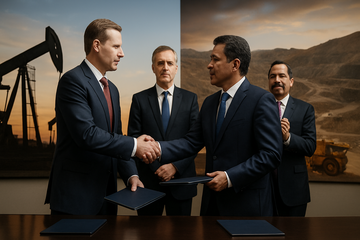
The G20 Energy Abundance Ministerial in Houston ran Sept. 14–16, 2026, with Heeney Capital and Continental Resources both signing Venezuelan agreements on the closing day. Heeney announced a mining concession with the Republic of Venezuela and Corporación Venezolana de Minería (CVM) to develop the El Callao district in the Guayana Shield, with a stated investment ceiling of ~$1 billion and a target of multi-billion-dollar tax and royalty receipts for Caracas. Continental, the largest privately held US oil producer, signed an MOU with PDVSA to operate and develop the 126,000-acre Ayacucho 2 Block in the Orinoco Belt, with an estimated 30 billion barrels of resource in place and a planned 100% working interest once a Contrato de Participación Productiva is executed.
- Continental's MOU frames a long-term CPP with PDVSA on the Ayacucho 2 Block, with the company flagging deployment of \"private capital, technology, technical expertise, and large-scale operating capability.\"
- Heeney's El Callao concession sits in the Guayana Shield, a prolific gold belt with Tier 1 assets; the deal targets international mining and processing standards plus workforce and community investment.
- Both deals follow the May 1, 2026 Mercuria–Heeney offtake agreements worth ~$2.2 billion in annual mineral export value, with a potential $3.0 billion more in aluminum, nickel, and ferrous products.
- Heeney has separately launched a US$250 million critical-minerals fund in August 2026 and is advised by Willkie on the Venezuelan program.
THE WIDER FRAME
The Sept. 16 Deals Are the Capstone of an Eight-Month US-Venezuela Pivot
The G20 signings did not happen in isolation. Between January and August 2026, OFAC issued a series of general licenses—GL 46 (oil, Jan. 29), GL 47 (diluents, Feb. 3), GL 50 (oil and gas sector operations, Feb. 13), GL 51 (gold exports, March 6), and an amended GL 46D (Aug. 27)—that progressively lifted the legal walls US firms faced since 2019. On Aug. 28–29, 2026, the Trump administration announced a structural agreement with North American Blue Energy Partners (NABEP) covering 17 oil fields with ~65 billion barrels of P1 reserves under 100-year concessions, US government rights to 35% of NABEP's parent company, and a guaranteed 20% off-take at cost plus right of first refusal on the remaining 80%. NABEP disclosed planned capex of nearly $100 billion and projected tax revenue of more than $209 billion for the Venezuelan state.
| License | Issued | Authorized activity |
|---|---|---|
| GL 46 / 46D | Jan. 29 / Aug. 27, 2026 | Venezuelan-origin oil transactions, established US companies |
| GL 47 | Feb. 3, 2026 | Export of US diluents to Venezuela |
| GL 50 | Feb. 13, 2026 | Oil and gas sector operations, exploration and production |
| GL 51 / 51A | March 6, 2026 | Export and downstream dealing in Venezuelan-origin gold and minerals |
| GL 46D amendment | Aug. 27, 2026 | Expanded energy-sector authorizations tied to NABEP deal |
UPSTREAM
The Oil Services Stack: SLB, Halliburton, and Baker Hughes Are Already Mobilizing
Venezuelan crude requires intensive services to bring back online. After Halliburton wrote off $312 million in residual Venezuela exposure in 2018 and Schlumberger (now SLB) recorded multi-hundred-million-dollar impairments, all three majors were largely out of the country until OFAC licenses restarted the clock in February 2026. SLB signed a long-term framework MOU with PDVSA on June 10, 2026, and on Aug. 19, 2026, executives disclosed plans to reactivate up to 15 idle Venezuelan drilling rigs in under a year—with as many as four running before year-end 2026. Halliburton is preparing a rapid restart, with management highlighting the appeal of getting paid for well work rather than for barrels. Baker Hughes runs the rig count that anchors the picture: Venezuela had only two active onshore drilling rigs at the end of July 2026, almost all working for Chevron's projects.
Reactivating 15 rigs is a small number in absolute terms but a large multiple of today's base—15 vs. 2 active. If even half reach active status by mid-2027, the service-intensity uplift for SLB and Halliburton alone would absorb several hundred million dollars of incremental Latin America revenue, on a base where SLB's Well Construction and Reservoir Performance segments together generate the majority of group EBITDA at a 19.7% margin. Drilling-rig lessors Helmerich & Payne and Patterson-UTI round out the upstream stack, with idle US-land rigs redeployable into Venezuela as soon as contracts land.
DOWNSTREAM
US Gulf Refiners Are the Most Direct Beneficiaries—PBF Trades at 6.2x Earnings
Venezuelan crude is heavy and sour—exactly the grade PBF Energy, Valero, and Marathon Petroleum refineries along the US Gulf are configured to process. Reuters reported in January 2026 that Marathon Petroleum would bid for Venezuelan crude and would be allowed to import it for the first time since sanctions re-imposed restrictions in 2019. PBF Energy, which already processes Venezuelan heavy at its Chalmette and Delaware City refineries, was named by Piper Sandler in early 2026 as having a durable edge in processing Venezuelan crude. Per the NYT (Jan. 14, 2026) and Reuters (Jan. 6, 2026), just three companies—Valero, Chevron, and PBF Energy—processed roughly 80% of all Venezuelan crude imported to the US prior to sanctions.
| Company | TTM revenue | Trailing P/E | EV/EBITDA | Q2 2026 revenue growth |
|---|---|---|---|---|
| PBF Energy | $34.4B | 6.2x | 3.7x | +56.2% |
| Valero | $132.4B | 16.0x | 8.3x | +51.7% |
| Marathon Petroleum | $154.1B | 13.8x | 7.8x | +53.7% |
| Chevron | $209.4B | 20.4x | 7.9x | +53.5% |
MINING EQUIPMENT
Caterpillar Is the Indirect Industrial Pickup From El Callao
The El Callao Mining District is a Tier 1 gold belt with documented reserves above 23 million ounces and historical production of more than 2,000 tonnes of gold across the broader Guayana Shield. Heeney's stated ~$1 billion investment ceiling implies tens of millions of dollars of heavy mobile equipment orders—electric rope shovels, hydraulic shovels, off-highway trucks, rotary drills, and longwall-style equipment—over a multi-year buildout. Caterpillar's Resource Industries segment, which sells exactly that equipment into mining customers globally, is the most direct listed exposure on the equipment side; Komatsu (Japan-listed, 6301.T) is the next-largest supplier and benefits symmetrically. Listed gold comparables such as Newmont are not direct beneficiaries of an El Callao concession held by a private vehicle, but their valuations provide a useful anchor for what a Tier 1 Guayana Shield asset might be worth on the public market.
El Callao historical gold production
~2,000 t Au
Cumulative district endowment, Velasquez et al. (2014), Economic Geology
Heeney Capital El Callao investment ceiling
~$1B
Sept. 16, 2026 concession with CVM at G20 Energy Abundance Ministerial, Houston
STRUCTURE
Why This Isn't 'Sanctions Relief'—It's a US Government-Backed Equity Recapture
The 2019–2025 Venezuela framework was sanctions relief in the narrow sense—OFAC narrowed or widened authorizations, and private actors took or held positions accordingly. The 2026 framework is different. NABEP's deal gives the US Department of War a 35% equity stake in the parent company, the US Department of State a guaranteed 20% off-take at cost plus right of first refusal on the remaining 80%, and the whole arrangement is governed by US law and US courts with a US-citizen board majority. The deal is, in effect, a nationalization-of-counterparty-risk exercise: any US firm contracting with NABEP faces the US Treasury as equity counterparty, not a foreign sovereign. That changes the risk calculus for Chevron, SLB, Halliburton, and the Gulf refiners from \"Venezuela optionality\" to \"Venezuela under US contract.\"
HORIZONS
What Moves First, What Compounds Over Three Years
Days-to-quarters (Q4 2026 through mid-2027): SLB reactivates up to four rigs by year-end 2026 and the balance by mid-2027, with each active rig translating into drilling-and-evaluation revenue at well-construction margins. Halliburton and Baker Hughes follow with completion, intervention, and digital-twin contracts as wells come online. Chevron begins the $7 billion capital program toward its 2031 doubling target. The first heavy Venezuelan crude cargoes reach Gulf Coast refiners—PBF, VLO, MPC—with an immediate spread benefit on cheaper feedstock. Caterpillar records initial equipment orders tied to El Callao pre-stripping.
One-to-three years (2027–2029): NABEP capex scales toward the $100 billion disclosed envelope, with the 17-field portfolio moving toward the stated 1+ million bpd target. Continental Resources's CPP agreement executes—Ayacucho 2's 30 billion barrels of resource moves from MOU to producing asset. Heeney's El Callao concession moves from permitting into construction, with steady-state gold output potentially reaching mid-six-figure-ounce annual levels based on comparable Guayana Shield operations. The US refining complex re-anchors feedstock on a heavier, cheaper barrel slate, structurally supporting PBF Energy's crack spreads and Valero's Gulf utilization. Watch for: (1) NABEP rig count disclosures vs. its 1+ million bpd target, (2) Continental Resources's first CPP signature, (3) any reinstatement of broad secondary sanctions that would unwind the framework.
RISKS
What Could Unwind the Thesis
- Political reversal: Venezuela is governed by interim authorities under Delcy Rodríguez; a future government could contest the NABEP, Continental, or Heeney contracts. The US court's governing-law clause mitigates but does not eliminate this risk.
- Operational reality: Venezuela's producing base is decayed—PDVSA's own reported output is ~1.25 million bpd, and rigs must be refurbished after years of inactivity. The 15-rig plan is a multi-quarter, not multi-month, execution.
- Capital intensity: NABEP's ~$100 billion capex is enormous relative to the equity base of the participating companies; debt and tariff structures will determine who actually funds it.
- Refiner feedstock substitution: If heavy-sour Canadian and Mexican barrels remain cheaper, US Gulf refiners may not run Venezuelan barrels at the volumes the market is currently pricing.
- Reverse-sanctions risk: OFAC has revoked Venezuela licenses before (GL 43 was revoked in early 2024). A future US administration could tighten, not loosen, the framework.
Investable names tied to the US private-capital return to Caracas
- Trading at 6.2x trailing earnings and 3.7x EV/EBITDA on TTM through Q2 2026, PBF Energy is the deepest-value US refiner leveraged to heavy Venezuelan crude returning to the Gulf Coast.
- Already processed Venezuelan heavy at Chalmette and Delaware City; first new cargoes in Q4 2026 should expand feedstock optionality and pull crack spreads wider within weeks.
- Risk: if Canadian and Mexican heavy-sour barrels stay cheaper, PBF Energy's theoretical Venezuela uplift competes with existing North American supply.
- At 16.0x trailing earnings and 8.3x EV/EBITDA on $132.4 billion TTM revenue (FY2025 10-K), Valero is the largest heavy-sour-exposed US refiner, with 3.2 million bpd of capacity already configured for Venezuelan grades.
- Restart of Venezuelan crude flow would unlock the Corpus Christi and Port Arthur complexes that were idled or reconfigured during the 2019–2025 absence.
- Catalyst: Q4 2026 / Q1 2027 cargo arrivals as licenses move from authorizing into operational reality.
- Plans to reactivate up to 15 idle Venezuelan drilling rigs—four by year-end 2026, the rest by mid-2027—with each rig driving well-construction and reservoir-performance revenue at a 19.7% group EBITDA margin (FY2025 10-K).
- June 10, 2026 framework MOU with PDVSA positions SLB for first-mover share of a Venezuela service market that had effectively been at zero for seven years.
- Risk: 26.4x trailing PE on TTM through Q2 2026 already discounts meaningful Venezuela upside—execution is in the price.
- Halliburton management has publicly framed Venezuela as a fast-turnaround, paid-for-work opportunity that offsets weak US shale demand—an unusual upside lever for a stock that otherwise tracks Lower 48 activity.
- Venezuela exposure was written down to zero in 2018 ($312 million residual impairment); a reactivated book of work would rebuild Latin America revenue without proportional capital cost.
- Trading at 18.3x trailing earnings with a forward P/E of 12.1x—cheaper than SLB on both metrics despite comparable Venezuela optionality.
- Baker Hughes's OFSE segment captures drilling services, but the company's industrial and energy-technology (IET) business also fits Venezuela's digital-infrastructure and LNG-modernization needs.
- Trading at 18.2x trailing earnings on $27.7 billion TTM revenue (FY2025 10-K); a Venezuela rebound adds incremental but not transformative earnings.
- Counterweight: IET's exposure to LNG and gas-turbine cycles may dilute the Venezuela signal in 2027–2028 if global gas demand softens.
- Chevron remains the only legacy US operator in Venezuela, with the announced Sept. 2, 2026 plan to invest $7 billion and double current production by 2031—giving it the deepest operating base as Continental and NABEP ramp.
- Trailing P/E of 20.4x on $209.4 billion TTM revenue reflects a fully integrated model; Venezuela upside is real but a smaller percentage of group earnings than for pure-play refiners.
- Watch for the next quarterly update on Venezuela-specific volumes—every 50,000 bpd of incremental output adds roughly $1 billion of annual EBITDA at current prices.
- Marathon Petroleum publicly committed in January 2026 to bid for Venezuelan crude—the first US refiner to do so publicly—and operates the Garyville complex configured for heavy grades.
- At 13.8x trailing earnings and 7.8x EV/EBITDA, MPC sits between PBF Energy's deep-value and Chevron's integrated multiple, with more direct Venezuela leverage than Chevron but a more diversified feedstock slate than PBF.
- Catalyst: first Venezuelan cargo arrival at a Gulf Coast or Midwest terminal within 60–90 days of full license execution.
- Caterpillar's Resource Industries segment is the dominant global supplier of mining trucks, shovels, and drills—the exact equipment stack that an El Callao development of up to ~$1 billion implies.
- Binary catalyst: Heeney Capital's first equipment purchase orders, expected late 2026 / early 2027 as the concession moves from permit to construction phase.
- Already trades at 33.8x trailing earnings on $74.7 billion TTM revenue (FY2025 10-K); the bar is high for Venezuela to move the multiple materially.