
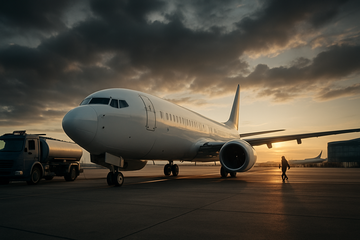
Order at stake
150 737 MAX
100 firm + 50 options; mix of 737-8 and 737-10
List-price value
~$18B
$120M × 150; 30–50% typical discount implies ~$10–14B real revenue
Broader package (Sept 2025)
225 jets
75 787s (50 firm + 25 options) + up to 150 737 MAX
Boeing total backlog
$715.3B
Record at June 30, 2026, including 6,200+ commercial jets at $597B
737 MAX production rate
47/month
Up from 38; new 4th 'North Line' in Everett opened mid-2026
CFM LEAP deliveries H1 2026
+41% YoY
1,030 LEAPs delivered; CFM backlog exceeds $210B
The event
Boeing Is One Engine-Servicing Agreement Away from a 150-Jet Salvage
Boeing is on the verge of converting the 150-jet 737 MAX half of a 225-aircraft Turkish Airlines package into a firm order, after a year-long delay rooted in engine-maintenance economics rather than airframe demand. Reuters reported on Sept. 15, 2026 that a deal could be signed the following week, citing sources familiar with the talks. Boeing and CFM International declined to comment; Turkish Airlines did not respond.
The original package was announced on Sept. 25, 2025 in Washington after a Trump-Erdogan meeting: 50 firm Boeing 787s (35 787-9 and 15 787-10) plus 25 options, alongside a memorandum for up to 150 737 MAX jets — Turkish's biggest-ever single-aisle commitment to Boeing. The 787 tranche was structured as a firm order from day one; the 737 MAX tranche was held back by an explicit engine condition. Twelve months later, that condition is the only thing still unresolved.
The mechanism
Why a MAX Sale Lives or Dies on a CFM Maintenance Contract
CFM International is the sole-source LEAP-1B supplier for every 737 MAX that leaves the Renton or Everett line, and the 50-50 joint venture between GE Aerospace and Safran controls both the spare-engine pool and the heavy-maintenance access for those engines. That single-source position is what gave Turkish Airlines a credible threat in October 2025 to redirect the entire 737 MAX commitment to Airbus, where the A320neo family has two engine choices (RTX Pratt & Whitney and CFM itself).
- Cost disagreement: Turkish Chairman Ahmet Bolat publicly cited 'feasible economic terms' as the precondition for staying with Boeing; CFM declined to disclose details.
- Premier MRO tier: Turkish asked to join the top tier of CFM maintenance partners — internally dubbed a 'Premier' plant — to win earlier access to the latest LEAP-1B repair technology, useful for a flag carrier scaling to 800 aircraft by 2033.
- Industrial deal scope: Reuters also flagged a separate long-term engine maintenance contract on spare engines and shop-visit economics as part of the dispute.
- Counter-threat: With Airbus, 'I have choices,' Bolat told Reuters on Oct. 9, 2025, leaning on the A320neo's two-supplier engine market as leverage against CFM's monopoly on the MAX.
For CFM, conceding Premier status to a carrier of Turkish's growth profile is not free. GE Aerospace disclosed a $210B+ total backlog on its Q2 2026 call, and the durability-kit upgrade for the LEAP-1B is being rolled into engines starting in early 2027 — exactly the period when Turkish's firm 737 MAX deliveries would begin. Letting a fast-expanding flag carrier become a top-tier LEAP shop pulls forward the share of aftermarket revenue CFM keeps in-house and sets a template for other large MAX operators that have been watching the same terms.
The demand side
A $715B Backlog Already Absorbs the Headline — The Question Is Mix and Cash
On a percentage basis, a salvaged 150-jet Turkish MAX order barely moves Boeing's commercial backlog needle. Boeing reported a record $715.3B total backlog at June 30, 2026, including 6,200+ commercial jets worth $597B. Adding ~$10–14B of 737 MAX revenue into a 2029–2034 delivery window — the 787 tranche is already scheduled in that band — extends the backlog line without changing its slope.
Boeing revenue Q2 2026
$24.6B
Up 8% YoY; commercial segment +8% to $11.75B
Commercial deliveries Q2
171 jets
Up from 150 in Q2 2025; 737 deliveries alone totaled 104
737 deliveries H1 2026
243
Already exceeds full-year 2024
Net commercial orders Q2
246
Driven by lessors and flag-carrier renewals
Q2 2026 GAAP loss
($0.67) / share
Net loss of $444M, materially narrower than Q2 2025
The signal investors should read is not the headline backlog multiple but the operating margin: a salvaged deal with 2029+ delivery slots is largely a pre-production cash event (deposits and escalation) that does not bend near-term gross margin, which Boeing management has said will stay depressed through 2026. The real commercial-cycle proof point is what happens to net order intake in the back half of 2026, not whether Turkish signs in September.
The production side
737 MAX Is Ramping Right Into the Demand Wave — If Labor and Engines Cooperate
The 737 program spent 2025 emerging from a 38-per-month FAA production cap and is now climbing. Boeing confirmed on its Q2 2026 call that it is transitioning toward 47 MAX per month, with the certification flight testing for the 737-7 and 737-10 completed and first deliveries targeted for 2027. The FAA issued the amended type certificate for the 737 MAX 7 on Aug. 3, 2026, opening another ~150-seat single-aisle variant into the delivery pool.
- Rate path: 38 → 42 → 47 jets/month; Boeing has publicly studied pushing eventually to 70/month — a level the program has never sustained.
- Capacity: a fourth 737 line ('North Line') opened at the Everett, Washington site in mid-2026, the first new 737 assembly line outside Renton in the MAX era.
- Vertical integration: Boeing completed its $8.3B acquisition of Spirit AeroSystems in December 2025, taking 737 fuselage work back in-house — the deal eliminates a long-running quality risk but adds near-term integration cost.
- Turkish delivery window: the original 787 MOU scheduled 787-9/787-10 deliveries 2029–2034; the MAX tranche would sit in the same outer years, just as the new lines reach steady-state rate.
The other shoe
SPEEA's Strike Vote Is the Bigger Near-Term Threat to the 737 Production Line
The Turkish salvage is a single-customer demand story; the SPEEA contract is a system-wide supply risk. Roughly 17,000 Boeing engineers and technical workers rejected the company's first four-year offer on Aug. 21, 2026 by 64% (professional unit, 7,238 to 4,027) and 72% (technical unit, 2,795 to 1,094), while authorizing a strike by 88% and 90% margins respectively. The current contracts expire Oct. 6; a strike could begin Oct. 7.
Boeing responded on Sept. 11, 2026 with a sweetened 'final offer': a 10% guaranteed wage increase effective Oct. 16, another 4% in March 2027, 6% wage pools in 2028–2030, plus 4% guaranteed in each of those years. The SPEEA bargaining committee has recommended a 'Yes' vote. The membership voting window runs Sept. 24 to Oct. 1.
SPEEA's economic profile is also worth weighing. The 10% immediate + 4% March 2027 + 6% pool structure compounds to nearly 29% over four years, per the union's own framing. That is below the 35–40% range that ended the 2024 IAM machinists strike, but it lands just as Boeing is forecasting low margins through 2026 and an uneven delivery cadence into 2027.
Supply chain
Where the Real Money Flows: Engines First, Then Structures
The salvage value chain is short and concentrated. CFM controls the bottleneck — sole-source LEAP-1B on every MAX and the maintenance-economics fight that almost killed the Turkish deal. A signed deal does not change CFM's monopoly, but a Premier-MRO concession to a flag carrier targeting 800 aircraft by 2033 is the first structural break in CFM's after-sale pricing model in this cycle.
| Tier | Entity | Symbol | Direct linkage | Stakes |
|---|---|---|---|---|
| Engine OEM | GE Aerospace (50% of CFM) | GE | Sole-source LEAP-1B on 737 MAX | CFM backlog >$210B; Premier MRO concession sets precedent for other MAX operators |
| Engine OEM | Safran (50% of CFM) | SAF.PA | Sole-source LEAP-1B on 737 MAX | Half of every LEAP-1B spare-parts dollar; exposure to long-term service contracts |
| Engine components | Howmet Aerospace | HWM | Airfoils, seamless rings for LEAP/GE9X | Engine Products is the largest segment; Q2 revenue $9.1B with 24% YoY growth |
| Competing engine | RTX (Pratt & Whitney) | RTX | Powers A320neo — the Airbus escape route | Turkish threat validated P&W as credible leverage; CFM's Premier concession was the cost |
| Airframer | Airbus | AIR.PA | Would have absorbed the 150 if CFM walked | 8,754 plane backlog; would have pushed A320neo backlog further out, not price |
| Downstream buyer | Turkish Airlines | — | Anchors the order; ~583 aircraft today, target 800 by 2033 | Already operating MAX 9s and 787-9s; CFM/GE deals across widebody and narrowbody fleets |
| Lessor | AerCap | AER | Already bridging Turkish's fleet via 34-aircraft dry-lease | If MAX slips past 2029, lessors backfill narrowbodies; if MAX holds, lessor demand still grows |
Synthesis
Salvage ≠ Recovery. Investors Should Read This as a 2029–2034 Deliverability Story
Three layers, three different time horizons. The deal saves face in the news flow, but the airframe was always the easy part — the Turkish 787 tranche was firm from day one, and the MAX MOU was always likely to convert if the engine terms moved. The harder questions sit further out.
- Short term (days–quarters): the salvage is a positive read-through for Boeing order momentum and for GE Aerospace/Safran on the LEAP-1B install base; the SPEEA Oct. 1 vote is a binary catalyst that outweighs the Turkish news until that risk clears.
- Medium term (12–24 months): the 737-10 certification (targeted 2026), the 737-7 commercial entry (early 2027), and the fourth-line ramp to 47/month are the production milestones that actually have to land for the Turkish order to deliver on time.
- Long term (2029–2034): the real commercial-cycle test is whether Boeing can produce 47–53 MAX per month out of two lines with a reintegrated Spirit fuselage operation, while CFM services a much larger LEAP-1B installed base — a capacity chain that today has no slack.
Stocks this event actually moves
- Turkish 150-MAX salvage adds ~$10–14B of 2029–2034 revenue into a record $715.3B backlog, but a 30–50% list-price discount caps the near-term gross-margin lift.
- SPEEA strike risk starting Oct. 7 threatens the 47/month 737 ramp more than the Turkish deal helps it; vote window closes Oct. 1.
- Reintegrated Spirit AeroSystems (acquired Dec. 2025 for $8.3B) removes a quality risk but adds near-term cost just as MAX deliveries are climbing.
- 737-10 certification targeted for 2026 and 737-7 deliveries starting early 2027 unlock the variants Turkish ordered on the same delivery schedule.
- CFM (50/50 with Safran) keeps 100% of the LEAP-1B install base if the Turkish MAX deal signs, extending a $210B+ total backlog deeper into the next decade.
- Premier MRO concession to Turkish sets a precedent other large MAX operators will press for, potentially compressing CFM's per-engine services margin in 2027+.
- H1 2026 LEAP deliveries were up 41% YoY (1,030 units); the durability-kit upgrade in early 2027 front-loads shop-visit revenue into 2027–2028, just as Turkish's MAX would enter service.
- Safran captures half of every LEAP-1B spare-parts dollar and the full SAFRAN Propulsion MRO share on the MAX; a signed Turkish deal secures the 2029+ services annuity.
- Safran has guided to ~2,000 LEAP deliveries in 2026 with further increases to come — Turkish volumes extend the post-2026 trajectory rather than reset it.
- A CFM Premier-MRO concession to Turkish compresses CFM's services margin the same way it does for GE Aerospace, but Safran's larger civil-aero mix makes it proportionally more exposed to that effect.
- An 8,754-plane backlog (record, per company) already absorbs the A320neo family; had the Turkish MAX collapsed to Airbus, the order would have shifted mix, not total backlog.
- Airbus targeted 870 deliveries in 2026 and was 351 in by mid-year; a Boeing win removes a one-off catalyst but does not alter the multi-year delivery gap.
- A320neo remains the structural alternative if CFM terms force future MAX orders to switch; Pratt (RTX) and CFM dual-source on A320neo keeps that escape route open for every MAX customer.
- Pratt & Whitney's GTF powers the A320neo — the leverage Turkish used in the CFM fight — validates RTX as the structural alternative on the MAX competitive set.
- RTX was not directly in the line of fire on this deal; impact is indirect, via continued A320neo backlog accretion if any MAX-switching occurs in 2027+.
- GTF inspection-cycle disruption in 2024–2025 still affects shop-visit revenue timing; the Turkish case reminds the market that single-source engines are a negotiating liability for OEMs and a moat for duopoly positions.
- Engine Products — airfoils and seamless rings for LEAP/GE9X — is Howmet's largest segment; sustained LEAP volume growth (1,030 H1 2026 deliveries, +41% YoY) extends a multi-year tailwind on a 2026 Q2 revenue base of $9.1B (+24% YoY).
- A signed Turkish deal does not change Howmet's per-engine content, but adds one more high-volume operator to the LEAP install base through 2034.
- Howmet's gross margin (34.4% TTM) and 30%+ EBITDA margin scale with LEAP and GE9X shop-visit demand — both rise mechanically with a larger MAX fleet.
- AerCap already bridges Turkish's fleet via a 34-aircraft dry-lease (including 3 B787-9s); a salvaged MAX deal shifts demand from lessor-owned MAX to airline-owned MAX, modestly reducing the lessor-driven MAX backlog in 2029+.
- AerCap's separate Farnborough 2026 order for 15 787-9s keeps the lessor's widebody order book expanding independent of the Turkish outcome.
- Net: lessor economics are second-order; watch AER for any expansion of its MAX lease pipeline if Turkish delays the firm 100 portion of the order past 2030.