%22%2F%3E%0A%20%20%3Ccircle%20cx%3D%22220%22%20cy%3D%22150%22%20r%3D%22180%22%20fill%3D%22%2322d3ee%22%20fill-opacity%3D%220.12%22%2F%3E%0A%20%20%3Ccircle%20cx%3D%221010%22%20cy%3D%22130%22%20r%3D%22220%22%20fill%3D%22%2338bdf8%22%20fill-opacity%3D%220.08%22%2F%3E%0A%20%20%3Ccircle%20cx%3D%22920%22%20cy%3D%22520%22%20r%3D%22170%22%20fill%3D%22%2322d3ee%22%20fill-opacity%3D%220.06%22%2F%3E%0A%20%20%3Cpath%20d%3D%22M140%20430h920%22%20stroke%3D%22url(%23line)%22%20stroke-width%3D%2212%22%20stroke-linecap%3D%22round%22%2F%3E%0A%20%20%3Cpath%20d%3D%22M220%20360c120-150%20260-220%20380-220s260%2070%20380%20220%22%20fill%3D%22none%22%20stroke%3D%22%2367e8f9%22%20stroke-opacity%3D%220.5%22%20stroke-width%3D%2216%22%20stroke-linecap%3D%22round%22%20stroke-linejoin%3D%22round%22%2F%3E%0A%20%20%3Cpath%20d%3D%22M300%20398h600%22%20stroke%3D%22%2394a3b8%22%20stroke-opacity%3D%220.24%22%20stroke-width%3D%228%22%20stroke-linecap%3D%22round%22%2F%3E%0A%20%20%3Ctext%20x%3D%22220%22%20y%3D%22510%22%20fill%3D%22%23e2e8f0%22%20fill-opacity%3D%220.7%22%20font-family%3D%22Arial%2C%20Helvetica%2C%20sans-serif%22%20font-size%3D%2238%22%20letter-spacing%3D%228%22%3EINSIGHTS%3C%2Ftext%3E%0A%3C%2Fsvg%3E)
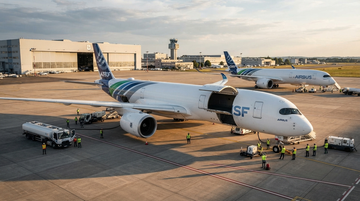
A first-flight milestone that shifts who gets the next widebody freighter slots
Airbus is positioning the A350F to take control of the calendar—while Boeing’s 777-8F still has time-risk built into it
The A350F is moving from ground work into flight-test execution, and that step changes the economics of “who gets the freighter seats” in the 2027–2030 cargo buildout.
Airbus has tentatively set the A350F first flight for the third week of September 2026, which is the kind of date that drives certification planning, supply-chain recovery, and—most importantly—customer delivery slot expectations. Boeing, meanwhile, is disclosing a structural schedule relationship that effectively keeps the 777-8F’s commercial arrival later than many shippers would prefer: the freighter’s first delivery is expected about two years after the 777-9 first delivery.
Verified event timing
What’s actually been confirmed: A350F flight-test cadence points to a September launch target, not just a year-level ambition
A350F first flight
3rd week of Sep 2026 (target)
Tentative target reported Aug 18, 2026 by Reuters via an euronext financial news reprint.
A350F flight-test build
2 aircraft
Airbus press release dated Apr 23, 2026 says it is manufacturing two A350F aircraft for flight testing during 2026–2027.
A350F flight-test campaign window
2026–2027
Airbus press release dated Apr 23, 2026 frames flight testing across 2026 and 2027.
On the supply-chain and engineering side, Airbus has also already disclosed major hardware readiness: a press release dated Apr 23, 2026 notes the completion of the first A350F main-deck cargo door manufacturing and assembly and provides door dimensions (a large main-deck cargo opening). While door work isn’t the same thing as first flight, it is a tangible waypoint that supports the idea the aircraft is entering the testing phase rather than remaining in pure build.
That matters for investors because certification delays often cascade from late installations, safety-test iteration, or flight-test readiness gaps. When the milestone is a near-term first flight target, the market reads “lower probability of further slippage” even before the certification date is disclosed.
Boeing’s schedule disclosure
Boeing’s freighter timing anchor: the 777-8F is still structurally tied to the 777-9’s first delivery
In Boeing’s SEC filings, the company describes the relationship between the 777-9 and the 777-8 Freighter program timing. Boeing states that the first delivery of the 777-8 Freighter is expected to occur approximately two years after the first delivery of the 777-9.
Separately, Boeing discloses its own 777-9 first delivery expectation as occurring in 2027. Taken together, that disclosure structure implies an additional timing buffer before 777-8F deliveries can begin—meaning Airbus’s nearer-term A350F first-flight milestone can translate into earlier widebody-freighter availability expectations for customers.
Supply-chain aware: why the first flight changes more than just one program headline
Full supply-chain transmission: first flight pulls on certification, aircraft outfitting, and air-cargo fleet planning
- Flight-test start dates concentrate work across avionics integration, flight control validation, and cargo-system safety demonstration—so readiness issues surface earlier and drive fewer late-stage certification “loops.”
- Once certification is on the calendar, aircraft outfitting for operator-specific options (freight door configuration, interiors, and mission fit) becomes schedulable in parallel rather than sequentially—reducing delivery slippage risk.
- For lessors and cargo airlines, delivery timing affects lease placement and network ramp: aircraft availability windows determine when routes can be launched profitably rather than just when they can be sold.
Investor-relevant angles with hard anchors
What to watch in the next 2–6 months (and what it implies for cargo demand capture)
| Milestone | What it signals | Why it matters for cargo airlines | Investor read-through |
|---|---|---|---|
| A350F first flight (target: 3rd week of Sep 2026) | Flight-test campaign can start on schedule | Type certification path becomes more predictable | Earlier delivery expectations raise the odds of booking slot wins |
| A350F flight testing across 2026–2027 (2 aircraft for testing) | Testing capacity is planned, not just conceptual | Fewer “test aircraft gaps” that delay certification | Reduces perceived probability of extended delays |
| Boeing: 777-8F first delivery ~2 years after 777-9 first delivery | Freighter arrival tied to upstream program timing | Customers plan fleet replacements with longer lead times | Potentially shifts incremental widebody freighter demand toward the earlier entrant |
The near-term implication is not that the cargo market suddenly “needs” more freighters in September. It’s that operators decide how to allocate scarce near-term widebody freighter capacity.
If one OEM’s schedule becomes more credible sooner, it can become the preferred anchor for long-horizon contracts—especially where shippers are pushing e-commerce throughput, nearshoring, and time-sensitive inventory buffers that benefit from larger payload aircraft and more consistent lift.
Broader financial context
For Boeing shareholders, the program timing still shows up in fundamentals—even before a delivery cadence improves
Boeing FY2025 revenue
$89.5B
FY2025 income statement, reported Jan 30, 2026.
Boeing FY2025 net income
$2.24B
FY2025 income statement, reported Jan 30, 2026.
Boeing FY2024 revenue
$66.5B
FY2024 income statement, reported Feb 3, 2025.
Horizons
Short-term vs. long-term: what moves first, and what ultimately determines winners
In the short term (days to quarters), the biggest “first mover” signal is whether Airbus converts the September first-flight target into actual flight-test start without further calendar slips. That determines whether customers treat the A350F as a credible 2027-era capacity solution.
In the long term (1–3 years), the winner is the OEM that credibly delivers enough widebody freighter capacity into the window when the industry’s cargo demand is shifting: e-commerce throughput growth, nearshoring-driven network redesign, and automation/AI-enabled capacity planning all increase the value of aircraft that are available predictably rather than just theoretically on order.
Listed companies most exposed to the timing and execution difference
- Boeing’s SEC disclosure implies the 777-8F first delivery is ~two years after the 777-9, prolonging later freighter availability risk into 2028-era planning windows.
- If widebody freighter customers anchor to Airbus earlier, Boeing enters the freighter upgrade wave later, which can reduce near-term pricing power.
- Execution credibility can still help, but FY2025 results show recovery without eliminating program timing uncertainty for investors focused on delivery cadence.
- Airbus’s reported tentative first-flight target in the third week of September 2026 tightens the path to certification-and-delivery predictability.
- Airbus disclosed it is manufacturing two A350F aircraft for flight testing across 2026–2027 supporting a scaled testing plan rather than a one-off milestone.
- If the A350F becomes the earlier widebody freighter anchor, Airbus can capture more 2027–2030 order-book momentum than a delayed competitor.
- Engine and systems execution is sensitive to freighter certification timing; earlier A350F flight-test start reduces probability of additional downstream integration delays.
- However, Boeing’s program still has long-cycle engine/system implications; later 777-8F availability can spread demand for spares and maintenance later.
- GE’s exposure depends on how each OEM’s schedule translates into actual production deliveries not just first-flight targets.
- If Airbus’ A350F timeline improves credibility, operators like FedEx can plan replacement lift earlier in the widebody segment.
- But if Boeing’s 777-8F remains structurally later, FedEx may face more constrained fleet mix choices for specific network needs.
- The net impact depends on whether carriers shift freighter allocation toward earlier entrants within the 2027–2030 window as contract options are exercised.