%22%2F%3E%0A%20%20%3Ccircle%20cx%3D%22220%22%20cy%3D%22150%22%20r%3D%22180%22%20fill%3D%22%2322d3ee%22%20fill-opacity%3D%220.12%22%2F%3E%0A%20%20%3Ccircle%20cx%3D%221010%22%20cy%3D%22130%22%20r%3D%22220%22%20fill%3D%22%2338bdf8%22%20fill-opacity%3D%220.08%22%2F%3E%0A%20%20%3Ccircle%20cx%3D%22920%22%20cy%3D%22520%22%20r%3D%22170%22%20fill%3D%22%2322d3ee%22%20fill-opacity%3D%220.06%22%2F%3E%0A%20%20%3Cpath%20d%3D%22M140%20430h920%22%20stroke%3D%22url(%23line)%22%20stroke-width%3D%2212%22%20stroke-linecap%3D%22round%22%2F%3E%0A%20%20%3Cpath%20d%3D%22M220%20360c120-150%20260-220%20380-220s260%2070%20380%20220%22%20fill%3D%22none%22%20stroke%3D%22%2367e8f9%22%20stroke-opacity%3D%220.5%22%20stroke-width%3D%2216%22%20stroke-linecap%3D%22round%22%20stroke-linejoin%3D%22round%22%2F%3E%0A%20%20%3Cpath%20d%3D%22M300%20398h600%22%20stroke%3D%22%2394a3b8%22%20stroke-opacity%3D%220.24%22%20stroke-width%3D%228%22%20stroke-linecap%3D%22round%22%2F%3E%0A%20%20%3Ctext%20x%3D%22220%22%20y%3D%22510%22%20fill%3D%22%23e2e8f0%22%20fill-opacity%3D%220.7%22%20font-family%3D%22Arial%2C%20Helvetica%2C%20sans-serif%22%20font-size%3D%2238%22%20letter-spacing%3D%228%22%3EINSIGHTS%3C%2Ftext%3E%0A%3C%2Fsvg%3E)
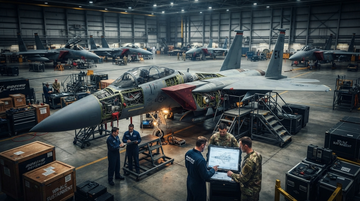
The Air Force just put a decade-plus sustainment “floor” under a 1970s airframe.
Under a sole-source IDIQ known as F-15 Eagle Crest, Boeing received a $131.23 billion ceiling to cover aircraft production, systems integration, modernization/upgrades/retrofits, and sustainment—plus the establishment of organic depot maintenance capabilities to help Air Force depots perform heavy overhauls. That single contract is a useful stress test for how the Pentagon’s “sustainment over new starts” strategy flows through contractor margins when the government is simultaneously building internal repair capacity and tightening sustainment IP constraints.
The contract headline investors will trade
A sustainment-first IDIQ that includes both new work and a depot-capacity transfer
Contract ceiling
$131.23B
Ceiling value for the F-15 Eagle Crest sole-source IDIQ contract (awarded Aug. 24, 2026)
Ordering window
Aug. 2026–Aug. 2031
Ordering period expected to end Aug. 24, 2031 (with option to extend to Aug. 24, 2036)
Program completion
Aug. 2037
Expected completion August 2037
Customer footprint
US + 7 FMS nations
Air Force, Air National Guard, and foreign customers under FMS: Japan, Israel, Saudi Arabia, South Korea, Singapore, Indonesia, and Poland
Three features matter for profit mechanics.
First, the agreement is structured as an IDIQ: the ceiling defines the maximum obligation, while ordering flexes over time. Second, the scope is not just production; it spans modernization and sustainment. Third—and most strategically important—it explicitly includes work to stand up “organic depot maintenance” so Air Force depots can perform their own heavy overhauls rather than relying only on contractor-performed depot labor.
Supply chain map from the government’s wording
What the scope implies for upstream components and depot-level labor
Even without a subcontract list in the contract announcement, the government’s described work breaks naturally into three “flow paths.”
1) Production & integration flow path: airframe manufacturing plus integration of mission systems. This pulls from avionics/software domains, wiring harnesses/cabling, and test/verification ecosystems.
2) Modernization/upgrades/retrofits flow path: typically requires replacement blocks (avionics, mission computers, displays, electronic warfare integration) and software loading/verification.
3) Sustainment & depot heavy overhaul flow path: parts provisioning, industrial engineering, and depot-level maintenance execution.
The depot-capacity language matters because it changes the downstream labor allocation: it increases the chance that some heavy maintenance activities shift into government depots (or grow government depot throughput over time), while contractors pivot to program integration, engineering services, and supply of critical parts/subassemblies.
- The Air Force’s stated scope ties Boeing’s deliverables to mission capability availability, not just airframe completion milestones.
- “Organic depot maintenance” reduces the guaranteed share of depot work that stays purely contractor-performed as internal capacity grows.
- FMS customers expand the long-cycle sustainment addressable market if Boeing’s integration baseline remains the de facto upgrade path across fleets.
Depot-capacity context (why “organic” shifts the bargaining power)
Warner Robins Air Logistics Complex
Executes depot maintenance including F-15
Warner Robins Air Logistics Complex states it provides depot maintenance and engineering support to major weapon systems including F-15.
402 AMXG (Warner Robins)
Performs programmed depot maintenance on F-15
The Warner Robins unit page describes program depot maintenance responsibilities for F-15 as part of the depot ecosystem.
Boeing margin interpretation
Why this order-quantity-flex contract tests Boeing’s defense margin mix
Boeing’s defense economics are historically sensitive to (a) how much work migrates to cost-plus or incentive structures versus fixed-price deliverables, and (b) whether sustainment is treated like a recurring “spares + engineering services” stream or like a labor-intensive depot business.
This contract’s blend—production + modernization + sustainment + depot-capacity build—creates a specific margin test: Boeing must keep manufacturing-and-integration performance high while also supporting a transition that could move a portion of heavy overhaul labor from contractor facilities toward Air Force depots.
In other words, the government is paying Boeing to manage capability delivery while simultaneously reducing the long-run necessity of contractor-run depot capacity.
| Company | FY2023 revenue | FY2024 revenue | FY2025 revenue | FY2025 operating income |
|---|---|---|---|---|
| Boeing | $77.794B | $66.517B | $89.463B | -$5.416B |
Right-to-Repair policy pressure meets sustainment lock-in
Why IP access and repair rights change the value of long sustainment frameworks
Sustainment programs often create quasi-lock-in: original contractors control repair access, tools, software, and technical data needed for certain depot-level maintenance tasks.
Policy efforts pushing “Right to Repair” principles aim to ensure the government has fair and reasonable access to repair parts/tools/data needed to maintain equipment. Even when the government still awards the prime sustainment framework, increased repair access can dilute the long-run margin premium that comes from sole-provider execution of certain overhaul steps.
In the F-15 Eagle Crest wording, the most direct “margin-rights” lever is not just IP—it is the government’s insistence on establishing organic depot maintenance capability. That is effectively a structural step toward internal execution, which reduces how much of the depot economics can be captured by the prime contractor alone.
- If depots can execute more heavy overhaul work internally, Boeing’s sustainment margin shifts from depot labor to engineering, integration, and parts supply.
- If repair access expands beyond the incumbent’s controlled workflow, Boeing’s bargaining power faces downside on follow-on maintenance scope even if the program framework remains intact.
Supply-chain beneficiaries (and victims) by role
Which public names are most likely to ride along—versus get competed out
Because the contract announcement emphasizes scope but does not publish a full subcontractor roster, the most defensible way to map public equities is by role.
- Primes and systems integrators: most exposed to the total work scope and the program-management center of gravity.
- Propulsion and auxiliary-power ecosystems: likely beneficiaries where modernization or sustainment steps touch engine-related availability, test, and overhaul cycles.
- Electronics and mission system modernization: exposed to retrofits, software loading, and replacement of line-replaceable units or shop-replaceable modules.
- Depot ecosystems: when “organic” depot maintenance expands, companies reliant purely on depot labor volumes face a relative headwind.
With that lens, the investable angle is not “who is guaranteed subcontract work,” but “who benefits from long-duration capability delivery while the depot-transition reduces contractor-run labor share.”
Horizon view
Short-term catalysts vs. 1–3 year structural shifts
- In the next few quarters, Boeing will likely convert framework authority into task orders, making near-term guidance tied to ordering pace rather than ceiling math.
- Over 1–3 years, the key swing factor is whether organic depot maintenance materially reduces contractor-heavy overhaul workloads—or whether Boeing remains central via engineering + supply.
- For electronics/propulsion suppliers, the swing is whether upgrades concentrate on replace-and-verify cycles that keep recurring module sustainment spend with commercial OEMs.
Investable coverage: the listed names most plausibly connected to the F-15 sustainment framework
- The award adds long-duration sustainment-and-modernization revenue visibility, but operating income can still suffer if depot-transition costs rise (FY2025 operating income was -$5.416B).
- A sole-source IDIQ with a ceiling of $131.23B reduces immediate competitive re-bid risk while increasing execution and cost-control scrutiny through ordering to 2031/2037.
- The scope explicitly includes creating organic depot maintenance capability, meaning Boeing may see a lower share of depot labor over time even if engineering and integration remain central.
- If F-15 modernization and sustainment extend engine/auxiliary support workload, RTX could benefit from higher availability-focused maintenance demand tied to long program ordering through 2037.
- If “organic depot maintenance” shifts heavy overhaul toward Air Force depots, RTX’s upside could cap at parts/modules and engineering interfaces rather than full depot labor volumes.
- If mission system integration work packages expand as part of F-15 modernization, Lockheed Martin could gain from continued avionics/mission systems sustainment interfaces throughout the ordering window.
- If Right-to-Repair style access and depot organic capability reduce incumbent integration lock-in, share gains may depend more on component-level differentiation than program capture.
- Modernization and sustainment typically involve sensors, mission systems, and electronic support—Northrop could track demand if upgrade baselines require its modules across the 7 FMS customers.
- If the depot-transition reduces contractor-executed overhaul scope, Northrop’s upside may skew toward electronics refresh and test/verification rather than depot labor.
- If F-15 sustainment includes avionics upgrades and retrofit refresh cycles, Rockwell Collins could capture replacement-display/mission-display and related avionics sustainment demand across the long ordering period.
- If Right-to-Repair access reduces OEM exclusivity on technical support workflows, Collins’ margin could depend on service execution differentiation rather than data/tool lock-in.