%22%2F%3E%0A%20%20%3Ccircle%20cx%3D%22220%22%20cy%3D%22150%22%20r%3D%22180%22%20fill%3D%22%2322d3ee%22%20fill-opacity%3D%220.12%22%2F%3E%0A%20%20%3Ccircle%20cx%3D%221010%22%20cy%3D%22130%22%20r%3D%22220%22%20fill%3D%22%2338bdf8%22%20fill-opacity%3D%220.08%22%2F%3E%0A%20%20%3Ccircle%20cx%3D%22920%22%20cy%3D%22520%22%20r%3D%22170%22%20fill%3D%22%2322d3ee%22%20fill-opacity%3D%220.06%22%2F%3E%0A%20%20%3Cpath%20d%3D%22M140%20430h920%22%20stroke%3D%22url(%23line)%22%20stroke-width%3D%2212%22%20stroke-linecap%3D%22round%22%2F%3E%0A%20%20%3Cpath%20d%3D%22M220%20360c120-150%20260-220%20380-220s260%2070%20380%20220%22%20fill%3D%22none%22%20stroke%3D%22%2367e8f9%22%20stroke-opacity%3D%220.5%22%20stroke-width%3D%2216%22%20stroke-linecap%3D%22round%22%20stroke-linejoin%3D%22round%22%2F%3E%0A%20%20%3Cpath%20d%3D%22M300%20398h600%22%20stroke%3D%22%2394a3b8%22%20stroke-opacity%3D%220.24%22%20stroke-width%3D%228%22%20stroke-linecap%3D%22round%22%2F%3E%0A%20%20%3Ctext%20x%3D%22220%22%20y%3D%22510%22%20fill%3D%22%23e2e8f0%22%20fill-opacity%3D%220.7%22%20font-family%3D%22Arial%2C%20Helvetica%2C%20sans-serif%22%20font-size%3D%2238%22%20letter-spacing%3D%228%22%3EINSIGHTS%3C%2Ftext%3E%0A%3C%2Fsvg%3E)
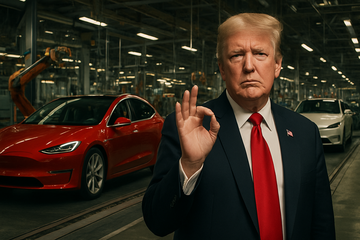
Two policy facts landed nine days apart and point in opposite directions. On Sep 3, the industry's largest US lobby filed a letter to congressional leaders demanding a permanent ban on Chinese connected vehicles. On Sep 12, the President said on Fox News he would be \"OK with that\" — Chinese automakers opening plants on US soil and hiring American workers — explicitly ruling out Chinese plants in Mexico shipping into the US. The shift converts a trade barrier into a localization barrier, and that re-prices every auto name that touches the US market.
Trump statement on Chinese US plants
Sep 12, 2026
Fox News 'Ingraham Angle' interview, reported by Reuters and The Hill
Industry ban letter to Congress
Sep 3, 2026
Alliance for Automotive Innovation; signatories include Ford, GM, Stellantis, Toyota, Honda, BMW, VW, Volvo
US tariff on Chinese EVs
100%+
Still in force, per Reuters and the White House
Mexico tariff on Chinese vehicles
50%
Effective Jan 1, 2026, per Mexican congressional vote and Reuters reporting
Industry tariff cost since 2025
$35.4B
Automotive News tally, March 16, 2026
BYD H1 2026 revenue
RMB 344.82B
Down 7.13% YoY, per Aug 28, 2026 interim results
The event
Trump reframes the threat from imports to US plants
Speaking to Laura Ingraham on Friday, President Trump said that \"if China wanted to come in and open a plant to build their cars here, I'd be okay with that,\" and pointed to Japan as precedent: \"Japan does it, but they hire our people. The big thing is they hire our people.\" He drew one sharp line: he does not want Chinese automakers to build cars in Mexico and ship them to the United States.
The collision
Nine days earlier, US and foreign OEMs asked Congress to slam the door
| Date | Actor | Action | Effect for Chinese OEMs |
|---|---|---|---|
| Sep 3, 2026 | Alliance for Automotive Innovation (Ford, GM, Stellantis, Toyota, Honda, BMW, VW, Volvo) | Letter to House and Senate leadership urging permanent ban on Chinese connected vehicles, hardware and software before year-end | Outright prohibition on sale, import, and US manufacture |
| Sep 8, 2026 | USDOT Secretary Sean Duffy | Letter to Ford CEO Jim Farley citing CATL, Geely, and BYD partnerships as national-security concerns | Heightened political risk for any existing Chinese tie-up |
| Sep 12, 2026 | President Trump (Fox News) | Says US-built Chinese cars are welcome; Mexican-built Chinese cars for US sale are not | Localization pathway opens; Mexico backdoor closes |
Why BYD and Geely can clear the gate
The localization math favors the OEMs with the cheapest EVs and the deepest pockets
BYD is the lowest-cost producer in the global auto industry. Its cheapest EV retails at roughly $10,000 in some emerging markets — two to three times cheaper than a comparable US-built model. That cost gap is the entire prize: if BYD can build at US labor cost while preserving its scale advantage in cells, motors, and electronics, the unit economics of a $25,000 US-made BYD versus a $35,000 US-made Ford or GM compact EV change overnight. The capital is there — BYD had 869,600 employees on its books as of mid-2026 and ran RMB 28.9 billion of R&D in the first half.
BYD H1 2026 — profit slips while overseas share climbs
Source: BYD interim results, released Aug 28, 2026
Unit: RMB billions / %
H1 revenue (RMB B)
-7.13% YoY
344.8
H1 net profit (RMB B)
-20.5% YoY
12.3
H1 R&D spend (RMB B)
Record first half
28.9
Overseas share of H1 revenue (%)
Crossed 50% for the first time
53
Geely's template
Geely has already cracked the code — in Valencia
Geely announced a manufacturing joint venture with Ford at Ford's Valencia, Spain plant on July 23, 2026 — operations scheduled for the first half of 2027, with Geely's EX2 electric vehicle slated for the line. The deal is the prototype for the US play: an incumbent Western OEM contributes an idle plant and a dealer network; the Chinese OEM contributes a competitive EV platform. Geely and BYD had earlier been finalists to buy the idle Nissan–Mercedes-Benz plant in Aguascalientes, Mexico — a 230,000-vehicle-capacity site that Trump's Mexico exclusion now puts out of reach as a US launch pad.
The squeeze
Ford is trapped between Trump's invitation and Duffy's letter
Four days before Trump's plant comment, Transportation Secretary Sean Duffy wrote directly to Ford CEO Jim Farley citing the automaker's CATL licensing deal at Marshall, Michigan, its Valencia JV with Geely, and unspecified BYD discussions as \"profound\" national-security concerns. Duffy also flagged Ford's decision to keep building the Lincoln Nautilus in China until 2030. Ford called the letter \"wrongheaded\" and pointed out it owns the Marshall plant, controls operations, and employs the workforce. The dueling signals from the same administration — open the door to Chinese plants, blast Ford for doing deals with the Chinese — leave the company with no clean path.
| Metric (USD) | Ford TTM Q2'26 | GM TTM Q2'26 | Tesla TTM Q2'26 |
|---|---|---|---|
| Revenue | $188.0B | $185.5B | $103.6B |
| Net income | -$7.4B | $1.9B | $3.8B |
| Diluted EPS | -$1.87 | $1.98 | $1.08 |
| Gross margin (TTM) | 10.8% | 5.7% | 18.9% |
| Forward P/E | 7.5x | 5.7x | 151.5x |
For Ford, the pain is acute: a TTM net loss of $7.4 billion on essentially flat revenue means every incremental policy shock flows straight to the bottom line. GM's net income is positive but its diluted EPS has fallen from $6.37 in FY2024 to $1.98 on a TTM basis — a 69% compression driven by tariff costs (the industry has absorbed $35.4 billion in tariff expense since 2025, per Automotive News) and EV write-downs.
Upstream and downstream
The supply chain is the real battleground — CATL, USMCA content, and the Mexico wall
- CATL is in the crossfire. The world's largest EV battery maker sits on the Pentagon's list of firms with alleged ties to the Chinese military. Its licensing deal with Ford at Marshall, Michigan — first LFP cells shipping this year on a $3.5B plant investment — was the specific trigger Duffy cited. Any US-built BYD plant would need a battery partner, and CATL's US options are narrowing.
- USMCA rules of origin are the lever. Vehicles built in Mexico or Canada with 75% North American content enter the US duty-free. Trump's Sep 12 line on Mexico cuts that pathway for any Chinese OEM, forcing US capex or non-USMCA entry at the 100%+ EV tariff.
- Mexico's 50% tariff on Chinese cars (effective Jan 1, 2026) blocks the easiest backdoor and was a precondition for the USMCA review now underway. A Chinese OEM that wanted to localize for North America through Mexico is now stuck: too expensive to ship from China, too expensive to ship from Mexico.
- The Valencia template generalizes. Ford's July 2026 deal with Geely — an underused plant, a partner EV, a Western brand co-credit — is the most credible vehicle for any Chinese OEM to clear Trump's 'build in America' test without owning a politically radioactive brand.
- Battery localization is the gating constraint. Ford's BlueOval Battery Park in Marshall ships LFP cells this year using CATL technology. BYD makes its own cells. Geely sources from CATL and others. Whichever Chinese OEM localizes US cell production first owns the cost curve.
Near-term vs. structural
Three catalysts to watch in the next 90 days — and three in three years
Short-term (days to quarters), three things move first. First, the Connected Vehicle Security Act — the bipartisan Dingell-Moolenaar bill that would statutorily ban Chinese connected vehicles — is still live in the House even after Trump's pivot; whether congressional leaders treat Trump's comment as a green light to slow the bill or as a signal to harden it tells you which way the political capital flows. Second, the USMCA joint review formally opened in July 2026 with a proposed tightening of auto rules of origin from 75% to 82% North American content (50% US) — a higher bar that would benefit US-located Korean and Japanese transplants and penalize any new Chinese-built US plant that has not yet built out a domestic supply chain. Third, Ford's response to Duffy's letter — and any decision to unwind the CATL licensing deal at Marshall or the Geely Valencia JV — would crystallize the cost of being a Chinese-partnered OEM in the US.
Long-term (one to three years), the structural shift is the localization curve. BYD and Geely have publicly signaled US-plant readiness; if even one major Chinese OEM commits to a US gigafactory-plus-assembly complex, the cost-basis of US compact EVs resets and Ford's and GM's remaining EV programs face a structural pricing problem. Conversely, the Trump administration's simultaneous posture — invitation to build, hostility to existing Chinese ties — may force BYD and Geely into the same partnership structure they used in Valencia, in which case Ford and GM collect JV economics but surrender the brand. Either way, Hyundai and Kia — already US-localized, USMCA-compliant, and untouched by any Chinese-deal controversy — sit in the protected center of the new map.
Stocks the Sep 12 pivot actually re-prices
- Trump's invitation turns a US plant from political impossibility into the highest-margin destination for overseas capacity, given overseas revenue already crossed 53% of H1 2026 sales
- At ~$10,000 cost-basis EVs, BYD unlocks sub-$25,000 US pricing that compresses Ford and GM compact-EV margins from day one if a plant announcement follows
- H1 2026 net profit fell 20.5% on a 7.1% revenue drop at home — a US plant pulls future growth away from a saturating Chinese market
- Risk: 100%+ US EV tariff and Biden-era sales/import rules still gate access until BYD commits US capex, which BYD has not yet announced
- Valencia JV with Ford, operations H1 2027, creates the lowest-friction template for any US plant announcement — incumbent plant plus partner EV brand
- US plant option unlocks a domestic channel for the EX2 and Geely-brand portfolio currently priced out by the 100%+ EV tariff
- Geely ADR market cap of $22.3B at 8.9x TTM P/E vs BYD's 26x leaves more upside if Geely secures US localization
- TTM net loss of $7.4B (EPS -$1.87) means every dollar of tariff, Chinese-deal friction, or EV price competition hits equity directly
- Duffy's Sep 8 letter targeting Ford's CATL, Geely, and BYD links forces a choice: unwind partnerships or absorb political risk in a Republican administration
- Lincoln Nautilus not coming home from China until 2030 leaves Ford exposed to Chinese-built-vehicle tariffs for four more model years
- Catalyst: Ford's reply to Duffy (due in days) and any unwind of Marshall CATL licensing will move the stock on the next session
- Diluted EPS fell from $6.37 (FY2024) to $1.98 (TTM Q2'26), a 69% drop that exposes GM to incremental pricing pressure from a localized Chinese competitor
- GM's $185.5B TTM revenue base faces structural margin erosion if Chinese OEMs plant-build in the US, since GM cannot match the cell-to-vehicle cost basis
- Coalition leadership in the Sep 3 ban letter now looks like a defensive crouch, not policy influence
- The 100%+ Chinese EV tariff remains in place and Tesla is the only scaled US EV manufacturer — any Chinese US plant is still 2–3 years from volume
- Tesla's $103.6B TTM revenue and 18.9% gross margin keep it the highest-margin US EV player through the pivot
- Risk: 332x trailing P/E prices in dominance that gets diluted if a localized BYD undercut arrives
- Pentagon list designation cited explicitly by Duffy puts CATL's $3.5B Marshall, Michigan licensing deal at risk
- Any Chinese OEM that localizes US production will need a non-CATL battery partner or accept a de facto US battery prohibition
- Quarterly H1 net margin of ~16% with $13.7B TTM free cash flow cushions a near-term policy shock, but CATL cannot grow US cell share in this environment
- Already US-localized with full USMCA compliance — sits in the protected center of any rules-of-origin tightening from 75% to a proposed 82%
- Forward P/E of 12.3x with $7.74T KRW market cap leaves room for a re-rating as Chinese OEMs face US-entry friction
- Neutral on China policy, no Pentagon-list exposure — Hyundai is the cleanest beneficiary of any USMCA tightening