%22%2F%3E%0A%20%20%3Ccircle%20cx%3D%22220%22%20cy%3D%22150%22%20r%3D%22180%22%20fill%3D%22%2322d3ee%22%20fill-opacity%3D%220.12%22%2F%3E%0A%20%20%3Ccircle%20cx%3D%221010%22%20cy%3D%22130%22%20r%3D%22220%22%20fill%3D%22%2338bdf8%22%20fill-opacity%3D%220.08%22%2F%3E%0A%20%20%3Ccircle%20cx%3D%22920%22%20cy%3D%22520%22%20r%3D%22170%22%20fill%3D%22%2322d3ee%22%20fill-opacity%3D%220.06%22%2F%3E%0A%20%20%3Cpath%20d%3D%22M140%20430h920%22%20stroke%3D%22url(%23line)%22%20stroke-width%3D%2212%22%20stroke-linecap%3D%22round%22%2F%3E%0A%20%20%3Cpath%20d%3D%22M220%20360c120-150%20260-220%20380-220s260%2070%20380%20220%22%20fill%3D%22none%22%20stroke%3D%22%2367e8f9%22%20stroke-opacity%3D%220.5%22%20stroke-width%3D%2216%22%20stroke-linecap%3D%22round%22%20stroke-linejoin%3D%22round%22%2F%3E%0A%20%20%3Cpath%20d%3D%22M300%20398h600%22%20stroke%3D%22%2394a3b8%22%20stroke-opacity%3D%220.24%22%20stroke-width%3D%228%22%20stroke-linecap%3D%22round%22%2F%3E%0A%20%20%3Ctext%20x%3D%22220%22%20y%3D%22510%22%20fill%3D%22%23e2e8f0%22%20fill-opacity%3D%220.7%22%20font-family%3D%22Arial%2C%20Helvetica%2C%20sans-serif%22%20font-size%3D%2238%22%20letter-spacing%3D%228%22%3EINSIGHTS%3C%2Ftext%3E%0A%3C%2Fsvg%3E)
Policy trade • connected vehicles • legislative lock-in
The push isn’t “more tariffs”—it’s a market exclusion written into law
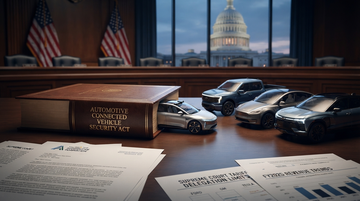
Recent coverage says the Alliance for Automotive Innovation (the industry group led by John Bozzella) is urging Congress to pass legislation that would make the Chinese-vehicle restriction “the law of the land”, framed as barring Chinese connected vehicles and related software/hardware from the U.S. market.
This matters because tariffs are a lever that can be adjusted by executive action (and can be legally constrained). A statutory ban is a structural change to the “how the U.S. competes” problem: it can reduce the ability of Chinese OEMs to access the U.S. market even when duties rise or paperwork strategies evolve.
What’s being proposed • what gets banned • why “connected” is the key choke point
Why lawmakers and automakers keep pointing at connected software/hardware
- The proposed restriction is framed around Chinese connected vehicles plus vehicle software and hardware, concentrating compliance risk into the electronics stack rather than only the vehicle’s shipping cost.
- This design aims to reduce workarounds that can exist under duty-based regimes, shifting enforcement from origin classification to technology/control linkage.
- It also changes the competitive baseline for any OEM whose U.S. strategy relies on “technically compliant” configuration rather than on pure volume economics.
Facts anchored in primary reporting • who is lobbying • what they want Congress to do
Who is pushing, and what’s the ask (timing + legislative permanence)
A Reuters-sourced report carried by WTVB-AM states that the Alliance for Automotive Innovation urged Congress to pass legislation barring Chinese vehicles from the U.S. market before year-end, describing it as making the restriction permanent and codified—“the law of the land.” The report also describes the coalition framing Chinese automakers as exporting subsidized vehicles with connected software and hardware.
Separately, the same reporting references related legislative work tied to codifying a Biden-era style market restriction and notes that committee dynamics and ownership-threshold rules could affect which automakers are covered (including discussion around a 15% ownership threshold concept in committee commentary).
Markets and legal constraints • Supreme Court backdrop for executive tariff power
Can legislative bans survive the Supreme Court’s tightening on tariff power?
The U.S. Supreme Court’s 2026 decision restricting the President’s ability to impose tariffs under emergency powers is part of the backdrop for why stakeholders prefer statutory action. When tariff authority is constrained, a tariff-only thesis (“raise duties until imports stop”) becomes less reliable.
A statutory exclusion, by contrast, is Congress acting directly—so the legal argument shifts from “was the executive allowed to impose tariffs under X statute?” to “does Congress have the constitutional and statutory authority to bar market entry for a defined category?”
Supply-chain transmission • where the money and leverage travel next
If the U.S. excludes Chinese connected cars, the effects propagate through OEM platforms and component ecosystems
A connected-vehicle ban doesn’t just cut import volumes. It changes procurement and integration priorities:
- OEM platform teams may redesign electrical architectures to reduce any covered “linked” elements.
- Software and data-capture pathways become a compliance boundary, not just a product feature.
- Supply-chain partners that sell integration-ready modules can face demand shocks if they are effectively dependent on covered Chinese-origin tech flows.
Investor relevance: these mechanisms tend to benefit incumbents with domestic production depth and proven compliance processes, while raising transition costs for OEMs that have built their cost advantage around scale and standardized electronics.
Detroit pricing power • what changes if the competitor set shrinks
Statutory exclusion can reinforce pricing power more than a tariff does—because it narrows the “substitutes” frontier
Tesla revenue trend
$94.8B (FY2025)
FY2025 revenue, reported Jan 29, 2026 (vs. $97.7B FY2024). Source: Tesla annual income statement figure disclosed for FY2025.
Ford revenue trend
$187.3B (FY2025)
FY2025 revenue, reported Feb 11, 2026 (vs. $185.0B FY2024). Source: Ford annual income statement figure disclosed for FY2025.
GM revenue trend
$185.0B (FY2025)
FY2025 revenue, reported Feb 7, 2026 (vs. $187.4B FY2024). Source: General Motors annual income statement figure disclosed for FY2025.
Stellantis revenue trend
$153.5B (FY2025)
FY2025 revenue, reported Feb 26, 2026 (vs. $156.9B FY2024). Source: Stellantis annual income statement figure disclosed for FY2025.
Why these figures matter for the policy debate: automakers arguing for market exclusion are doing so while still relying on large, fixed-cost revenue bases. If Chinese connected cars face a statutory entry barrier, domestic and global competitors can re-price the U.S. EV/CUV value ladder faster than with tariff changes alone.
That would likely tighten near-term substitution options (fewer “close enough” alternatives), which is exactly the path that supports margin discipline for players with less constrained U.S. supply.
Tesla moat • what a Chinese-car ban would mean for Tesla specifically
Tesla’s moat question: a statutory ban can protect brand-and-cost advantages, but it doesn’t remove Tesla’s competitive math
- A Chinese connected-vehicle ban would reduce cross-shopping pressure for EVs and connected features, helping Tesla hold price bands longer in quarters when demand is sensitive to upgrade cycles.
- But Tesla still faces U.S. regulatory and cost headwinds unrelated to Chinese OEMs; a ban can improve near-term relative positioning without guaranteeing Tesla’s absolute margins if input costs or product mix move against it.
Mexico/loophole import strategies • why a statute changes the incentive structure
Why “loophole” import strategies matter less under a technology/control ban
A tariff fight is, by design, a contest over origin and classification. If the policy shifts to excluding vehicles tied to Chinese connected hardware/software, the economic incentive moves away from “route the goods to lower the duty” and toward “change the product to fall outside the definition.”
That’s the core investor takeaway: statutory exclusions can make transshipment less effective than tariff adjustments, because they target capability linkage rather than just border tax math.
Horizons • what moves first vs. what re-rates later
Short-term (days–quarters): headlines and compliance uncertainty • Long-term (1–3 years): structural margin regime shift
- In the next few quarters, expect stock reaction to policy probability and legislative drafting scope, not to realized sales impacts.
- If the ban becomes durable, the longer-term re-rating would come from U.S. price discipline and reduced competitive churn for OEMs with scale, while import-heavy strategies face higher compliance/transition friction.
- On the downside, an overly broad definition of “connected” could raise compliance costs across the ecosystem, dragging industry margins rather than concentrating them.
Synthesis • the investable thesis
A legislative exclusion is a different kind of industrial policy—one that can reshape pricing power faster than tariffs
The market has already debated tariffs. This new push is about codifying an exclusion so that Chinese connected vehicles—plus related software/hardware—cannot reach U.S. customers even if duty levels move or enforcement is gamed.
For investors, the key question is not whether the tariff thesis failed. It’s whether a statute creates a new competitive scarcity that (1) helps incumbents defend pricing, (2) pressures lower-cost entrants to re-engineer their stack, and (3) alters who captures EV value as the compliance frontier shifts from the border to the product definition.
Listed names most directly exposed to a China connected-vehicle market exclusion
- A statutory China connected-vehicle restriction could reduce near-term price competition and help Tesla hold U.S. EV price bands longer if demand remains stable.
- If the competitor set shrinks, Tesla’s scale economics can convert into steadier gross profit per vehicle while rivals face compliance transition costs.
- The market’s first reaction should reflect policy probability and drafting scope, which can move the stock before any revenue line changes.
- A durable market exclusion could improve Ford’s ability to defend U.S. EV/CUV pricing versus Chinese connected imports.
- If substitutions narrow, Ford’s revenue base may see less incentive to discount, supporting operating leverage in the next few quarters.
- A downside is that broader “connected” definitions could raise industry compliance costs, which would dilute any pricing benefit.
- GM’s exposure is partly through its U.S. volume mix; a statutory exclusion could reduce competitive churn and support margin stabilization.
- With tariffs potentially constrained by legal limits, a statute could lock in a higher competitive floor for domestically aligned offerings.
- Near-term share moves should track legislative velocity and scope, not immediate sales execution.
- If the ban is tied to “connected” tech and ownership thresholds, Stellantis could benefit from reduced Chinese-vehicle substitution in the U.S.
- However, if the drafting broadens definitions, compliance and supplier shifts could offset pricing gains for multi-brand platform strategies.
- The main timing catalyst is when Congress clarifies ownership thresholds and the product/software boundary.