%22%2F%3E%0A%20%20%3Ccircle%20cx%3D%22220%22%20cy%3D%22150%22%20r%3D%22180%22%20fill%3D%22%2322d3ee%22%20fill-opacity%3D%220.12%22%2F%3E%0A%20%20%3Ccircle%20cx%3D%221010%22%20cy%3D%22130%22%20r%3D%22220%22%20fill%3D%22%2338bdf8%22%20fill-opacity%3D%220.08%22%2F%3E%0A%20%20%3Ccircle%20cx%3D%22920%22%20cy%3D%22520%22%20r%3D%22170%22%20fill%3D%22%2322d3ee%22%20fill-opacity%3D%220.06%22%2F%3E%0A%20%20%3Cpath%20d%3D%22M140%20430h920%22%20stroke%3D%22url(%23line)%22%20stroke-width%3D%2212%22%20stroke-linecap%3D%22round%22%2F%3E%0A%20%20%3Cpath%20d%3D%22M220%20360c120-150%20260-220%20380-220s260%2070%20380%20220%22%20fill%3D%22none%22%20stroke%3D%22%2367e8f9%22%20stroke-opacity%3D%220.5%22%20stroke-width%3D%2216%22%20stroke-linecap%3D%22round%22%20stroke-linejoin%3D%22round%22%2F%3E%0A%20%20%3Cpath%20d%3D%22M300%20398h600%22%20stroke%3D%22%2394a3b8%22%20stroke-opacity%3D%220.24%22%20stroke-width%3D%228%22%20stroke-linecap%3D%22round%22%2F%3E%0A%20%20%3Ctext%20x%3D%22220%22%20y%3D%22510%22%20fill%3D%22%23e2e8f0%22%20fill-opacity%3D%220.7%22%20font-family%3D%22Arial%2C%20Helvetica%2C%20sans-serif%22%20font-size%3D%2238%22%20letter-spacing%3D%228%22%3EINSIGHTS%3C%2Ftext%3E%0A%3C%2Fsvg%3E)
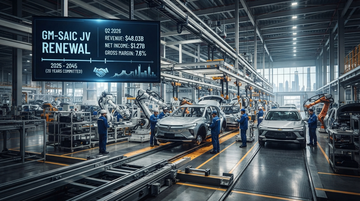
Verified event → what was renewed
GM didn’t exit its China JV—it renewed it for 20 years after restructuring, keeping a China manufacturing footprint into the mid-2040s
The core event is straightforward: General Motors renewed its joint-venture agreement with China’s SAIC for 20 years, extending the partnership through 2045. The reporting also ties the renewal to a “lengthy restructuring” that involved “plant closures” and “the elimination of some models,” implying GM used the restructuring window to reset the JV’s competitiveness before signing up for another long term.
What the renewal likely signals (based on what was disclosed)
Term
20 years (through 2045)
Stated as a 20-year renewal; the timeline implies an end year of 2045.
Context
After a restructuring
The same report links renewal to plant closures and elimination of some models.
Structure
50-50 joint venture
The JV renewal is characterized as a 50-50 arrangement.
First principles → why the decision is “trade-war proof” (for now)
The JV renewal beats tariffs-and-trade rhetoric because it treats manufacturing control as a long-duration hedge, not a quarterly bet
US automakers often frame China exposure as something to manage tactically—route inventory, localize production, hedge logistics, adjust pricing. But a JV renewal is different: it is a structural commitment to keep industrial capacity and product programs inside the China footprint. That’s why this reads like the cleanest “China fight stop” signal yet: it suggests GM decided that the only sustainable response to geopolitical friction is to redesign operations so the China plant network remains rational even when exports, tariffs, or policy uncertainty swing.
Full supply chain → what moves upstream and downstream
Second-order supply-chain effect: GM’s “stay in China” logic reshapes both upstream procurement and downstream product allocation
- Upstream: long-duration JV continuity makes suppliers more likely to support China-based tooling and qualification cycles, because restart risk falls when contracts are extended.
- Upstream: even if some GM sourcing is rebalanced for geopolitics, the JV renewal reduces the probability of a total deindustrialization of platforms produced in China.
- Downstream: a renewed China manufacturing license makes it easier to shift which models win where, without re-architecting factories every trade-policy cycle.
- Downstream: the restructuring mention (plant closures, model elimination) implies GM already culled low-return programs, so the next phase is more likely mix-optimization than wholesale rebuilds.
The key is the interaction between “restructuring” and “renewal.” Restructuring tells you GM wasn’t willing to pay the tuition for scale without profitability. Renewal tells you it concluded that the remaining product and plant system can be made to work—or at least can be made sufficiently controlled—to justify staying for another 20-year interval.
Fundamentals tie-in → what GM’s recent financial health implies about risk tolerance
GM can afford to play the long game—because profitability is stabilizing while the company retains significant balance-sheet capacity
Q2 2026 revenue
$48.03B
Quarterly revenue reported for the quarter ending 2026-06-30.
Q2 2026 net income
$1.27B
Quarterly bottom-line net income reported for the quarter ending 2026-06-30.
Q2 2026 gross margin (reported)
7.6%
Computed from gross profit $3.66B over revenue $48.03B in the data set.
2026-06-30 cash & equivalents
$20.13B
Cash and cash equivalents on the balance sheet for 2026-06-30.
GM’s latest quarterly snapshot shows the company operating with positive net income in Q2 2026, rather than being forced into a pure liquidity-conservation posture. While this doesn’t prove the JV renewal economics line-by-line, it does support a practical inference: GM has room to keep options open in China while it executes the restructuring and then rides the updated footprint through the next cycle.
Competitive landscape → why BYD’s export surge doesn’t automatically force GM to retreat
BYD’s rise changes unit economics, but a JV renewal suggests GM is optimizing around control, not around headlines
BYD’s momentum pressures margins for everyone selling into China and beyond. But GM’s renewal suggests it believes the right response is to control its production and product allocation through the JV rather than treating China as a temporary, reversible trade exposure. In other words, GM is betting that the competitive fight can be fought inside the JV structure (through mix, cost discipline, and model curation) rather than by dissolving industrial capacity and trying to reconstitute it elsewhere at speed.
Horizons (short + long) → what to watch next
What happens next: the near-term is execution, the long-term is whether JV governance becomes the Western template
| Horizon | What moves first | Why it matters | Evidence to seek |
|---|---|---|---|
| Next 1–3 quarters | China JV product mix and plant utilization | It determines whether restructuring results in stable profitability | JV/GM commentary on model lineup, production, and margins (not just deliveries) |
| Next 6–18 months | Supplier localization/requalification cadence | It reveals whether the JV renewal anchors a stable supply chain in China | Supplier qualification updates and any disclosed procurement re-routing |
| 1–3 years | Governance and rights in JV operations | If governance is credible, it becomes a template for other Western OEMs | Disclosures around decision rights, capital allocation, and program selection |
| 3+ years into the renewal | Whether GM uses the footprint for exports or stays domestically focused | It determines how exposed GM remains to tariff/export policy swings | Sales mix disclosures and any export-volume changes tied to product programs |
Synthesis → the investable thesis
GM’s JV renewal is the template signal: US OEMs may stop “fighting China” by exiting—and instead redesign around JV continuity and restructuring discipline
The cleanest read is this: GM used restructuring (plant closures, model elimination) to make the SAIC JV defensible, then signed a 20-year renewal that keeps it defensible again through 2045. That combination means the strategy is no longer “win China sales immediately” or “escape China quickly.” It’s “keep a controlled manufacturing position long enough to let product and cost discipline catch up,” even as export threats and tariffs remain in the background.
Listed stocks most exposed to the “JV continuity vs exit” template
- General Motors's renewed China JV term reduces long-horizon China exit risk, which can lower strategic uncertainty in capital allocation over the renewal window.
- GM’s recent profitability suggests the company can absorb JV execution volatility without forced retrenchment in the near term.
- If Ford follows with a similar JV-continuity stance, investors should expect less policy-driven fragmentation of its China footprint within 1–3 years.
- If Ford instead accelerates exit plans, the near-term impact could be higher restructuring charges and execution risk versus peers who keep industrial continuity.
- A JV renewal template would mean Stellantis treats governance and plant continuity as strategic levers, potentially improving downside control after product resets.
- If Stellantis declines JV-style continuity, it may reallocate capex away from China faster, raising the probability of near-term margin pressure.
- A renewed GM JV implies China demand remains contestable; that can keep price pressure high in EV-adjacent segments, which can weigh on competitors’ margins (including GM-related supply chain models).
- As Western OEMs stay engaged through 2045, BYD’s export and domestic scale advantages face less “strategic exit” relief, sustaining competitive intensity.
- The JV renewal extends SAIC’s Western partnership operating runway through 2045, supporting longer-dated revenue visibility for JV-linked production.
- Because restructuring already happened, SAIC gets a higher probability of smoother utilization and mix improvement than in a fresh start.