%22%2F%3E%0A%20%20%3Ccircle%20cx%3D%22220%22%20cy%3D%22150%22%20r%3D%22180%22%20fill%3D%22%2322d3ee%22%20fill-opacity%3D%220.12%22%2F%3E%0A%20%20%3Ccircle%20cx%3D%221010%22%20cy%3D%22130%22%20r%3D%22220%22%20fill%3D%22%2338bdf8%22%20fill-opacity%3D%220.08%22%2F%3E%0A%20%20%3Ccircle%20cx%3D%22920%22%20cy%3D%22520%22%20r%3D%22170%22%20fill%3D%22%2322d3ee%22%20fill-opacity%3D%220.06%22%2F%3E%0A%20%20%3Cpath%20d%3D%22M140%20430h920%22%20stroke%3D%22url(%23line)%22%20stroke-width%3D%2212%22%20stroke-linecap%3D%22round%22%2F%3E%0A%20%20%3Cpath%20d%3D%22M220%20360c120-150%20260-220%20380-220s260%2070%20380%20220%22%20fill%3D%22none%22%20stroke%3D%22%2367e8f9%22%20stroke-opacity%3D%220.5%22%20stroke-width%3D%2216%22%20stroke-linecap%3D%22round%22%20stroke-linejoin%3D%22round%22%2F%3E%0A%20%20%3Cpath%20d%3D%22M300%20398h600%22%20stroke%3D%22%2394a3b8%22%20stroke-opacity%3D%220.24%22%20stroke-width%3D%228%22%20stroke-linecap%3D%22round%22%2F%3E%0A%20%20%3Ctext%20x%3D%22220%22%20y%3D%22510%22%20fill%3D%22%23e2e8f0%22%20fill-opacity%3D%220.7%22%20font-family%3D%22Arial%2C%20Helvetica%2C%20sans-serif%22%20font-size%3D%2238%22%20letter-spacing%3D%228%22%3EINSIGHTS%3C%2Ftext%3E%0A%3C%2Fsvg%3E)
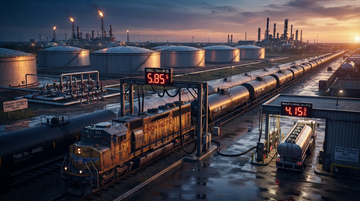
Three weeks after the White House announced what it called the \"biggest oil deal in world history,\" the deal's central consumer promise is failing its first real-world test. On Sept. 4, the AAA national average for diesel reached $5.85 a gallon—an all-time high, up roughly 58% from $3.71 a year earlier—while regular gasoline sat at $4.15. The U.S. average for jet fuel hovered near $4.16 a gallon, up more than 87% since the Iran war began on Feb. 28. None of that has anything to do with Venezuela. All of it has to do with a Strait of Hormuz crisis that briefly knocked 10.1 million barrels a day out of the global oil supply, and a refining sector that is now pricing scarcity into every gallon.
U.S. diesel (Sept. 4, 2026)
$5.85/gal
AAA national average; record high, up ~58% YoY from $3.71
U.S. regular gasoline (Sept. 7, 2026)
$4.15/gal
AAA national average; up ~30% YoY
Jet fuel (Sept. 2, 2026)
$4.16/gal
Argus US Jet Fuel Index; up 87% since Feb. 28
Venezuela total output (July 2026)
1.12M bpd
OPEC secondary-source estimate; ~1% of global supply
Chevron Venezuela output (target)
~600,000 bpd
Within 5 years, vs. ~280,000 bpd today
Pentagon equity in NABEP
35%
Via Office of Strategic Capital; 20% off-take at cost + first refusal on remaining 80%
The Deal: 100 Years, 65 Billion Barrels, and a Pentagon Equity Stake
The agreement, signed Sept. 2 in Caracas by Secretary of State Marco Rubio and Secretary of War Pete Hegseth, grants a new private Venezuelan vehicle—North American Blue Energy Partners (NABEP), owned by Venezuelan businessman Alejandro Betancourt—100-year operating rights to 17 oil fields holding roughly 65 billion barrels of proven reserves. The Pentagon's Office of Strategic Capital takes a 35% equity stake in NABEP's corporate parent, the State Department gets the right to purchase 20% of all output at production cost and first refusal on the remaining 80%, and the U.S. government holds veto power over board appointments. NABEP has committed up to $100 billion in new infrastructure investment and the deal projects more than $200 billion in royalties and taxes over 25 years.
Three weeks in, the deal is real—but the central sales pitch to American consumers is collapsing. President Trump repeatedly told voters the deal would \"substantially lower\" gas prices \"long into the future.\" Yet on Sept. 4, with the deal already public and field-level negotiations underway, diesel hit a fresh record and gasoline lingered near a Labor Day peak. The disconnect isn't spin; it's the timeline. Chevron, the only major U.S. oil company currently producing in Venezuela, said Sept. 2 it will spend more than $7 billion to double its Venezuela output to roughly 600,000 barrels a day—but not for five years. Even that modest increment is being absorbed by a global market missing 10 million barrels a day of supply.
Why the Gas Pump Doesn't Care Yet: Three Structural Bottlenecks
Three layers separate the announcement from the pump. First, Venezuela isn't producing enough to matter at the margin. OPEC's secondary-source data put July 2026 output at roughly 1.12 million barrels a day—about 1% of global supply—after years of sanctions, mismanagement and capital flight. The Council on Foreign Relations estimates that simply repairing and modernizing Venezuela's dilapidated infrastructure would cost $10–$20 billion, and bringing new fields online would require at least $100 billion in fresh capital over more than a decade. Rystad Energy says meaningful production from existing fields is unlikely before the mid-2030s.
Second, even if barrels arrived tomorrow, U.S. refining capacity is constrained. Venezuelan crude is extra-heavy and sulfur-laden, requiring specialized high-complexity coking refineries—exactly the kind of asset the Gulf Coast is built around. Valero, the most Venezuelan-friendly U.S. refiner, said on its Q2 call that roughly 5 million barrels a day of global refining capacity is currently offline and light-product inventories sit about 130 million barrels below normal. There is no slack to absorb a meaningful new heavy stream today.
Third, the deal unwinds a parallel oil economy that has been quietly discounting Venezuelan crude into Chinese teapot refineries for years. More than half of Venezuela's 768,000-barrel-a-day export flow was going to China through ship-to-ship transfers, rebranding and spoofed tanker signals. With U.S. policy now declaring that \"all Venezuelan oil will flow through legitimate and authorized channels,\" that discount channel narrows—pushing effective global crude prices higher, not lower. China also carries an estimated $10–$12 billion in outstanding oil-repayment debt with Caracas (part of a broader $150–$200 billion debt stack), and roughly 82 million barrels of stored crude off China and Malaysia that may cushion but cannot replace active flows.
- Venezuela is producing ~1.12M bpd today vs. U.S. consumption of ~20M bpd—a structural mismatch that no single deal can close before 2030.
- Roughly 5M bpd of global refining capacity is offline, and Venezuelan crude needs the coking capacity the Gulf Coast already runs near full out.
- The deal removes the discounted China channel that had suppressed Venezuelan crude prices for years—lifting the global benchmark in the near term.
- A 100-year concession outlasts multiple U.S. administrations, creating enforceability risk that lenders are unlikely to ignore.
Who Wins Right Now: Refiners Are Pocketing the Spread
While consumers wait for Venezuelan barrels, U.S. refiners are printing money. The 3-2-1 crack spread—a benchmark for refinery margins that converts three barrels of crude into two of gasoline and one of diesel—has blown out to roughly $59 a barrel, with diesel crack spreads reaching $93.84 per barrel in early August, a record. The Q2 2026 earnings cycle told the story directly: Marathon Petroleum, Valero and Phillips 66 collectively earned $12.6 billion in a single quarter, quadruple their year-ago profit, and their shares each gained more than 80% year-to-date against an 11% S&P 500.
| Company | Q2 2026 R&M margin ($/bbl) | Q2 2025 R&M margin ($/bbl) | Q2 2026 reported earnings |
|---|---|---|---|
| Marathon Petroleum (MPC) | $36.33 | $17.58 | $5.14B net income |
| Phillips 66 (PSX) | $24.08 | ~$10.11 | $3.8B |
| Valero (VLO) | Record margins | Strong YoY gains | Multi-billion (Q2 print) |
Marathon's regional breakdown is the cleanest illustration of why this matters. Its Gulf Coast segment earned $36.52 a barrel in Q2 on 1.335 million barrels a day of throughput, while its West Coast segment cleared $41.28 a barrel—numbers that simply did not exist before the Strait of Hormuz crisis. Halliburton, the oilfield services company already in talks with Caracas to support the Venezuelan expansion, is positioned to capture the next leg as drilling activity picks up.
Who Loses: Airlines Are Eating a $6 Billion Fuel Bill
On the downstream side, airlines are absorbing the cost. United Airlines said in late August it expects to pay roughly $6 billion more for fuel in 2026 than it did in 2025—a more than 50% jump—with full-year EPS guidance of just $9 to $11 a share even after factoring in fare increases. American Airlines forecast an almost identical $6 billion fuel-cost increase, withdrawn guidance entirely, and guided to a third-quarter fuel cost of $3.75 per gallon at a time when spot jet fuel is closer to $4.16. Southwest Airlines and Alaska Airlines have both pulled or revised 2026 outlooks lower as well.
Delta Air Lines is the structural outlier: roughly 80% hedged on jet fuel for fiscal 2026 at prices far below spot, which has protected near-term margins even as competitors have warned. That hedge ratio is the gap between Delta and the rest of the field, and it explains why Delta has held up while UAL and AAL sold off sharply in August. Transcontinental U.S. airfares have already roughly doubled—from $167 to $414 on average for a transatlantic, transcontinental-style ticket—since the Iran war began, and the airlines are explicitly warning that higher fares will persist into 2027.
The Geopolitical Quid Pro Quo: China, OPEC, and the Iran War Backdrop
Three structural drivers explain why the announcement coincided with record prices rather than relief. The first is the Iran war itself. The U.S.–Israeli conflict that began Feb. 28 closed the Strait of Hormuz for roughly six weeks, knocked 10.1 million barrels a day out of the global market in March, and pushed WTI to an April peak of $114.58 a barrel. Even with the ceasefire periodically fraying, light-product inventories remain about 130 million barrels below normal, and oil prices have rebounded to five-week highs on renewed disruption fears—settling up more than $4 on Sept. 1 alone.
The second is China. For more than half a decade, Chinese teapot refineries quietly absorbed the bulk of sanctioned Venezuelan crude, paid through a network of shadow-fleet ship-to-ship transfers and rebranding schemes, and effectively subsidized Venezuelan production. The Trump administration's stated policy is now that \"all Venezuelan oil will flow through legitimate and authorized channels\"—a posture that ends the discount trade. The result is that the marginal Venezuelan barrel now sells at a global benchmark rather than a China-discounted price, which lifts the average price refiners pay even before any new production is added.
Third, Venezuela is reportedly weighing whether to leave OPEC. Trump publicly framed the decision as up to Caracas, but the strategic logic is clear: OPEC's quotas have capped Venezuela's ability to monetize its reserves at full market prices for years. A withdrawal would free Venezuela to produce and export more aggressively under the new U.S. framework—but the same infrastructure, capital and refining constraints that limit the deal today still apply.
What Moves First—and What Doesn't
Short-term (days to quarters): Crack spreads and refiner earnings remain the cleanest expression of the gap. As long as the Strait of Hormuz remains unstable and global refining capacity is short, Marathon Petroleum, Valero, Phillips 66 and HF Sinclair continue to benefit from elevated margins, and any meaningful pullback in crude prices without a corresponding drop in product prices will widen those margins further. Airlines without 2026 hedges—American Airlines, United Airlines, Southwest Airlines—remain exposed to jet fuel near $4.16 a gallon, and fuel surcharges will keep showing up in ticket prices.
Long-term (one to three years): The Venezuela deal's real payoff, if it arrives, sits in 2027–2030 and beyond. Chevron's $7 billion program to double its Venezuelan output to ~600,000 barrels a day is a five-year build. NABEP's $100 billion infrastructure plan is a 25-year royalty story, not a pump-price story. The 35% Pentagon equity and the 100-year concession structure also create enforceability risk that capital markets will price in—particularly with a U.S. presidential election looming in 2028 and the deal structured to outlast it. The investors most exposed to the deal's downside—legal, political, or financial—are the ones who lend against it, not the ones who fill up today.
The honest read: the deal is a strategic asset for the U.S. position in global energy and a long-term option on Venezuelan output. It is not, and was never going to be, a fix for a $5.85 diesel pump. That record is being set by a war in Iran, a closed strait, and a refining sector running out of slack—and none of those will resolve in the next three weeks.
Where the Trade Actually Lives
- Sept. 2 plan to invest $7B in Venezuela lifts long-dated Venezuelan output to ~600,000 bpd, up from ~280,000 bpd today—adding reserve life at sub-$20/bbl lifting cost.
- Doubling Venezuelan production hedges Gulf Coast refining demand for heavy crude, where Valero and Marathon need every heavy barrel they can secure.
- Refining margins of $36+/bbl at Marathon and record cracks across the industry push integrated earnings even without Venezuela upside—Venezuela is upside on top.
- Q2 2026 R&M margin hit $36.33/bbl vs. $17.58/bbl a year earlier—more than doubled, with West Coast at $41.28/bbl.
- Highest near-term beneficiary of tight U.S. refining capacity: ~5M bpd of global refining offline and 130M bbl of light-product inventories below normal.
- Venezuela deal does not change crack spreads in 2026, but heavy crude flowing through Gulf Coast in 2027+ would extend margin tailwind into the next cycle.
- Already the leading U.S. refiner for Venezuelan heavy crude—Pascagoula imported ~40% of its heavy crude from Venezuela in 2024.
- Q2 2026 refining margins at record levels; company flagged structurally tight global product markets on its earnings call.
- Direct structural winner if/when Venezuelan flows resume—every incremental heavy barrel finds a ready coking home on the Gulf Coast.
- Q2 2026 reported earnings of $3.8B vs. $207M in Q1—refining realized margin $24.08/bbl vs. $10.11/bbl a quarter earlier.
- Combined with Marathon and Valero, the top three U.S. independent refiners cleared $12.6B in Q2, quadrupling YoY profits.
- Heavy-crude processing footprint and growth-investor positioning make PSX the highest-multiple refiner beneficiary in this cycle.
- Forecast ~$6B in additional 2026 fuel costs vs. 2025—a 50%+ jump—with Q3 fuel guided at $3.75/gal vs. $4.16 spot.
- Pulled full-year guidance entirely; transcontinental fares already ~2x pre-war levels ($167 to $414 average).
- No meaningful 2026 jet fuel hedge; pure spot exposure into a winter travel season with diesel at record highs.
- Late-August update: ~$6B extra fuel cost in 2026; full-year EPS guided to just $9–$11 despite fare increases.
- CEO Scott Kirby said the carrier expects to recover 100% of higher fuel costs in Q4 via gradual fare hikes—pushing the pain to consumers and bookings.
- Unhedged spot exposure into Q4 is the structural risk; if jet fuel ratchets higher on Strait of Hormuz headlines, UAL absorbs it directly.
- ~80% hedged on jet fuel for fiscal 2026—the best-protected U.S. carrier in this cycle and the cleanest relative winner.
- If fuel normalizes in 2027+, the hedge locks in above-market costs and weighs on next-year margins—a known structural overhang.
- Best positioned for the next 6–9 months, worst positioned for a fuel collapse that may not arrive until the Venezuela deal actually flows.
- Already in talks with NABEP and Chevron on Venezuelan field development—a multi-year, multi-billion-dollar services opportunity.
- If Venezuela is to actually hit 65B-barrel potential, U.S. service companies will be paid first—Halliburton is the most leveraged pure play.
- Long-cycle upside rather than near-term pump-price play: the deal's value to HAL is 2027+, not 2026.