
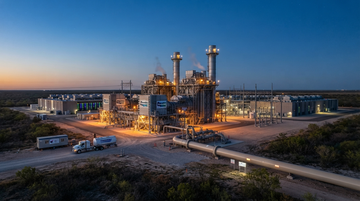
Encinal gas plant, agreed cost
$22.3B
Sept 7, 2026 Reuters/Korea Herald, up from $19.8B initial plan
Generation capacity
6.3 GW
Combined-cycle; first power targeted 2030
$350B framework's $200B strategic bucket, annual cash cap
$20B
U.S.–ROK Joint Fact Sheet, Nov 13, 2025
Tariff Korea secured in exchange
15%
Averts threatened 25% rate
Two days after Reuters reported the size of the Encinal deal, Seoul's Ministry of Trade, Industry and Energy said the figures circulating were inaccurate and that consultations continued, leaving investors to price a headline number Korea hasn't confirmed. The reason the dispute matters: a ~$5 billion jump from the July plan to the September headline absorbs roughly one-quarter of Korea's annual $20 billion cash cap under the broader framework — and the U.S. side, not Korea, drove the upward revision. What follows is what the sources actually establish, not just what the first wire moved.
Encinal Was Supposed to Be a $19.8B Plant — Now It's $22.3B and Seoul Is Pushing Back
On July 28, Korean outlets reported Seoul was nearing a decision to back a $19.8 billion, 6.4 GW combined-cycle plant at Encinal, Texas, structured as an equity stake in a special-purpose vehicle funded through the Korea–U.S. strategic investment fund. Reuters and the Korea Herald reported on September 7 that the parties had agreed on a ~$22.3 billion, 6.3 GW version — a ~25% cost increase that, as Chosun and KED Global had reported in late August, the Trump administration had unilaterally pushed for.
| Reporting date | Stated cost | Capacity | Source |
|---|---|---|---|
| Jul 28, 2026 | $19.8B | 6.4 GW | Korea JoongAng Daily |
| Aug 28, 2026 | $19.8B → +25% | 6.4 GW | KED Global on U.S. demand |
| Sept 7, 2026 | $22.3B | 6.3 GW | Yahoo/Reuters; Korea Herald |
| Sept 7, 2026 | \"Inaccurate\" | — | Korea MOTIE spokesperson, per Yahoo |
The dispute isn't just number-juggling. If the $22.3B figure sticks, Encinal alone consumes more than one year's worth of Seoul's $20B annual cash-investment allowance under the Joint Fact Sheet — meaning Korea's other strategic-sector promises (chip fabs, batteries, biotech) get pushed right in the funding queue. That is why the Korea Herald explicitly notes the equity stake in the SPV is still under discussion: the financing stack, not the megawatt number, is the actual sticking point.
The $350B Trade Deal Was Built to Avoid a 25% Tariff, Not to Power Korean Fabs
Encinal is the first concrete deployment of a framework that started as a tariff-escape hatch. In July 2025, the Trump administration threatened a 25% tariff on Korean autos and goods; Seoul responded with a $350 billion investment pledge. The Nov. 13, 2025 Joint Fact Sheet formalised it as $150 billion for U.S. shipbuilding plus $200 billion for strategic sectors, with Korea's parliament passing an implementing bill in March 2026 and the cabinet approving the implementing decree in June 2026.
- Korea's tariff landed at 15%, an effective discount versus the threatened 25%, per KEIA.
- Of the $350B total, $100B is set aside for U.S. LNG and energy purchases, per Reuters/Yahoo.
- The strategic-sector $200B is backloaded — capped at $20B per year in cash, with the framework running through January 2029.
- Samsung Electronics' $17B Taylor, Texas fab sits outside the $350B framework as a separate corporate commitment.
This Plant Doesn't Power SK Hynix' Fab — It Powers Texas AI Data Centers
The most important nuance in the Encinal story is what it actually powers. Per the Korea Herald, a data center complex with up to 5 GW of load is planned nearby, and the plant is structured to back that with decade-long PPAs — not to feed SK Hynix's $3.87 billion HBM advanced-packaging facility in West Lafayette, Indiana. The Indiana fab broke ground in late August and targets H2 2029 mass production, with Air Liquide supplying the on-site industrial gases. The two projects are running in parallel, not in series.
The chip-fab piece of the brief's framing was, in fact, explicitly carved out: KED Global reports that the \"proposed chip fab investment was excluded\" from this first announcement. So the trade flow is not Korean capital → US gas → Korean fabs. It is Korean capital → US gas → Texas data centers, with Korean fabs sitting on a parallel track funded by direct SK Hynix and Samsung Electronics corporate balance sheets.
Why this matters for the gas plant: ERCOT, the Texas grid operator, halted new data-center connections in early September, citing more than 700 GW of pending large-load requests — roughly five times the system's all-time record. Encinal is being positioned as a behind-the-meter solution for AI campuses that can't wait for the grid, which is the entire reason a Korean-financed plant in Texas can command a 25% premium in the first place.
The Trade Flow Has Three Stages and Four Listed Winners
If you trace Korean capital from Seoul to a Texan electron, the chain runs through three distinct layers, each with its own listed beneficiary. Stage one is gas supply, where US LNG producers are the natural counterparties to Korea's $100B energy purchase pledge. Stage two is power equipment, where Korean EPC contractors are now winning U.S. combined-cycle work at scale. Stage three is data-center power off-take, where the actual revenue PPA structure lives.
| Stage | Listed beneficiary | Recent data point | Source |
|---|---|---|---|
| LNG supply | Cheniere Energy | Q2 2026 net income $3.07B, vs $1.63B a year earlier | Cheniere 10-Q |
| LNG supply | Energy Transfer | 18-yr SPA with SK Gas, first cargoes 2026, Lake Charles | Energy Transfer |
| Power equipment | Doosan Enerbility | Seven 380-MW gas turbines for U.S. delivery from May 2029 | Turbomachinery Magazine |
| Memory (parallel) | SK Hynix | Q2 2026 revenue ₩79.3T, TTM ROE ~100% | SK Hynix Q2 2026 income statement |
Cheniere Energy is the most directly tied beneficiary among U.S. listed names: it has roughly 1.2 mtpa of contracted Korean offtake —0.4 mtpa with KOSPO, 0.4 mtpa with POSCO International, and an SK Group SPA of similar size signed in 2022. With Encinal adding6.3 GW of incremental U.S. gas demand, Korean utilities will likely need to top up their Henry Hub–linked LNG books, which routes margin straight to Cheniere's liquefaction fees.
On the memory side, SK Hynix and Samsung Electronics are riding a parallel wave of HBM-driven profits that the Encinal deal doesn't directly fund but absolutely enables. SK Hynix's TTM revenue reached ₩189.2 trillion with operating margin north of 60% — the kind of cash generation that lets the parent underwrite both the Indiana fab and the SPV equity for Encinal simultaneously. The two stories are operationally separate; they are financially inseparable at the SK Group level.
Two Horizons: A 2030 First-Power Date vs. A Decade of Industrial-Policy Rotation
Q2 2026 net income across the trade-flow beneficiaries
Korean memory names ride HBM; U.S. LNG names ride Korea-bound cargo volumes; Korean EPC rides U.S. gas-turbine orders.
Unit: Local currency, billions
Samsung Electronics (₩T, Q2 2026)
71.6
SK Hynix (₩T, Q2 2026)
93.9
Doosan Enerbility (₩B, Q2 2026)
157.6
Cheniere Energy ($M, Q2 2026)
3,068
Energy Transfer ($M, Q2 2026)
2,088
KKR ($M, Q2 2026)
700.5
Short-term, three numbers move first: the Korean cabinet's final Encinal cost confirmation (which the Industry Ministry is still contesting), the EPC award for the gas turbines and steam turbines (where Doosan Enerbility is the front-runner), and any incremental Korean-tied LNG SPA announcements from Cheniere Energy and Energy Transfer. If the $22.3B figure sticks, Doosan Enerbility is the cleanest single-name play: a $5B-plus EPC delta would lift its order book materially above the19-unit gas-turbine backlog it exited2025 with.
Long-term, the more interesting question is what the second project under the $350B framework looks like — the first one explicitly excluded chip fabs. If the U.S. pushes Korea toward a second gas-plant project on similar terms, the gas-turbine and EPC pipeline doubles. If Korea redirects remaining capacity toward SK Hynix's Indiana or Samsung Electronics's Taylor, the framework pivots back to chips. That second-project decision, expected through2027, is the milestone investors should mark.
Investable names in the Korean capital → Texas electron flow
- Q2 2026 net income of ₩93.9T leaves the parent more than able to fund both the Indiana fab and the Encinal SPV equity simultaneously.
- TTM operating margin above 60% means HBM cash flow, not Encinal gas demand, is the immediate earnings driver — but the $350B frame keeps the Indiana fab de-risked against tariff risk.
- Risk: if Korea's cabinet cuts Encinal back below $20B to free cash for fabs, SK Hynix's parallel-track fab funding window widens.
- Returns to profitability in Q2 2026 with ₩157.6B net income after four straight loss quarters, putting the balance sheet back in position to chase mega-EPC bids.
- Already won seven 380-MW U.S. gas turbines for May 2029 delivery — exactly the equipment that anchors a 6.3 GW combined-cycle plant.
- Backlog is the leading indicator: each $1B of Encinal EPC adds roughly ₩80-100B of incremental annual revenue at Doosan's current mix.
- Q2 2026 net income jumped to ₩71.6T from ₩4.9T a year earlier, putting the HBM-driven earnings cycle at full scale.
- The $17B Taylor, Texas fab sits outside the $350B framework — meaning Samsung's U.S. capacity expansion isn't competing with Encinal for the same cash envelope.
- If the next $350B project pivots back to chips, Samsung is the second-largest Korean beneficiary after SK Hynix.
- Already holds roughly 1.2 mtpa of contracted Korean offtake across KOSPO, POSCO International and SK Group SPAs.
- Q2 2026 net income of $3.07B — up 87% year-over-year — confirms the liquefaction-fee economics scale with any incremental Korean demand.
- Watch for a follow-on Korean SPA once Encinal's final cost is confirmed; KOSPO's 0.4 mtpa SPA runs through 2046, so any top-up would be net-new offtake.
- Has the only existing 18-year SK Gas SPA anchored at Lake Charles LNG, with first cargoes slated for 2026 — direct exposure to the Korean offtake thesis.
- Q2 2026 revenue of $34.3B was72% higher year-over-year, but net income of $2.09B reflects the heavier leverage of a midstream MLP versus Cheniere's pure liquefaction play.
- Mixed: ET wins on volume growth from Korean gas demand but absorbs more of the construction-cost inflation risk on its LNG project pipeline.
- Parent of SK E&S (LNG trading) and SK Energy, both of which sit inside the Korean offtake chain — but SK Innovation's TTM income is still negative on consolidated battery losses.
- Watch catalyst: any formal SK E&S role in the Encinal gas-to-power SPV would revalue the LNG trading arm.
- Risk: continued battery-segment losses could distract from the energy-trading upside from Encinal offtake.
- Infrastructure platform is the most likely U.S. private capital partner for the Encinal SPV alongside Korean state capital.
- Q2 2026 net income of $700M reflects the firm's broader infra and credit cycle, not Encinal specifically.
- Watch: KKR's infrastructure fund vintages close in 2026-27; an Encinal anchor commitment would be the cleanest single signal of U.S. private capital crowding into the Korean deal.