%22%2F%3E%0A%20%20%3Ccircle%20cx%3D%22220%22%20cy%3D%22150%22%20r%3D%22180%22%20fill%3D%22%2322d3ee%22%20fill-opacity%3D%220.12%22%2F%3E%0A%20%20%3Ccircle%20cx%3D%221010%22%20cy%3D%22130%22%20r%3D%22220%22%20fill%3D%22%2338bdf8%22%20fill-opacity%3D%220.08%22%2F%3E%0A%20%20%3Ccircle%20cx%3D%22920%22%20cy%3D%22520%22%20r%3D%22170%22%20fill%3D%22%2322d3ee%22%20fill-opacity%3D%220.06%22%2F%3E%0A%20%20%3Cpath%20d%3D%22M140%20430h920%22%20stroke%3D%22url(%23line)%22%20stroke-width%3D%2212%22%20stroke-linecap%3D%22round%22%2F%3E%0A%20%20%3Cpath%20d%3D%22M220%20360c120-150%20260-220%20380-220s260%2070%20380%20220%22%20fill%3D%22none%22%20stroke%3D%22%2367e8f9%22%20stroke-opacity%3D%220.5%22%20stroke-width%3D%2216%22%20stroke-linecap%3D%22round%22%20stroke-linejoin%3D%22round%22%2F%3E%0A%20%20%3Cpath%20d%3D%22M300%20398h600%22%20stroke%3D%22%2394a3b8%22%20stroke-opacity%3D%220.24%22%20stroke-width%3D%228%22%20stroke-linecap%3D%22round%22%2F%3E%0A%20%20%3Ctext%20x%3D%22220%22%20y%3D%22510%22%20fill%3D%22%23e2e8f0%22%20fill-opacity%3D%220.7%22%20font-family%3D%22Arial%2C%20Helvetica%2C%20sans-serif%22%20font-size%3D%2238%22%20letter-spacing%3D%228%22%3EINSIGHTS%3C%2Ftext%3E%0A%3C%2Fsvg%3E)
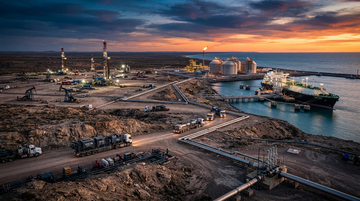
Event: a marquee outsider steps into Argentina’s Vaca Muerta
Thiel’s 1% stake is not about controlling Vista—it’s about backing the export unlock logic
On Aug. 15, 2026, Reuters reported that Peter Thiel’s hedge fund Thiel Macro LLC (via SEC disclosure cited by Reuters) bought about a 1% stake in Vista Energy, described as roughly 1.2 million American depositary shares for about $76 million. The market signal isn’t “market power.” It’s conviction that Argentina’s shale rules are finally financeable—the kind of conviction that matters when long-cycle LNG infrastructure is the endgame.
What’s verified from the disclosures reported publicly
Issuer named in coverage
[Vista Energy](vist)
Coverage identifies Vista as the company tied to Vaca Muerta shale.
Stake size reported
≈ 1% of Vista’s capital
Stated as 1% in Reuters-reported coverage.
Scale of position
≈ 1.2 million ADS
ADS count stated in contemporaneous reporting.
Implied value in reporting
≈ $76 million
Value cited in reporting tied to the SEC filing.
Mechanism: why a small % matters in long-cycle shale
In unconventional, the first “seal of approval” is often regulatory—export access is the real asset
A 1% stake rarely changes governance in US-style E&Ps. In Argentina-style projects, the decisive question is different: can investors underwrite a path from drillpad economics to export-grade volumes on financeable terms?
That’s why a mainstream billionaire endorsing Vista (Vaca Muerta’s most visible public vehicle) is best read as support for the transition from “resource story” to “deliverability story.” Vista’s own public financials show the capital intensity investors must underwrite: FY2025 revenue of $2.47B and net income of $719M, but free cash flow turning negative while capex ramps (see fundamentals blocks below).
Vista FY2025 revenue
$2.47B
FY2025 financials, filed Apr. 28, 2026
Vista FY2025 net income
$719.1M
FY2025 financials, filed Apr. 28, 2026
Vista FY2025 free cash flow
-$821.6M
FY2025 cash flow statement, filed Apr. 28, 2026
Supply chain: what the Vaca Muerta “bet” transmits through the system
If Vaca Muerta is the next shale battleground, the US supply chain doesn’t just sell pumps—it sells LNG confidence
- Upstream drilling-services demand tends to follow “how fast can you scale,” so marginal rigs/completion capacity is the first choke point in new shale areas.
- Midstream bottlenecks determine whether gas can be monetized; the export path can convert “barrels in the ground” into “contracts you can finance.”
- Export facilities (and their supporting logistics) create the financing calendar; that timeline—rather than commodity prices—drives which E&Ps win.
Investor relevance: where the thesis hits US listed E&Ps
US E&Ps should model a new “marginal barrel” customer: global LNG balancing through the late 2020s
The headline story is “Argentina got a Thiel vote.” The investable implication is subtler: global gas markets care less about reserve size and more about marginal supply that can reach LNG or displace LNG-linked demand.
That matters for US E&Ps because they compete in the same global equilibrium, even when their operating footprint is thousands of miles away. If Vaca Muerta’s ramp is real, the swing factor becomes how quickly Argentina can produce exportable gas and how much incremental demand is absorbed by non-US supply.
Vista’s ramp requires capex even when profits are positive—free cash flow stays pressured
FY2023–FY2025 cash flow: operating cash flow positive, but capex drives negative free cash flow in FY2025.
Unit: USD
FY2023 free cash flow
Positive but small vs. revenue scale.
16,303,000
FY2024 free cash flow
Turned negative as investment accelerated.
-104,832,000
FY2025 free cash flow
Capex intensity peaked in the latest fiscal year.
-821,617,790
Fundamentals cross-check: Vista’s financial trajectory is consistent with a scale-up phase
Vista’s latest fundamentals support the “build now, monetize later” profile—exactly what LNG-linked shale requires
Financially, Vista Energy looks like a company financing a step-change rather than harvesting a mature play. FY2025 shows revenue rising to $2.47B (from $1.65B in FY2024) while capex remains heavy, depressing free cash flow to -$821.6M. Net debt also expands in FY2025 (net debt $2.77B at Dec. 31, 2025), matching a capital-transition story investors must underwrite.
| Fiscal year | Revenue | Net income | Net cash from operating | Capex | Free cash flow |
|---|---|---|---|---|---|
| FY2023 | $1.17B | $397.0M | $712.0M | $-688.4M | $16.3M |
| FY2024 | $1.65B | $477.5M | $959.0M | $-1.06B | $-104.8M |
| FY2025 | $2.47B | $719.1M | $638.5M | $-1.47B | $-821.6M |
Horizons: what moves first vs. what matters later
Short-term: sentiment and access to capital. Long-term: gas-to-export infrastructure that changes the global balance
- In the next few quarters, expect capital-market perceptions to dominate: can Vista sustain funding and execution while free cash flow remains negative?
- Over 1–3 years, the critical check is whether Argentina’s gas can clear infrastructure constraints fast enough to matter against other LNG supply ramps.
Bottom line thesis: Thiel’s stake makes Vaca Muerta investors’ default “next shale” scenario—so US gas-linked exposure must be re-rated to reflect a non-US marginal ramp
Thiel’s 1% stake in Vista Energy is a small disclosure, but it’s a big framing move: it signals that Vaca Muerta may be on the path from potential to deliverability, which is what global LNG markets actually price. For US E&Ps, the right adjustment isn’t “Argentina replaces the Permian.” It’s Argentina may compete for LNG-linked marginal demand on a similar multi-year schedule.
The near-term trade is mostly sentiment and capital allocation. The long-term trade is infrastructure: the winner is the supply chain that turns unconventional gas into exportable volumes on time.
A 1% filing stake is rarely control; in long-cycle energy, it often functions like a milestone endorsement—backing the path from regulations to exportable molecules.
Listed-market takeaways (how this Argentina shale signal transmits into investor positioning)
- The Thiel-reported stake suggests market validation while Vista funds a capex-heavy ramp (FY2025 capex $1.47B; FY2025 free cash flow -$821.6M).
- If export progress accelerates, revenue scaling can outpace cash burn; Vista’s revenue rose to $2.47B in FY2025 (from $1.65B in FY2024).
- In the next 1–2 quarters, focus on whether operating cash flow stabilizes before further capex increases net debt.
- If Argentina gas turns into incremental LNG earlier than expected, it can tighten future non-US LNG pricing leverage, pressuring spot and contract economics.
- Near-term exposure is sentiment: however, Cheniere’s valuation is more contract-anchored than marginal-barrel-driven.
- Over 1–3 years, the key risk is whether new LNG supply includes a meaningful Vaca Muerta tranche on competitive timelines.
- Global gas competition can increase throughput volatility, but it can also support utilization in pipelines and related midstream tied to volumes moving to LNG.
- If Argentina ramps gas flows, it can raise global demand for midstream bottleneck relief and logistics capacity.
- A credible Vaca Muerta export ramp increases the supply set competing globally, which can cap upside for gas-linked projects priced on scarcer marginal supply.
- Conversely, large integrated players can reallocate capital toward higher-return LNG and upstream basins if competitiveness shifts.