%22%2F%3E%0A%20%20%3Ccircle%20cx%3D%22220%22%20cy%3D%22150%22%20r%3D%22180%22%20fill%3D%22%2322d3ee%22%20fill-opacity%3D%220.12%22%2F%3E%0A%20%20%3Ccircle%20cx%3D%221010%22%20cy%3D%22130%22%20r%3D%22220%22%20fill%3D%22%2338bdf8%22%20fill-opacity%3D%220.08%22%2F%3E%0A%20%20%3Ccircle%20cx%3D%22920%22%20cy%3D%22520%22%20r%3D%22170%22%20fill%3D%22%2322d3ee%22%20fill-opacity%3D%220.06%22%2F%3E%0A%20%20%3Cpath%20d%3D%22M140%20430h920%22%20stroke%3D%22url(%23line)%22%20stroke-width%3D%2212%22%20stroke-linecap%3D%22round%22%2F%3E%0A%20%20%3Cpath%20d%3D%22M220%20360c120-150%20260-220%20380-220s260%2070%20380%20220%22%20fill%3D%22none%22%20stroke%3D%22%2367e8f9%22%20stroke-opacity%3D%220.5%22%20stroke-width%3D%2216%22%20stroke-linecap%3D%22round%22%20stroke-linejoin%3D%22round%22%2F%3E%0A%20%20%3Cpath%20d%3D%22M300%20398h600%22%20stroke%3D%22%2394a3b8%22%20stroke-opacity%3D%220.24%22%20stroke-width%3D%228%22%20stroke-linecap%3D%22round%22%2F%3E%0A%20%20%3Ctext%20x%3D%22220%22%20y%3D%22510%22%20fill%3D%22%23e2e8f0%22%20fill-opacity%3D%220.7%22%20font-family%3D%22Arial%2C%20Helvetica%2C%20sans-serif%22%20font-size%3D%2238%22%20letter-spacing%3D%228%22%3EINSIGHTS%3C%2Ftext%3E%0A%3C%2Fsvg%3E)
Verified federal directive reshapes grid-security spending timelines
What changed: grid security moved from risk-management to equipment-level emergency authority
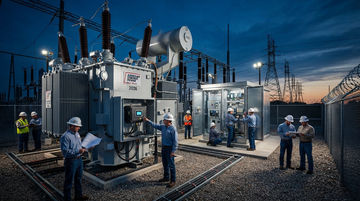
The executive pivot is straightforward: the order declares a national emergency because certain foreign-produced bulk-power system electric equipment could enable sabotage, unauthorized access, or other disruptions. That turns “grid security” into something regulators and buyers can enforce through procurement controls and mitigation conditions, rather than relying on voluntary best practices.
Load-bearing definitions inside EO 14420 (how the order narrows the spend)
Scope of the grid
Interconnected transmission/control systems needed for reliability (not local distribution).
Scope of equipment
Bulk-power substation/control-room items and critical control/digital elements (e.g., transformers, circuit breakers, protective relaying, instrument transformers, industrial control/IEDs, UPS for critical infrastructure).
Trigger for restrictions
Transactions involving foreign-produced equipment (including associated critical software/digital capabilities/services) where DOE determines the risk is undue or unacceptable.
What DOE can do even after purchase
Impose conditions on continued use/operation/maintenance/updating, including identification, isolation, monitoring, disconnection, replacement, or removal—phased if needed.
Policy mechanics translate into a pay-first supply chain
Who gets paid first: the compliance stack shifts dollars toward vendors that can deliver replacements, isolation, and secure integration fast
- Utilities and system operators face a new gating question on procurement and lifecycle services: whether foreign-produced equipment (and its critical digital dependencies) can be kept, isolated, or must be replaced.
- Once DOE identifies covered equipment, near-term work tends to split into (1) asset identification/inventory, (2) isolation/monitoring, (3) secure replacement—each typically favors firms that already sell replacement-ready hardware and OT-capable integration.
- Vendors that can provide both the physical “bulk-power substation” components and the secure digital/OT layer are positioned to win follow-on installation, commissioning, and lifecycle service contracts.
This is the “order book” effect: procurement restrictions apply to transactions after the order date, and mitigation can apply to already-installed foreign-produced assets. That means cash flow tends to shift before long-term fleet-wide capex cycles complete—creating a nearer-term book for (a) replacement equipment suppliers and (b) OT security tooling/integration services that utilities use to comply with isolation/monitoring/secure operation requirements.
Causal chain investors can underwrite with numbers
Why this is more than cyber spending: the order is written as a supply-chain risk rule, not an AI capex rule
The key difference versus most grid-security narratives is enforcement granularity. EO 14420 doesn’t just say “improve cybersecurity”; it ties restrictions and mitigation to foreign-produced bulk-power equipment and associated critical software/digital capabilities where DOE determines sabotage/subversion or unauthorized remote action risks. That framing changes buyer behavior from “strategic roadmap” to “compliance decisions” with deadlines.
| Milestone (from Aug. 26, 2026) | Agency action named in the order | What buyers can start doing right after |
|---|---|---|
| Within 120 days | Publish implementing rules/regulations | Utilities/integrators align procurement workflows to the new covered-equipment determinations |
| Within 180 days | Develop recommended Federal Acquisition Regulation (FAR) revisions | Federal procurement tends to prioritize U.S.-manufactured energy infrastructure in bids |
| Within 90 days after FAR recommendations | FAR Council considers amendments for notice/public comment | Procurement language for suppliers becomes more standardized—shortening deal cycles |
Market translation using listed-company fundamentals
What this likely does to margins and revenue timing (based on business models)
The order’s mix of hardware replacement/secure lifecycle services and OT cybersecurity tooling tends to favor revenue models with (1) recurring software or services attached to installed base and (2) proven ability to deliver complex OT-security deployment. To ground that, the article uses audited financial statements for several listed players in adjacent stacks: a focused OT/network security vendor (Palo Alto Networks), an OT/industrial automation vendor (Rockwell Automation), and a diversified industrial/automation integrator (Eaton). Their recent income-statement trends show that these businesses can scale revenue without collapsing gross profit in the period observed.
Palo Alto Networks revenue
$27.45B
FY2025 revenue, filed Feb. 26, 2026.
Rockwell Automation revenue
$8.34B
FY2025 revenue, filed Nov. 12, 2025.
Rockwell Automation operating income
$1.43B
FY2025 operating income, filed Nov. 12, 2025.
Eaton revenue
$9.22B
FY2025 revenue, filed Aug. 29, 2025.
Important limitation: the EO does not name specific vendors, and it does not guarantee an immediate allocation of contracts. So any “winners” argument must be mechanism-based (what types of capability get called) and timeline-based (what implementation deadlines pull work forward), not headline-driven.
Investor take: strategy for reading the next 6–18 months
The playbook: monitor DOE/FAR implementation signals, then track which vendors have the shortest path from compliance to deployed systems
- Near term (days–quarters): watch for implementing rules and any pre-qualification or vendor-recognition approach; buyers will likely ask integrators to show they can meet mitigation conditions quickly.
- Near term (days–quarters): expect OT-cyber deployments to be bundled with compliance work (segmentation, visibility, access control, remote-action risk reduction) because DOE’s scope includes associated critical software/digital capabilities.
- Long term (1–3 years): if FAR procurement revisions operationalize “U.S.-manufactured energy infrastructure” prioritization, supply-chain footprints may shift from qualification work into recurring replacement/service cycles.
Listed market takeaways that map to EO 14420’s compliance stack
- OT/network security demand should rise with compliance-driven visibility and access controls as buyers implement monitoring/isolation around covered equipment.
- FY2025 revenue of $27.45B suggests software/service scale that can absorb incremental grid OT budgets without relying on a single hardware cycle.
- If DOE implementation pulls forward OT deployments within 120–180 days, quarterly bookings can re-rate before wholesale grid build-out completes.
- EO 14420 covers industrial control/IED-style assets, so automation and control security layers can benefit from replacement plus secure commissioning workflows.
- FY2025 revenue of $8.34B and operating income of $1.43B show operating leverage that can translate incremental project work if demand concentrates in compliance windows.
- Within quarters, buyers typically need fast integration for isolation/monitoring, a pattern that tends to favor deployment-capable automation vendors.
- If the rule accelerates substation and protection-related replacements, Eaton can gain from higher call-off rates in electrical systems as utilities comply with mitigation conditions.
- Eaton FY2025 revenue of $9.22B indicates scale, but the direction is mixed because capacity and delivery constraints can delay margins until replacement schedules normalize.
- Over 1–3 years, FAR-driven procurement language could shift qualifying supply toward vendors with compliant footprints, but it may also pressure pricing during qualification waves.
- If covered foreign-produced equipment triggers replacement demand, Siemens’ grid-adjacent portfolio could see demand pull-forward for substations and controls.
- The effect is mixed because EO 14420’s risk determination is equipment/vendor-specific, so upsides depend on how DOE classifies Siemens-produced components under the covered-entity logic.
- In 6–18 months, the key watch item is whether DOE adopts vendor-recognition/pre-qualification approaches that make compliant procurement frictionless.
- The EO increases the chance that replacement/secure integration work is pulled forward for bulk-power substations, so GE Vernova could benefit if its equipment is less likely to be deemed covered under DOE determinations.
- Given the order does not name vendors, the near-term signal is which OEMs become replacement “fast lanes” for utilities facing mitigation conditions.
- Watch for DOE implementing rules within 120 days, because buyers’ procurement behavior usually changes immediately after those rules clarify coverage.
- The order includes associated critical software/digital capabilities, which can increase demand for industrial network security monitoring and segmentation around grid assets.
- A cyber vendor’s upside comes from recurring deployments, and Fortinet’s installed-base model should support revenue smoothing if compliance-driven deployments extend across quarters.
- Near term, the highest-probability use case is rapid hardening for unauthorized-access and remote-action risk, which can start before full hardware replacement completes.