
The event
A 32-Year-Old 767 Skids Off Runway 30 in a Thunderstorm
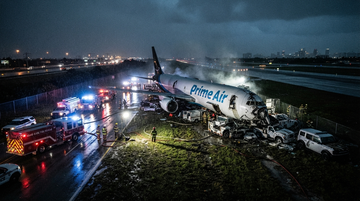
Prime Air Flight 7598 — registration N1997A, a 32-year-old Boeing 767-33A(ER)(BDSF) converted to cargo in 2015 — touched down at Miami International just before 2 p.m. ET on Sunday, September 6, 2026, after a 2-hour-11-minute flight from San Juan, Puerto Rico. The aircraft, powered by two General Electric CF6-80C2B6F engines, was operated by 21 Air under Amazon's brand and Amazon's logistics contract, but the flight, the crew, the maintenance and the insurance all sat with the contractor. The plane never made it to a taxiway.
ADS-B data captured the aircraft still moving at 112 knots — about 129 mph — as it exited the usable surface of Runway 30, with the last received speed at 69 knots before the signal cut. Miami International's runways are not equipped with an Engineered Materials Arresting System (EMAS), the crushable concrete beds the FAA recommends at airports where a full500-foot runway safety area is infeasible. Instead of stopping in a bed, the aircraft rolled through a perimeter road and into an Amazon-warehouse parking lot, striking multiple vehicles and catching fire.
Casualties
5 dead, 5 injured
Three critical; pilot and co-pilot initially trapped, per Miami-Dade Fire Rescue
Runway
MIA Runway 30
Over9,000 ft long; no EMAS installed; FAA confirmation, per NYT live blog Sep 6
Weather at touchdown
26-knot gusts
METAR KMIA 061753Z: 190° at 17kt, gusting 26kt, thunderstorms, 10SM visibility
Aircraft
N1997A, 32 years old
767-33A(ER)(BDSF), converted to cargo 2015; CF6-80C2B6F engines (GE)
Operator
21 Air
Independent carrier controlled by Jim Crane's Avia Acquisitions; runs 8 of Amazon's ~101-aircraft fleet, per NYT Sep 6
MIA disruption
187 cancelled, 266 delayed
FAA ground stop extended to 5:30 p.m. ET; two of four runways still closed next morning
Who actually flies these planes
Amazon Doesn't Own the Risk — The Contractor Stack Does
Amazon's Prime Air is a virtual airline. Amazon leases or owns the metal but contracts out the three things that determine whether a plane flies and who pays when it doesn't: crew, maintenance and insurance. That arrangement — called CMI in the industry — is why 21 Air, an independent Greensboro-based ACMI cargo operator controlled by Houston Astros owner Jim Crane, was in the left seat of N1997A even though every Amazon Air plane wears Amazon's livery. The hull-loss claim will land on 21 Air's underwriters first; Amazon's exposure is contractual and reputational, not balance-sheet-direct.
- Amazon's air arm runs ~101 aircraft with an average fleet age of 26.5 years, per planespotters.net
- 21 Air operates 8 of those planes; Air Transport International, an unrelated carrier owned by ATSG, operates about 40 under its own separate Amazon contract
- Cargojet (CGGJF) flies2 Amazon-owned 767-300BDSFs under a contract extended through March 2029
- 21 Air is privately held through Jim Crane's Avia Acquisitions, so the operator of the crashed plane has no listed equity
Correction (Sep 29, 2026): An earlier version of this article said 21 Air was owned by ATSG and that Air Transport International was its sister carrier. Both statements were wrong. 21 Air is an independent carrier controlled by Jim Crane's Avia Acquisitions; ATSG and its subsidiary Air Transport International have no ownership or corporate affiliation with 21 Air.
Upstream exposure
The 767 Backbone Is Closing — Boeing Stops Building Them Next Year
N1997A was built in 1994, before the iPod, before the Airbus A330, and four years before Google. That32-year airframe is not an outlier inside Amazon's fleet — it's representative. The Amazon Air fleet averages 26.5 years old, and of the 60 Boeing 767-300 freighters Amazon runs, every single one was originally built as a passenger jet and later converted to a freighter (BCF or BDSF). The airframes can keep flying — aviation regulators cap commercial life on cycles and hours, not birthdays — but the supply pipeline is closing.
Boeing confirmed in October 2024 that it will end767-300F freighter production in 2027 to comply with new ICAO noise and emissions rules that take effect in 2028. The line's final delivery, the 152nd 767-300F, went to FedEx earlier in 2026; UPS and FedEx have already absorbed the remaining slots. There is no Boeing widebody freighter in production below the 777F — and the 777-8F has been delayed to 2028. The market for converted 767 freighters is therefore a zero-sum auction.
| Operator | Widebody freighters | 767 share | 767 fleet age |
|---|---|---|---|
| FedEx Express | 478 aircraft | ~152 (the global 767F leader) | ~17.7 yrs |
| UPS Airlines | 277 aircraft | 102 (largest single 767 operator worldwide) | ~24 yrs |
| Amazon Air | ~101 aircraft | 60 | 26.5 yrs |
| Cargojet | 27 Amazon/DHL/charter | 2-4 | 30+ yrs |
Downstream exposure
FedEx and UPS Can't Hide From This — Their Widebodies Sit in the Same Stack
Amazon's air network has stopped being a side project. By2024 it was operating at 14.6% of FedEx Express's payload capacity and 20.0% of UPS's — measured by maximum tonnage, not aircraft count. That makes a hull loss inside the Amazon Air network a same-industry event for the two incumbents: it moves hull-insurance pricing for every 767-300F in U.S. service and invites the FAA to revisit age, weather minima and runway-end safety across the entire domestic ACMI fleet.
UPS knows exactly what that regulatory arc looks like. On November 4, 2025, UPS Airlines Flight 2976 — a 34-year-old MD-11F — suffered an engine separation during the takeoff roll at Louisville and crashed, killing 14 people (three crew and 11 on the ground). Within four days the FAA had issued an emergency airworthiness directive, UPS had grounded its entire MD-11 fleet, and FedEx had followed. By January 2026 UPS had retired the type entirely and ordered replacement 767Fs. The lesson: a single fatal hull loss in a domestic cargo fleet is enough to ground the whole model.
- UPS's MD-11 grounding lasted ~3 months; the carrier replaced those freighters with new 767Fs
- FedEx's 767s are younger (17.7-year fleet average) but the global 767F order book is now closed
- Amazon's 767 average age of 26.5 years sits well above both incumbents, sharpening the regulatory spotlight
- If the FAA probes runway-end safety, every U.S. airport without EMAS becomes a candidate upgrade — a capex line item for hub operators
The competitive layer
Amazon's Drone Math Just Got Sharper
Crashed metal on the ground in Miami is the inverse of what Amazon's drone team is selling internally. MK30 drones — 83-pound electric aircraft delivering up to 5-pound packages within a 7.5-mile radius — have no runway to overrun, no 32-year-old airframe to certify, and no humans in the loop between the warehouse and the doorstep. They are also unprofitable today: eMarketer cited Amazon's own projection of $63 per drone delivery in 2025 versus $6-$10 for ground delivery. But the comparison that matters for capex is per-mile: Amazon-cited figures put drone delivery cost at roughly $0.05 per mile — about one-thirtieth of the equivalent truck cost.
On August 19, 2026 — three weeks before the Miami crash — Amazon announced plans to scale Prime Air drone delivery to nearly 500 U.S. cities and towns by year-end 2026, with12-20 drones per site. Each drone costs roughly $142,000 per unit, and Amazon has spent more than $2 billion on the program to date. The strategic logic has always been that crewed-cargo exposure is a soft cost that drone substitution converts into a hard asset. Sunday's crash shortened the payback math.
Crewed cargo vs drone — per-package and per-mile economics
Amazon-cited unit economics,2025–2026
Unit: USD
Drone delivery ($/package)
Amazon projection, 2025; per eMarketer
63
Ground delivery ($/package)
Midpoint of $6-$10 Amazon range
8
Drone delivery ($/mile)
~1/30 of ground; Amazon-cited
0.1
767-300F operating cost ($/block-hour)
Simple Flying, 2025
12,440
Insurance & fundamentals
What the Re-Pricing Looks Like in Dollars
Hull insurance for a medium-widebody freighter runs0.6%-1.2% of agreed hull value annually, per multiple aviation insurance pricing guides published in 2026. A 32-year-old 767-300 freighter carries an agreed value that has historically fallen between $20M and $30M — but with the production line shutting in 2027, replacement-cost scarcity is already pushing residual values higher, not lower. A $25M hull at 0.9% is a $225,000 annual premium per airframe, multiplied across Amazon's 60-aircraft 767 fleet alone is a ~$13.5M annual line item before any post-Miami adjustment.
Loss-of-hull-limit (LHL) liability — the third-party coverage that pays when an overrun reaches people and property on the ground — is where the Miami event will move the needle hardest. Ground casualties push reinsurers to revisit both operator-level and airport-level underwriting, which is why the absence of EMAS at MIA matters beyond this one event: every U.S. cargo hub without EMAS becomes a question for the underwriter. NTSB's finding will determine whether this was weather, crew, maintenance, runway infrastructure or a combination — and reinsurers typically price each scenario differently.
| Layer | Current pricing | Post-Miami direction | Mechanism |
|---|---|---|---|
| Hull (per airframe) | 0.6%-1.2% of hull value | Tighter; upward | Production end → residual-value support |
| LHL (third-party) | Per-seat-mile-rated liability | +30% to +60% possible | Ground fatalities; fleet-wide reset |
| War risk (787/777F linked) | Separate policy | Indirect | Reinsurer portfolio rebalancing |
| Airport EMAS exposure | Underwriter-by-underwriter | New disclosure line | NTSB EMAS finding at MIA |
The synthesis
Three Transmission Channels, Three Different Time Horizons
The Miami crash lands in three distinct places and on three distinct clocks. The first clock is days-to-quarters: hull and LHL insurance re-pricing across every U.S. 767 ACMI operator, plus the risk that FedEx and UPS face their own pilot-weather scrutiny on a fleet that flew ~30% of U.S. cargo last year. The second clock is quarters-to-year: the NTSB report — likely Q1 2027 — will name causes, and if EMAS or weather-minima deficiencies are flagged, capital expenditure at non-EMAS airports (MIA included) becomes a line item. The third clock is 1-3 years: Amazon's drone scale-up to 500 cities, where every mile of ground delivery converted from a 26-year-old 767 to a 4-year-old MK30 is a long-tail liability removed from the balance sheet.
For investors, the asymmetry sits with Amazon: the crash does not change its underlying retail cash flow, but it materially raises the relative attractiveness of a drone network that was already planned to triple its city count before Sunday. For FedEx and UPS, the same event is a cost-of-capital story — older fleets, newer EMAS capex needs, and an insurance book that just absorbed a peer-event precedent. For Boeing, the irony is that the airframes at the center of the story cannot be ordered again after next year.
Investable takeaways
- Drone scale-up to 500 cities by EOY 2026 accelerates as crewed-cargo liability re-prices; every767 mile removed is a long-tail claim avoided
- Short-term: 60-aircraft 767 fleet faces hull/LHL premium uplift of ~30%-60% on LHL lines, per aviation pricing guides
- Amazon Air already at 14.6% of FedEx capacity and 20.0% of UPS capacity — insurance reset hits via its CMI contractors, not directly on Amazon
- Operates 152 of the ~370 Boeing 767-300F freighters in global service; production line closure locks in replacement scarcity
- Younger 767 fleet (17.7-yr average) but same regulatory exposure — NTSB EMAS finding at MIA may force hub capex
- Watch Q4 FY2026 commentary (Mar 2026 quarter) for any insurance or runway-safety guidance; the Louisville MD-11 precedent is the template
- Largest single 767 operator worldwide with 102 freighters; replacing MD-11F fleet entirely with 767s through 2026
- Direct precedent: Louisville Flight 2976 (Nov 2025, 14 dead) led to fleet-wide grounding within 4 days; same template could repeat
- Watch Q3 2026 earnings (Oct 2026) for any fleet-age or pilot-weather policy commentary after Miami
- 767-300F production ends in 2027; final freighter delivered to FedEx in 2026 removes a steady revenue tail
- Airframe hull-loss headlines raise residual-value support for the existing fleet, partially offsetting new-build order book pressure
- NTSB will scrutinize 32-year-old converted767 maintenance and conversion programs; any fleet-wide AD risks a replacement-cycle air pocket
- Amazon contract extended through March 2029 with renewal option to 2031 — share of Amazon Air ACMI work rises if 21 Air capacity is grounded
- Operates 2-4 Amazon-owned 767-300BDSFs on CMI basis; could absorb overflow if NTSB pauses21 Air ops
- Small-cap leverage to the e-commerce air story, but only27 aircraft total — flow-through is marginal unless Amazon reassigns lift