%22%2F%3E%0A%20%20%3Ccircle%20cx%3D%22220%22%20cy%3D%22150%22%20r%3D%22180%22%20fill%3D%22%2322d3ee%22%20fill-opacity%3D%220.12%22%2F%3E%0A%20%20%3Ccircle%20cx%3D%221010%22%20cy%3D%22130%22%20r%3D%22220%22%20fill%3D%22%2338bdf8%22%20fill-opacity%3D%220.08%22%2F%3E%0A%20%20%3Ccircle%20cx%3D%22920%22%20cy%3D%22520%22%20r%3D%22170%22%20fill%3D%22%2322d3ee%22%20fill-opacity%3D%220.06%22%2F%3E%0A%20%20%3Cpath%20d%3D%22M140%20430h920%22%20stroke%3D%22url(%23line)%22%20stroke-width%3D%2212%22%20stroke-linecap%3D%22round%22%2F%3E%0A%20%20%3Cpath%20d%3D%22M220%20360c120-150%20260-220%20380-220s260%2070%20380%20220%22%20fill%3D%22none%22%20stroke%3D%22%2367e8f9%22%20stroke-opacity%3D%220.5%22%20stroke-width%3D%2216%22%20stroke-linecap%3D%22round%22%20stroke-linejoin%3D%22round%22%2F%3E%0A%20%20%3Cpath%20d%3D%22M300%20398h600%22%20stroke%3D%22%2394a3b8%22%20stroke-opacity%3D%220.24%22%20stroke-width%3D%228%22%20stroke-linecap%3D%22round%22%2F%3E%0A%20%20%3Ctext%20x%3D%22220%22%20y%3D%22510%22%20fill%3D%22%23e2e8f0%22%20fill-opacity%3D%220.7%22%20font-family%3D%22Arial%2C%20Helvetica%2C%20sans-serif%22%20font-size%3D%2238%22%20letter-spacing%3D%228%22%3EINSIGHTS%3C%2Ftext%3E%0A%3C%2Fsvg%3E)
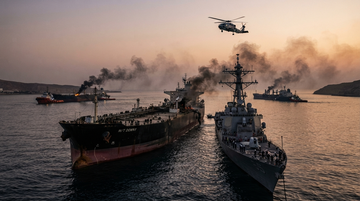
The Saturday escalation was the first time in the 2026 Iran war that IRGC ballistic missiles were fired at U.S. warships — and the first time the U.S. response involved sinking and disabling crude oil tankers rather than striking land-based missile sites. Each side framed the other as the aggressor, and the financial-market reaction will arrive in a different order than most investors expect. Crude is the headline number; insurance is the actual chokepoint.
Missiles on warships, missiles on tankers — the new escalation
On the afternoon of Sept 5, the IRGC fired multiple ballistic missiles from Iran at two U.S. Navy warships on patrol in the region — a carrier and a destroyer, per CENTCOM. The U.S. said the ships 'successfully evaded' and no American personnel were injured. Within hours, Adm. Brad Cooper, the CENTCOM commander, ordered retaliation against three Iranian crude-oil carriers: the M/T Downy off Kharg Island (which handles ~90% of Iran's crude exports), the M/T Stark 1 near Jask, and the unladen M/T Kylo — also known as the Noxen — in the Gulf of Oman, whose crew was ordered to abandon ship before it was struck in 'multiple critical locations.'
Iran's foreign ministry called the U.S. strikes 'a clear violation of the UN Charter' and 'a war crime,' and IRGC spokesman Lt. Col. Ebrahim Zolfaghari warned that 'if the U.S. continues strikes against ships,' Iranian forces would target U.S. military 'more severely than before.' On Sunday Sept 6, Iran claimed it had targeted an unmanned U.S. vessel in the Strait of Hormuz — a claim Washington had not confirmed by the time of writing. The exchange marks a structural shift: prior rounds of escalation involved land targets and ship blockades; this round targets hulls on both sides.
Iranian tankers disabled, Sept 5
3
M/T Downy (Kharg), M/T Stark 1 (Jask), M/T Kylo (Gulf of Oman)
U.S. warships targeted
2
Carrier and destroyer; both evaded; no U.S. casualties
Brent crude, week to Sept 4
$96.28/bbl
+4.6% on Sept 1 alone; 52-week range $58.72-$119.50
Iran oil exported, H1 2026
230.1M bbl
~$19.4B revenue; ~97% to China via shadow fleet
War-risk insurance, not crude, is the first market to break
Brent settled at $96.28/bbl on Sept 4 — elevated, but already priced in by a market that has lived through seven months of this war. The freight and insurance complex is the place where the Sept 5 escalation actually moves the tape, because that is where the marginal cost of doing business in the Persian Gulf is repriced. The numbers here are stark. War-risk premiums for a single seven-day Strait of Hormuz transit on a $138M VLCC were quoted at $10M to $14M in March 2026, against a pre-2026 benchmark of roughly 0.15% to 0.25% of hull value. By the week of Sept 1, high-risk underwriters were quoting 7.5% of hull value — and one broker expected 10% 'by end of today.' That is a 40- to 60-fold increase for any US/UK/Israeli-linked vessel, which underwriters now treat as 'missile magnets.'
Gulf war-risk premiums as a percentage of hull value
Quoted premium for a single seven-day transit through the Strait of Hormuz, per Lloyd's List coverage of broker quotes in March 2026.
Unit: % of hull value
Pre-2026 benchmark
Iran-Iraq tanker-war era ~5% (1980s)
0.2%
Plain-vanilla tonnage (Lloyd's)
Standard accepted rate
1%
Marsh broker average
0.8%-1.5% range
1.1%
High-risk vessel
Quoted Mar 11, 2026
7.5%
Projected high-risk, end-of-day
Per Lloyd's List underwriter source
10%
The structural break shows up in the consortium itself. On Jun 19, 2026, Lloyd's launched a Chubb-led marine war-risk facility offering up to $200M of hull and P&I capacity and $200M of cargo capacity — a total of $400M for the entire Strait of Hormuz transit market. That sounds large until you divide it by the regional cargo count: Goldman Sachs estimates Hormuz flows at roughly two-thirds of pre-war levels, or about 13M bpd, implying more than $100B of crude value is exposed to a single-strait event in any given month. A consortium sized at 0.4% of that exposure is a stopgap, not a backstop — and it covers primary policies, not the $200M-plus total loss a single VLCC write-off would generate.
VLCC freight is already doing the breaking — $647K/day on Saudi-China
Freight rates have already absorbed what crude has not. The benchmark Saudi Arabia-to-China VLCC route hit a record $647,000/day in late August 2026 — more than 10x the year-prior rate, per Baltic Exchange data cited by Bloomberg. Oman-to-China, the bellwether for Hormuz-exposed tonnage, rose to roughly $220,000/day, up from $131,000 a month earlier. VLCC spot rates have now spent eight consecutive months above $100,000/day. The driver is not just rate-of-attack risk: it is the structural inefficiency of a fleet that is running 23% more idling days per VLCC, repositioning around the Strait, and increasingly executing ship-to-ship transfers outside the Gulf before onward movement to Asia — a workflow that adds an entire second freight bill to every cargo.
VLCC daily TCE earnings by route
Spot time-charter equivalent earnings for very large crude carriers, late August 2026.
Unit: USD per day
West Africa–China VLCC
Six-month average context
104,120
US Gulf–China VLCC
Long-haul benchmark
115,137
Oman–China VLCC
Hormuz premium applied
141,198
Oman–China spot peak
Late Aug 2026, per OilPrice/Bloomberg
220,000
Saudi Arabia–China record
Baltic Exchange record, Aug 28, 2026
647,000
For the listed VLCC pure-plays, this is the most favorable setup of the cycle. Frontline booked Q2 2026 VLCC time-charter equivalents of $152,700/day — already a record in absolute terms — but the Q3 contracted rate of $156,900/day is the floor, not the ceiling. DHT Holdings, with a 22-VLCC fleet and no Suezmax or product-tanker exposure, captures the cleanest read on Hormuz-linked rate spikes. International Seaways, with both VLCCs and Suezmaxes, captures the additional Black Sea–Mediterranean arbitrage, where suezmax rates have set all-time highs above $438,000/day. All three trade at forward P/Es between 6.5x and 9.3x — well below the 10-year median — which leaves room for the market to re-rate the freight cycle upward as the Iran war's 'insurance premium' becomes structural rather than transient.
The shadow-fleet math: Iran is the supply-constrained side
Iran's exposure in this exchange is structurally worse than the headlines suggest. The three struck tankers were not random — they were part of the IRGC-funded 'multibillion-dollar shadow network' that Washington has been publicly cataloging for years. The shadow fleet moves roughly 1.3M to 1.6M bpd of Iranian crude, almost all of it to China; per TankerTrackers data, ~1.4M bpd traveled that route over the past year. Iran exported 230.1M barrels in H1 2026, generating roughly $19.4B in revenue. That is the entire war-chest base for the regime's regional proxies — and the U.S. doctrine announced on Sept 5 implies any tanker supporting the IRGC can be treated as a target.
- Iranian VLCCs struck on Sept 5 (M/T Downy, Stark 1, Kylo/Noxen) were each valued at $100M-$130M and took 18-24 months to build — replacements cannot arrive inside the conflict window.
- Kharg Island, where M/T Downy was struck, handles roughly 90% of Iran's crude exports; an extended outage there removes the country's primary loading point rather than its marginal one.
- Hormuz flows are already at ~10M bpd vs ~20M bpd pre-war — Sept 5's escalation pressures a further leg down as non-military tonnage re-routes via Yanbu and Fujairah shuttle trades.
- Iran's shadow-fleet tonnage is overwhelmingly aging and AIS-dark; it cannot absorb Western-style war-risk premiums and depends on Chinese state-owned refineries absorbing the freight costs in landed prices.
For listed tanker owners, the demand side is even more compelling than the supply side. The Iran war has already taken 27% out of VLCC cargo volumes year-on-year — roughly 6.1M bpd less moved on VLCCs in the August-versus-August comparison — but the higher tonne-miles (longer voyage distances around the Cape of Good Hope and via Mediterranean shuttle trades) more than offset the volume loss. The Sept 5 escalation raises the probability that non-military commercial tonnage will permanently avoid Hormuz, structurally increasing tonne-mile demand for the global VLCC fleet. That is the setup that makes Frontline, DHT, and International Seaways cycle-defining longs rather than tactical trades.
Defense gets a second wind; refiners face a freight squeeze
The Aegis combat system on the U.S. carrier and destroyer is built around interceptors from Lockheed Martin (PAC-3 MSE for Patriot, used ashore), Northrop Grumman (Aegis BMD hardware integration), Raytheon (Standard Missile-3 and SM-6 interceptors that did the actual at-sea intercept work), and General Dynamics (Mk 41 Vertical Launch System). With Iran's missile launches now aimed at U.S. hulls rather than just Iraqi or Israeli ones, demand for SM-3, SM-6 and PAC-3 interceptors is on a higher structural trajectory — CSIS has already warned that a renewed Iran war would 'test diminished interceptor inventories,' and the first five days of the original February 2026 strikes alone consumed over 800 Patriot interceptors. Each subsequent Iranian salvo against U.S. warships is a reorder event.
| Company | Ticker | Primary linkage | Direction |
|---|---|---|---|
| Lockheed Martin | LMT | PAC-3 MSE Patriot interceptor production | Bullish |
| Northrop Grumman | NOC | Aegis BMD integration / IBCS | Bullish |
| RTX Corp. | RTX | SM-3 / SM-6 shipboard interceptors | Bullish |
| General Dynamics | GD | Mk 41 VLS / naval combat systems | Bullish |
| Marathon Petroleum | MPC | Refining margin exposure to crude landing costs | Mixed |
| Valero | VLO | Crack spread benefit vs feedstock freight cost | Mixed |
| Phillips 66 | PSX | Petchem + refining, dual exposure | Mixed |
| HF Sinclair | DINO | Mid-continent refining, smaller tanker exposure | Mixed |
U.S. refiners face a more complicated trade. Higher freight costs inflate landed crude prices, which compresses crack spreads on the buy side; but on the sell side, gasoline and diesel crack spreads are widening because of the same supply disruption. Marathon Petroleum, Valero, and Phillips 66 sit in the middle of this tug-of-war. Diesel has already printed an all-time high of $5.85/gallon on the AAA tracker — eclipsing the prior $5.81 record from June 2022 — and gasoline has hit $4.15/gallon, up roughly $1 from a year earlier. The historical playbook: refiners win on margins in the first 30-90 days of a Gulf escalation and lose on feedstock cost in the back half. Asia is the marginal buyer: China's crude imports through Hormuz are down 39% year-on-year, and any further Iranian-tanker destruction pressures Chinese state refiners to bid up Atlantic-basin crude — the same dynamic that benefits Exxon Mobil and Chevron upstream.
Days to quarters: the Monday open and what to watch
Markets reopen Sunday evening in Asia and Monday morning in New York. The order of price discovery should follow the freight and insurance chain, not the crude chain: Asian-traded tanker equities and VLCC futures will move first, U.S.-listed tanker names will follow, then crude futures, then defense. Expect Sunday-night trading in Frontline (dual-listed in London and on the Oslo exchange before its U.S. listing) to set the U.S. tone. With Brent at $96.28 and VLCC spot at $647K/day on Saudi-China, a 3-5% gap-up in the leading names is the base case; a larger move requires a confirmed Iranian strike on a Saudi or UAE land target.
- Sunday/Sept 7 open: Asian crude futures (INE, Tocom) and tanker equities first; U.S. crude opens at ~6 PM ET Sunday with the typical 1-2% risk premium expansion.
- Sept 7-14: Watch for a second Iranian strike — most likely on Saudi Red Sea shipping (Yanbu) or UAE's Fujairah terminal — which would re-price war-risk on Atlantic-basin VLCCs and could double the Oman-China TCE.
- Sept 14-30: P&I club renewal cycle in London begins to incorporate the Sept 5 risk profile; underwriters are likely to raise call rates on any vessel entering the Persian Gulf or Gulf of Oman regardless of flag.
- Q4 2026: Lloyd's and IUA quarterly results will reveal whether the Hormuz consortium is running at full capacity or already capped out; if capped, expect a third 'emergency facility' round and a one-way increase in vessel avoidance.
One to three years: a Gulf risk premium reset
Beyond the cyclical setup, the Sept 5 exchange establishes a precedent that resets the structural Gulf risk premium. Iran's shadow-fleet tanker capacity cannot be replaced inside 18-24 months — global shipyards are full through 2028 with VLCC orders from non-Iranian buyers — so each disabled vessel permanently removes Iranian export revenue. A 30% structural cut to Iran's 1.4M-bpd shadow-fleet flow would redirect roughly $8-10B per year of crude into other channels, mostly Chinese and Indian teapot refiners that currently discount heavily for sanctions risk. The U.S. 'tanker-for-tanker' doctrine, by making that tonnage a kinetic target, accelerates the transition.
For listed tanker owners, the structural implication is that VLCC day rates do not revert to pre-war levels once the conflict ends — they revert to a new floor anchored by a 40- to 60-fold war-risk premium that the insurance market will not unwind. That is what makes Frontline, DHT Holdings, and International Seaways long-cycle holdings rather than event trades, even at current forward P/Es of 6.5x to 9.3x. For Lockheed Martin, Northrop Grumman, RTX Corp. and General Dynamics, the missile-on-warships precedent translates into multi-year replenishment demand for SM-3, SM-6, PAC-3 MSE and Mk 41 VLS capacity. For Exxon Mobil and Chevron, a structurally tighter Iranian export base is a long-tail oil-price tailwind. For the Energy Select Sector SPDR ETF and the United States Oil Fund, the same structural tightness supports a higher equilibrium price band — though commodity ETFs absorb the volatility in both directions and are not the cleanest vehicle for the trade.
Investable takeaways
- Q2 2026 VLCC TCE of $152,700/day is the floor — 82% of Q3 days were booked at $181,700/day, with the unfixed 18% now repricing into a market above $220,000/day Oman-China.
- Net debt/EBITDA at 1.1x and trailing P/E of 6.8x leave room for a multiple re-rate if VLCC spot holds above $200K/day through Q4 2026.
- 82-VLCC-equivalent exposure makes Frontline the cleanest pure-play on the Hormuz freight premium; record $659.2M Q2 net income demonstrates cycle leverage.
- Pure 22-VLCC fleet with no Suezmax or product-tanker dilution — captures the full Hormuz premium without offsetting cyclical exposure.
- Dividend yield at ~24% (TTM) and trailing P/E of 6.9x make it the highest-conviction income-and-cycle play on a sustained tanker super-cycle.
- Net debt/EBITDA of 0.46x and 80% institutional ownership signal management confidence and balance-sheet capacity to ride out rate volatility.
- Dual VLCC + Suezmax exposure lets INSW capture both the Hormuz rate spike and the parallel Black Sea-Mediterranean suezmax squeeze above $438,000/day.
- Trailing P/E of 6.5x and 4.2x EV/EBITDA — among the lowest in the listed tanker universe — leaves meaningful room for multiple expansion if Q3/Q4 print above consensus.
- Strong balance sheet (current ratio 5.9x) supports continued buybacks and dividends through any 2027 tanker deliveries.
- Product-tanker focus is a partial offset — the Hormuz war-risk premium concentrates in crude tankers, not refined-product carriers.
- Any escalation that closes the Bab el-Mandeb or Red Sea would lift product-tanker rates alongside crude, providing a secondary upside vector.
- Lower beta to crude prices means STNG underperforms VLCC pure-plays in a sustained Hormuz disruption but holds up better in a ceasefire.
- PAC-3 MSE Patriot interceptor production is the principal beneficiary of recurring IRGC missile salvos against U.S. warships; over 800 interceptors were expended in the first five days of the Feb 2026 strikes.
- PAC-3 backlog already extends into 2028; Sept 5 establishes a kinetic-event precedent that supports a multi-year replenishment cycle.
- Defensive growth profile: defense demand is decoupled from freight cycles, providing portfolio ballast against crude-price whipsaws.
- Aegis BMD hardware integration on U.S. destroyers and carriers is the foundational enabler of the Sept 5 intercept outcome.
- Watch IBCS / missile-defense bookings in Q3 2026 results (late October) — confirmation of accelerated interceptor procurement is the catalyst.
- NOC's airborne early-warning portfolio (E-7 Wedgetail) supports longer-cycle Pacific and Gulf monitoring demand.
- SM-3 and SM-6 shipboard interceptors — the actual missiles that engage Iranian ballistic missiles at sea — are RTX products; every successful intercept supports reorder momentum.
- Tomahawk and maritime-strike demand rises if the U.S. doctrine expands beyond tankers to IRGC coastal missile sites.
- Raytheon's domestic manufacturing footprint and ~$80B backlog insulate RTX from rate-cycle volatility that pressures the tanker names.
- Mk 41 Vertical Launch System on every U.S. destroyer and carrier is GD-built; demand rises as U.S. Navy forward-deploys more BMD-capable hulls.
- Gulfstream business-jet and combat-vehicle units face slower growth, capping the upside from any missile-defense lift.
- Best treated as a broad defense-momentum holding rather than a pure Hormuz trade.