%22%2F%3E%0A%20%20%3Ccircle%20cx%3D%22220%22%20cy%3D%22150%22%20r%3D%22180%22%20fill%3D%22%2322d3ee%22%20fill-opacity%3D%220.12%22%2F%3E%0A%20%20%3Ccircle%20cx%3D%221010%22%20cy%3D%22130%22%20r%3D%22220%22%20fill%3D%22%2338bdf8%22%20fill-opacity%3D%220.08%22%2F%3E%0A%20%20%3Ccircle%20cx%3D%22920%22%20cy%3D%22520%22%20r%3D%22170%22%20fill%3D%22%2322d3ee%22%20fill-opacity%3D%220.06%22%2F%3E%0A%20%20%3Cpath%20d%3D%22M140%20430h920%22%20stroke%3D%22url(%23line)%22%20stroke-width%3D%2212%22%20stroke-linecap%3D%22round%22%2F%3E%0A%20%20%3Cpath%20d%3D%22M220%20360c120-150%20260-220%20380-220s260%2070%20380%20220%22%20fill%3D%22none%22%20stroke%3D%22%2367e8f9%22%20stroke-opacity%3D%220.5%22%20stroke-width%3D%2216%22%20stroke-linecap%3D%22round%22%20stroke-linejoin%3D%22round%22%2F%3E%0A%20%20%3Cpath%20d%3D%22M300%20398h600%22%20stroke%3D%22%2394a3b8%22%20stroke-opacity%3D%220.24%22%20stroke-width%3D%228%22%20stroke-linecap%3D%22round%22%2F%3E%0A%20%20%3Ctext%20x%3D%22220%22%20y%3D%22510%22%20fill%3D%22%23e2e8f0%22%20fill-opacity%3D%220.7%22%20font-family%3D%22Arial%2C%20Helvetica%2C%20sans-serif%22%20font-size%3D%2238%22%20letter-spacing%3D%228%22%3EINSIGHTS%3C%2Ftext%3E%0A%3C%2Fsvg%3E)
Policy → Price mechanics
What actually happened (and why it matters to pricing)
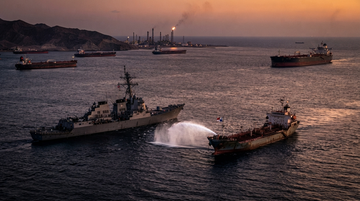
The critical shift for commodity markets wasn’t the broader Iran-U.S. rhetoric—it was a kinetic enforcement action.
The U.S. military said it fired on a merchant vessel attempting to reach Iran in violation of the U.S. blockade of Iranian ports, in line with escalating enforcement after periods of relative diplomatic optimism.
When the verbal “peace track” and the physical “blockade enforcement” diverge, crude doesn’t just price higher average risk; it prices higher probability of disruption-by-shipping—a difference that quickly changes how traders model tanker availability, route risk, and delivery timing.
Supply chain walkthrough
The late-de-escalation unwind travels through 4 links—then hits margins
- Shipping risk raises effective delivered crude cost by delaying voyages and increasing war-risk insurance and transit friction.
- Higher delivered cost feeds into refiner input uncertainty, which can widen crack spreads inconsistently instead of lifting them evenly.
- Route uncertainty forces inventory and scheduling buffers, which tends to reduce near-term refinery flexibility.
- If the market fears escalation beyond interdiction, tanker and offshore service pricing reprices, pulling forward cash needs for operators and support firms.
This is why the “peace premium” story often looks good in word-only headlines but breaks in earnings calls: refiners and trading desks underwrite spreads on assumptions about timing and controllability. A kinetic incident changes timing assumptions first, margins second.
Equity implications
Who benefits, who gets hurt—and what changes next quarter
For listed U.S. energy names, the fundamental question is whether higher crude prices flow through more quickly than costs rise.
- Integrated producers (upstream + downstream) tend to be better insulated when crude strengthens and refined product pricing holds up.
- Pure refiners can see timing mismatches: if feedstock logistics worsen faster than output pricing, crack spreads can compress even while crude rises.
To ground the “timing sensitivity” into numbers, consider how sharply earnings can move quarter-to-quarter in parts of the energy value chain, then map that volatility to shipping-driven uncertainty.
Exxon Mobil net income (Q2 2026)
$14.53B
Q2 2026, reported via quarterly income statement
Valero net income (Q2 2026)
$3.72B
Q2 2026, reported via quarterly income statement
Marathon Petroleum net income (Q2 2026)
$5.14B
Q2 2026, reported via quarterly income statement
CVR net income (Q2 2026)
$12.17B
Q2 2026, reported via quarterly income statement
| Company | Latest quarter shown | Net income |
|---|---|---|
| Exxon Mobil | Q2 2026 | $14.53B |
| Valero Energy | Q2 2026 | $3.72B |
| Marathon Petroleum | Q2 2026 | $5.14B |
| Chevron | Q2 2026 | $12.07B |
What the market is really pricing
The real “de-escalation premium” was about probability—not average tension
The key investor takeaway is not “oil goes up when tensions rise.” It’s that the market was previously pricing a lower probability of shipping disruption.
A blockade-breach interdiction changes the probability distribution: it signals that disruption is not merely reactive to attacks—it can be enforced.
That forces refiners to re-think underwriting assumptions in three ways: (1) input timing, (2) inventory cover and logistics costs, and (3) the likelihood that crude differentials widen.
2 horizons
Near-term (days–quarters): volatility first; margin second
- Volatility typically moves first via prompt spreads and shipping-risk premia, before it shows up in product pricing and refinery margins.
- If enforcement continues, tanker capacity gets tighter, which can delay feedstock deliveries and pressure utilization schedules.
- On the equity calendar, refiner earnings sensitivity rises because the cost/margin gap can widen between contracts and physical delivery.
Longer horizon (1–3 years): investors should watch for whether enforcement becomes routine enough to shift global shipping behavior—rerouting, fleet repositioning, and higher structural insurance/risk premia.
If it does, the “peace premium” becomes a smaller recurring input to expectations, and forward curves stay more risk-anchored.
Investor playbook
How to underwrite the next earnings cycle after a kinetic reset
For refining-focused portfolios, the underwriting checklist should switch from “crude up/down” to “crude up, but does the refiner still capture the spread?”
Concretely, ask whether management commentary points to (1) feedstock logistics friction, (2) inventory draw/cover changes, and (3) whether they can pass-through cost volatility.
For integrated producers, the checklist should be whether upstream strength remains coupled to downstream pricing—not separated by product feedstock and shipping costs.
Listed supply-chain equities most exposed to the escalation/re-pricing channel
- XOM’s earnings sensitivity can stay positive when crude strength outpaces downstream cost pressure (Q2 2026 net income $14.53B).
- If escalation lifts shipping risk structurally, XOM’s scale supports better margin buffering than less-integrated peers (cash flow and net income remain positive in recent quarters).
- Chevron can benefit when crude expectations rise and downstream pricing holds, with Q2 2026 net income at $12.07B.
- If enforcement persists, CVX’s integration should reduce earnings volatility versus pure refiners (quarterly net income stayed positive in the latest periods).
- VLO’s exposure is margin-timing: when shipping risk worsens, feedstock uncertainty can compress crack economics even if crude rises (Q2 2026 net income $3.72B).
- If crude rallies faster than products, VLO faces higher odds that utilization and logistics constraints drag through within quarters.
- MPC’s refining economics can swing when physical delivery timing deteriorates; its Q2 2026 net income was $5.14B.
- If risk premia keep expanding, MPC may see cost pass-through lags in the next reporting cycle.