%22%2F%3E%0A%20%20%3Ccircle%20cx%3D%22220%22%20cy%3D%22150%22%20r%3D%22180%22%20fill%3D%22%2322d3ee%22%20fill-opacity%3D%220.12%22%2F%3E%0A%20%20%3Ccircle%20cx%3D%221010%22%20cy%3D%22130%22%20r%3D%22220%22%20fill%3D%22%2338bdf8%22%20fill-opacity%3D%220.08%22%2F%3E%0A%20%20%3Ccircle%20cx%3D%22920%22%20cy%3D%22520%22%20r%3D%22170%22%20fill%3D%22%2322d3ee%22%20fill-opacity%3D%220.06%22%2F%3E%0A%20%20%3Cpath%20d%3D%22M140%20430h920%22%20stroke%3D%22url(%23line)%22%20stroke-width%3D%2212%22%20stroke-linecap%3D%22round%22%2F%3E%0A%20%20%3Cpath%20d%3D%22M220%20360c120-150%20260-220%20380-220s260%2070%20380%20220%22%20fill%3D%22none%22%20stroke%3D%22%2367e8f9%22%20stroke-opacity%3D%220.5%22%20stroke-width%3D%2216%22%20stroke-linecap%3D%22round%22%20stroke-linejoin%3D%22round%22%2F%3E%0A%20%20%3Cpath%20d%3D%22M300%20398h600%22%20stroke%3D%22%2394a3b8%22%20stroke-opacity%3D%220.24%22%20stroke-width%3D%228%22%20stroke-linecap%3D%22round%22%2F%3E%0A%20%20%3Ctext%20x%3D%22220%22%20y%3D%22510%22%20fill%3D%22%23e2e8f0%22%20fill-opacity%3D%220.7%22%20font-family%3D%22Arial%2C%20Helvetica%2C%20sans-serif%22%20font-size%3D%2238%22%20letter-spacing%3D%228%22%3EINSIGHTS%3C%2Ftext%3E%0A%3C%2Fsvg%3E)
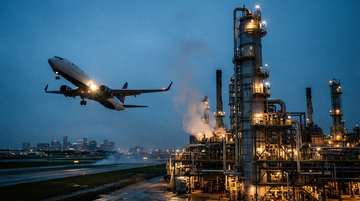
The market just delivered a rare setup: a positive geopolitical event causing the biggest single-session crude drop on the day—not a rally. When geopolitical risk premium falls as quickly as it rises, it changes what investors should infer from oil for (1) the Fed’s reaction function, (2) airline guidance on costs, and (3) refiners’ crack spreads.
In this note, we treat the move as a “premium unwind” event rather than a one-off price print, then map the causal chain upstream (oil/gas pricing), through transportation and input costs, and into equity fundamentals (margins, working capital, and leverage sensitivity).
Verified event + what the tape is actually saying
A positive US–Iran de-escalation sparked a ~5% crude unwind, not a cautious relief rally
WTI one-day move
−4.5%
Reported around the Sunday/Monday reopen following the weekend de-escalation; WTI fell to $85.29
Brent one-day move
−4.1%
Reported around the same reopen; Brent fell to $92.82
Brent contract example (another session print)
−4.9%
One actively traded contract showed a sharper −4.9% drop to $92.02
De-escalation timing anchor
Weekend pause
De-escalation described as a pause in attacks after the prior weekend (reported by Reuters)
| Market | Move (reported) | Implied takeaway | Source support |
|---|---|---|---|
| WTI | −4.5% | Risk premium unwound quickly | Reuters (WTI −4.02 to $85.29) |
| Brent | −4.1% | Relief was immediate, not gradual | Reuters (Brent −3.96 to $92.82) |
| Brent (example contract) | −4.9% | Multiple prints signaled a broad unwind, not micro-contract noise | WFSB (−4.9% to $92.02) |
Symmetry hypothesis → what changes for macro and equities
The “symmetric premium” regime means oil’s Fed signal flips faster than the Fed itself
Here’s the core investor mistake to avoid: using geopolitical-driven oil upswings as if they map cleanly into persistent inflation.
When de-escalation causes the same premium to unwind rapidly, the market is effectively repricing duration (conflict becomes shorter) and tail risk (probability of Hormuz-type disruption falls). That repricing has two macro consequences:
1) Near-term headline inflation expectations lose momentum (lower energy contribution). 2) Rate-cut odds can move faster than typical macro models predict—because oil is doing the “risk-premium removal” job directly.
The key difference versus the usual “sanctions/shipping premium” stories: those often describe additions to price risk. This one describes subtraction—meaning the first-round effect can be disinflationary and pro-risk-asset at the same time.
Airlines are a timing machine for fuel cost expectations
If crude unwinds in one session, airlines’ fuel-cost guidance stops being a one-way bet
- Fuel is a variable cost that reprices quickly when futures move; a sharp unwind raises the odds that guidance built on higher-for-longer assumptions becomes stale faster.
- The market often moves first through hedging and spot/futures mark-to-market, then later through reported unit costs—so equity reaction can lead earnings by multiple quarters.
- De-escalation reduces tail-risk adders (diversion, disruption) but can also revive demand uncertainty if consumers and corporates delay travel under a “soft macro” narrative tied to the Fed.
We can’t validate airline guidance text for this specific day within the budgeted sources, so we treat this as a mechanics argument: when crude drops ~5% on a headline, fuel-cost expectation distributions shift immediately. That changes the sign of the surprise term in airline earnings models.
Financially, the practical implication is timing: airlines with more net operating leverage to fuel and weaker free cash flow flexibility tend to see sharper estimate revisions when oil moves fast.
Refiners: cracks depend on product–crude relationships, but crude direction still matters
A rapid crude unwind pressures refinery crack assumptions—unless product demand benefits equally
| Transmission layer | What the unwind changes immediately | What shows up later | Investor watch-item |
|---|---|---|---|
| Crude inputs | Spot and nearby crude prices | Delivered crude and blend economics by region | Prompt spread and inventory valuation sensitivity |
| Product pricing | Near-term product quotes may lag crude | Utilization and maintenance decisions | Whether gasoline/diesel discounts move less than crude |
| Working capital | Margin volatility affects cash conversion timing | Receivables/payables and inventory turns | Cash conversion cycle changes |
Fundamentals snapshot: why the same oil move hits different balance sheets differently
Balance-sheet and margin structure determine whether oil’s unwind becomes equity outperformance or underperformance
Free-cash-flow yield baseline (FY2025) highlights who can better withstand margin volatility after a crude shock
Illustrative: higher free-cash-flow yield typically provides more cushion; the direction of next-quarter earnings revisions still depends on how cracks respond to crude.
Unit: decimal
Exxon Mobil FCF yield (FY2025)
TTM-style metric in the dataset; lower volatility exposure than pure-play refiners on inputs.
0
Chevron FCF yield (FY2025)
Dataset-based yield for FY2025.
0.1
Phillips 66 FCF yield (FY2025)
Shows sensitivity risk during margin compression periods.
-0
Marathon Petroleum FCF yield (FY2025)
More cushion when shocks hit; still crack-dependent.
0.1
This is not a forecast; it’s a stress-test lens. When crude drops abruptly, the market reprices both (a) the path of future prices and (b) the path of spreads and hedges. Companies with weaker cash generation and more exposure to near-term crack spreads can experience larger estimate swings even if demand doesn’t actually change yet.
For the symmetric unwind specifically, the key is that oil’s move is directionally opposite of many prior risk-premium-addition headlines—so the historical “oil up = better for refiners” intuition can fail in the first response window.
What to look at next (short-term vs long-term horizons)
Short-term: expect fast estimate revisions; long-term: the structural premium floor shifts
- Next days–quarters: track whether prompt product spreads follow crude lower (bearish for cracks) or hold up (bullish stabilization), because that determines the sign of “oil unwind → refiner earnings” surprises.
- Next days–quarters: watch airline fuel and hedging disclosures for whether management aligns guidance with futures or sticks to a prior average; the equity reaction typically precedes the accounting reality.
- 1–3 years: if de-escalation repeats, the equilibrium geopolitical premium can reset lower, reducing the probability distribution of extreme oil outcomes—and that can compress risk-premium embedded in long-dated valuations.
Synthesis thesis
Treat the day’s move as a regime signal: geopolitical risk premium is now reversible on the margin
This episode argues for a simple thesis: the market is now treating geopolitical risk as a reversible premium instead of a persistent inflation wedge.
That shifts the transmission mechanism:
- Fed pricing can change quickly because energy is directly disinflationary when crude falls.
- Airlines face a faster fuel-cost repricing loop (even if reported unit costs lag).
- Refiners see crack/spread uncertainty right away; without a product offset, a crude-led unwind can hurt first.
Put differently: when the same geopolitics that used to add premium removes it, your “macro-to-sector” mapping needs to invert on the next earnings cycle.
Listed equities most exposed to a symmetric crude-premium unwind
- A crude unwind can reduce upstream cash-flow sensitivity while providing margin volatility diversification versus pure refiners.
- Higher volatility risk can shift market expectations around realized pricing more quickly than reported earnings for FY2025-style cash yields.
- A fast crude drop can pressure near-term revenue momentum expectations while still leaving FY2025 free-cash-flow yield as a buffer.
- If the unwind is durable, Chevron’s integrated model can reduce reliance on tail-risk premiums for valuation support.
- Because FY2025 free-cash-flow yield is negative in the dataset, a crude-led crack compression tends to amplify equity downside in the next estimates window.
- If product spreads don’t offset, the unwind can reduce cash conversion resilience before utilization changes show up.
- With FY2025 free-cash-flow yield positive at ~0.096, MPC can absorb a crude unwind with more cushion if product spreads hold.
- If spreads track crude down less than expected, the unwind can pull forward margin recovery into coming quarters.
- A ~5% crude unwind can improve near-term fuel-cost expectations, which can lift estimate revisions faster than bookings change.
- If the Fed reacts to disinflation by cutting rates slowly or demand softens, DAL’s upside can face offsetting macro pressure in guidance updates.
- Fast oil repricing can compress future hedge/average-cost assumptions, shifting the sign of earnings surprises around fuel.
- If the symmetric unwind signals lower tail-risk but weaker macro, AAL can see demand and cost forces pull in opposite directions.