%22%2F%3E%0A%20%20%3Ccircle%20cx%3D%22220%22%20cy%3D%22150%22%20r%3D%22180%22%20fill%3D%22%2322d3ee%22%20fill-opacity%3D%220.12%22%2F%3E%0A%20%20%3Ccircle%20cx%3D%221010%22%20cy%3D%22130%22%20r%3D%22220%22%20fill%3D%22%2338bdf8%22%20fill-opacity%3D%220.08%22%2F%3E%0A%20%20%3Ccircle%20cx%3D%22920%22%20cy%3D%22520%22%20r%3D%22170%22%20fill%3D%22%2322d3ee%22%20fill-opacity%3D%220.06%22%2F%3E%0A%20%20%3Cpath%20d%3D%22M140%20430h920%22%20stroke%3D%22url(%23line)%22%20stroke-width%3D%2212%22%20stroke-linecap%3D%22round%22%2F%3E%0A%20%20%3Cpath%20d%3D%22M220%20360c120-150%20260-220%20380-220s260%2070%20380%20220%22%20fill%3D%22none%22%20stroke%3D%22%2367e8f9%22%20stroke-opacity%3D%220.5%22%20stroke-width%3D%2216%22%20stroke-linecap%3D%22round%22%20stroke-linejoin%3D%22round%22%2F%3E%0A%20%20%3Cpath%20d%3D%22M300%20398h600%22%20stroke%3D%22%2394a3b8%22%20stroke-opacity%3D%220.24%22%20stroke-width%3D%228%22%20stroke-linecap%3D%22round%22%2F%3E%0A%20%20%3Ctext%20x%3D%22220%22%20y%3D%22510%22%20fill%3D%22%23e2e8f0%22%20fill-opacity%3D%220.7%22%20font-family%3D%22Arial%2C%20Helvetica%2C%20sans-serif%22%20font-size%3D%2238%22%20letter-spacing%3D%228%22%3EINSIGHTS%3C%2Ftext%3E%0A%3C%2Fsvg%3E)
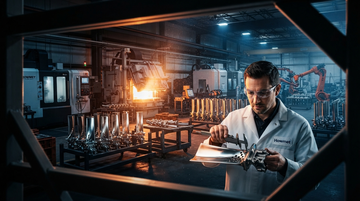
Howmet Aerospace shares fell as much as 9% on Sep 1, 2026 after Elon Musk confirmed SpaceX is building a single-crystal nickel-superalloy foundry in Bastrop, Texas to feed a 20 GW behind-the-meter gas-turbine build for its AI data centers. Two days later Bernstein analyst Douglas Harned raised his price target to $328 from $318 and called the drop a buying opportunity, with the stock recovering3.3% the next session. The argument matters because most of the public-side damage from a SpaceX vertical-integration headline falls on a single supply-chain link — investment-cast turbine blades — and that link is one of the most concentrated manufacturing markets in aerospace.
HWM Q2 2026 revenue
$2.55B
Up 24% YoY; reported Aug 6, 2026
Engine Products adj. EBITDA margin
37.7%
Q2 2026, up from 31.4% a year earlier
Industrial gas turbines revenue growth
+38%
Q2 2026 vs Q2 2025, company-reported
HWM IGT turbine-blade global share
>50%
Disclosed on Aug 6, 2026 earnings call
Single-crystal blade duopoly (HWM + PCC)
~80%
Of high-end investment castings
HWM customer agreements
Through 2030
Across all 7 major gas-turbine customers
What Bernstein actually bought
SpaceX's foundry is internal, not a new competitor
Harned's note draws a sharp line between SpaceX vertical-integrating its own turbine supply and SpaceX becoming a third-party casting supplier. \"Assuming SpaceX does the buildout to produce blades, we would not expect the company to become a new industry supplier of forgings and castings, which would have little connection with core SpaceX objectives,\" he wrote. \"We also are skeptical that SpaceX would be able to have volume production in time to meet its power expansion goals.\" The build targets20 GW of behind-the-meter capacity by end-2027, an internal Musk timeline, not a commercial sales channel.
The market disagreement hinges on whether SpaceX will stop at internal use. Citi sided with Bernstein the same week, calling the drop a buy-the-dip catalyst. The skeptical read — single-crystal directional solidification is one of the hardest metallurgical processes on Earth, with only a handful of qualified foundries worldwide — argues that even if SpaceX succeeds, it spends years solving the yield-and-coating stack rather than building merchant capacity. SpaceX itself outsources melt production of its proprietary SX alloys to an external mill under NDA, per industry reporting on its Raptor 3 turbopump program.
The moat in numbers
Why the duopoly is harder to break than the chart suggests
The high end of investment-cast turbine airfoils — single-crystal and directionally solidified nickel superalloys used in the hottest section of a gas turbine — is effectively a two-company market. Howmet Aerospace and Precision Castparts, owned by Berkshire Hathaway, hold roughly 80% combined share, with single-crystal concentrated even further. Doncasters (private, German-owned) and ATI cover the rest. A foundry cannot enter the market with just casting machines: it needs qualified alloys, vacuum-melt capacity, directional-solidification furnaces, single-crystal grain selectors, post-cast heat treatment, machining, performance coatings, hot isostatic pressing, and a decades-long aerospace qualification track record.
- Howmet Aerospace's >50% global IGT blade share, confirmed on the Aug 6, 2026 earnings call, sits on the back of vacuum-melted superalloy know-how and proprietary single-crystal grain growth.
- Precision Castparts is the only meaningful peer; Berkshire's deep pockets make a price war the wrong tool to break the duopoly.
- ATI supplies nickel and titanium billet/plate and powder upstream of casters but does not compete at scale in single-crystal airfoils — its $4.4B backlog is billet and forging, not blade castings.
- Haynes International, the third historic US superalloy name, was acquired by Acerinox for ~$970M and is no longer a standalone listed play.
The technical moat is reinforced by the supply chain's deliberate underbuilding. Both Howmet Aerospace and Precision Castparts have been explicit about limited capex appetite for IGT blade capacity. The result is a market that has run short of supply even with no new entrant in sight, exactly the dynamic Bernstein points to. Musk's plan doesn't subtract from that shortage — at most, it removes one captive buyer from the queue.
Demand vs. capacity
Why HWM is raising output while others pull back
Q2 2026 results, reported Aug 6, 2026, frame the gap between demand and supply. Total revenue of $2.55B was up 24% YoY with21% organic. Engine Products — where IGT blades and jet-engine airfoils live — grew third-party sales 32% to $1.37B, with adjusted EBITDA up 51% to $517M, a37.7% segment margin. Fastening Systems grew 37%. Industrial gas turbines as an end market grew 38%. The growth is being absorbed because Howmet Aerospace has been quietly adding capacity: a new Japan plant, a major European expansion, and a Virginia facility retooled by exiting some nickel-alloy work, with a new large casting machine going in and another following in the second half.
Howmet Q2 2026 segment revenue and margin (third-party sales)
Engine Products carry the IGT blade business and account for 54% of Q2 2026 revenue. EBITDA margin in this segment expanded660 bps YoY.
Unit: $M
Engine Products
$M, +32% YoY;37.7% EBITDA margin
1,373
Fastening Systems
$M, +37% YoY; 30.1% EBITDA margin
589
Forged Wheels
$M, +14% YoY; 27.8% EBITDA margin
316
Engineered Structures
$M, -13% YoY; 23.8% EBITDA margin
269
Capacity additions translate into38% more IGT blade output versus Q1 2025 by the end of 2026, on management's plan. Customer agreements run through 2030, and Howmet Aerospace has just finished negotiations with all seven of its major IGT customers, several of whom are already asking to revise demand outlooks higher. The bottleneck Musk is trying to escape is one HWM is actively widening.
Upstream and downstream
Who else in the chain wins (and loses) on the headline
SpaceX's foundry targets casting, not alloy production, so it would still buy nickel and cobalt superalloy billet, plate and powder from upstream melters. Carpenter Technology and ATI are the two listed US specialty-alloy producers exposed to that pull. Carpenter Technology, with ~60% of revenue from aerospace and defense and FY2026 revenue tracking above $2.8B, sells the nickel superalloys that go into both Howmet's blades and any new entrant's blades. ATI posted Q2 2026 sales of $1.26B, up 11% YoY, with jet-engine revenue up 13% and a record $4.4B backlog up 18% YoY. The takeaway: SpaceX's vertical move tightens alloy demand even if it leaves casting demand at Howmet Aerospace untouched.
- Upstream winners: Carpenter Technology and ATI — both already running record backlogs before the SpaceX announcement.
- Downstream customer OEMs (RTX, GE Aerospace, Rolls-Royce, Safran, IHI) are unaffected in the near term; their blade offtake runs through 2030 contracts.
- Negative read-through for IHI's industrial-gas-turbine blade ambitions: Safran and IHI were already exploring single-crystal airfoils because of the same shortage Musk just exposed.
- Berkshire's Precision Castparts is the only true duopoly peer; private, no listed trade, but it benefits from the same dynamic.
RTX and GE Aerospace each represented about 11% of Howmet Aerospace's 2025 third-party sales, almost entirely from the Engine Products segment, per the 2025 10-K. Neither is at risk of losing supply in the next 24 months. The medium-term read is that HWM's 50%+ IGT share becomes a strategic chokepoint for the OEMs themselves, which is why the customer agreements run through 2030 and why HWM's biggest customer (Pratt & Whitney) is already building out a next-generation GTFA engine program with HWM content scaling into2027.
Valuation and risks
What $259 already prices in — and what it doesn't
After the recovery, Howmet Aerospace trades at about $259 with a $103.7B market cap. EV/EBITDA on TTM sits around 39x and trailing P/E near 56x — rich on standard multiples, but in line with the broader aerospace supply-chain rerating since the GTF/Raptor ramp became visible in 2023-2024. Bernstein's $328 target implies ~27% upside; the Street consensus is $337 with a Moderate Buy rating skewed by 19 Buys vs 3 Holds. FY2026 EPS guidance is $5.23-$5.31 versus $3.77 in FY2025, a 39-41% jump.
| Company | Ticker | Mkt cap ($B) | EV/EBITDA (x) | EV/Sales (x) | Rev growth YoY |
|---|---|---|---|---|---|
| Howmet Aerospace | HWM | 103.7 | 39.1 | 11.8 | 24% |
| ATI Inc | ATI | 28.7 | 33.0 | 6.4 | 11% |
| Carpenter Technology | CRS | 12.1 | ~17 | ~3.6 | ~5% |
On the fundamentals, the bear case has two real teeth: first, a US-China trade escalation that hits aerospace exports (the 10-K calls this out as a risk) would tighten demand; second, even if SpaceX never sells a third-party blade, a successful Bastrop foundry teaches Musk the process and could pressure future pricing on captive orders. The bull case, which is what Bernstein is underwriting, is that the duopoly economics — single-crystal yields that take decades to learn, customer qualification cycles that run 3-5 years, and customer agreements through 2030 — keep HWM's IGT blade business intact while the market for upstream alloys stays tight for everyone, including SpaceX.
Synthesis
The trade is a mispriced duopoly, not a SpaceX-discount
Strip out the SpaceX headline and Howmet Aerospace's story is straightforward: a sub-segment of aerospace supply with a >50% global share, 37.7% Engine Products EBITDA margins, demand growing 38% in IGT, and contracts through 2030. The SpaceX foundry is real but aimed inward; it does not put third-party IGT blade orders at risk in this cycle. Bernstein's $328 target is not a heroic call — it's a recognition that a 9% drop on a vertical-integration story that doesn't reach the third-party market is closer to a mispricing than a regime change.
- Short-term (days-quarters): the recovery is incomplete; Bernstein's $328 implies ~27% upside, consensus $337 implies ~30%; a clean Q3 print sustains the rebound.
- Long-term (1-3 years): the single-crystal blade market stays structurally tight; HWM's capacity additions (+38% vs Q1 2025) and customer agreements through 2030 anchor revenue visibility.
- Key milestone: SpaceX Bastrop foundry commissioning timing — any slippage from Musk's end-2027 20 GW target tightens the IGT market further for HWM and ATI.
- Key risk: a faster-than-expected SpaceX commercial blade offering, even niche, would reset the duopoly math; watch Bastrop capex disclosures and any third-party casting RFPs.
Investable names
- Bernstein's $328 target implies ~27% upside as the Sep 1 selloff unwinds; >50% global IGT blade share and contracts through 2030 anchor the case.
- Q2 2026 Engine Products EBITDA margin hit 37.7%, up 660 bps YoY — operating leverage is real, not just volume.
- Capacity expansion of38% vs Q1 2025 directly answers the Musk foundry without conceding third-party share.
- Bear risk: 39x EV/EBITDA leaves little buffer if a faster SpaceX commercial offering emerges; watch Bastrop commissioning dates.
- Record $4.4B backlog (+18% YoY) and jet-engine revenue up 13% YoY in Q2 2026 confirms the same capacity-tight dynamic; SpaceX foundry would still need ATI billet.
- Q2 2026 commercial jet engine sales up 10% sequentially, content on next-gen platforms more than double legacy — the same demand Bernstein underwrites at HWM.
- 33x EV/EBITDA is a premium to Carpenter but below HWM; the listed name for upstream exposure without direct casting-competition risk.
- Risk: if SpaceX eventually skips merchant melters for its own alloy, ATI loses a captive buyer, not a core customer.
- FY2026 net sales tracking above $2.8B with FY2026 adjusted operating income guided to $700-$705M; aerospace & defense is ~60% of revenue.
- Lower EV/EBITDA (~17x) than HWM or ATI; the most direct upstream play if the IGT market stays supply-constrained through 2027.
- Demand pull from any new entrant (SpaceX or otherwise) sits on top of, not against, Carpenter's existing melt backlog.
- Risk: a deep aerospace downturn would hit Carpenter first because its order book is shorter-cycle than HWM's 2030-dated contracts.
- RTX represented ~11% of HWM's 2025 third-party sales; supply chain is locked in through 2030 contracts.
- GTF and Pratt GTFA engine ramps lift HWM content per engine into 2027, a tailwind for RTX's aftermarket.
- Mixed because RTX carries its own hot-section risk independent of HWM; SpaceX foundry doesn't change this picture near-term.
- Watch HWM's Pratt-specific disclosures in Q3 2026 for confirmation that the GTFA ramp is on schedule.
- GE Aerospace also represented ~11% of HWM's 2025 third-party sales; same2030 contract window as RTX.
- Beneficiary on the engine OEM side as HWM capacity expansion reduces hot-section supply risk through2027.
- Mixed because GE Aerospace trades on its own LEAP/9X aftermarket cycle, not on the superalloy supply chain.
- Risk: if HWM concentrates allocation between RTX and GE, GE could see tighter-than-expected blade deliveries by 2027.
- Rolls-Royce is one of HWM's seven major IGT customers; data-center gas turbine demand pulls both civil aerospace and IGT content.
- Watch variable: civil aerospace widebody recovery timing in2026-2027, which drives Trent engine spare-parts demand.
- Adverse: any trade escalation hitting UK-US aerospace exports would blunt the dual-engine exposure (civil + IGT).
- Listed in London as RR.L but US ADR RYCEY is the cleaner US trade for retail.