%22%2F%3E%0A%20%20%3Ccircle%20cx%3D%22220%22%20cy%3D%22150%22%20r%3D%22180%22%20fill%3D%22%2322d3ee%22%20fill-opacity%3D%220.12%22%2F%3E%0A%20%20%3Ccircle%20cx%3D%221010%22%20cy%3D%22130%22%20r%3D%22220%22%20fill%3D%22%2338bdf8%22%20fill-opacity%3D%220.08%22%2F%3E%0A%20%20%3Ccircle%20cx%3D%22920%22%20cy%3D%22520%22%20r%3D%22170%22%20fill%3D%22%2322d3ee%22%20fill-opacity%3D%220.06%22%2F%3E%0A%20%20%3Cpath%20d%3D%22M140%20430h920%22%20stroke%3D%22url(%23line)%22%20stroke-width%3D%2212%22%20stroke-linecap%3D%22round%22%2F%3E%0A%20%20%3Cpath%20d%3D%22M220%20360c120-150%20260-220%20380-220s260%2070%20380%20220%22%20fill%3D%22none%22%20stroke%3D%22%2367e8f9%22%20stroke-opacity%3D%220.5%22%20stroke-width%3D%2216%22%20stroke-linecap%3D%22round%22%20stroke-linejoin%3D%22round%22%2F%3E%0A%20%20%3Cpath%20d%3D%22M300%20398h600%22%20stroke%3D%22%2394a3b8%22%20stroke-opacity%3D%220.24%22%20stroke-width%3D%228%22%20stroke-linecap%3D%22round%22%2F%3E%0A%20%20%3Ctext%20x%3D%22220%22%20y%3D%22510%22%20fill%3D%22%23e2e8f0%22%20fill-opacity%3D%220.7%22%20font-family%3D%22Arial%2C%20Helvetica%2C%20sans-serif%22%20font-size%3D%2238%22%20letter-spacing%3D%228%22%3EINSIGHTS%3C%2Ftext%3E%0A%3C%2Fsvg%3E)
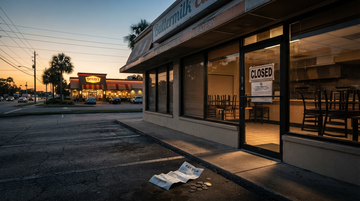
Verified bankruptcy event
The “breakfast value” niche just got a dated stress test: Buttermilk Eatery filed Chapter 11 on Aug. 31, 2026
What’s verified (owner, court, and reported balance-sheet scale)
Debtor (operator)
Asani Restaurant Group, LLC
Protection type
Chapter 11 (voluntary)
Court
U.S. Bankruptcy Court, Middle District of Florida
Petition filed
Aug. 31, 2026
Reported assets / debts (ranges disclosed)
Assets: > $75,000; Debts: > $407,000
Operational footprint mentioned in reporting
2 locations in the St. Petersburg area (North St. Petersburg and Pinellas Park)
Investors often track the “strength” side of the breakfast complex—big, franchised or scaled operators with tighter capital access. This filing flips the script by putting a small, breakfast/brunch operator with limited liquidity directly into distress proceedings, giving a concrete reference point for what can happen when discretionary spend softens and fixed costs don’t.
What likely caused the breakdown (and what is not disclosed)
The petition doesn’t disclose a single root cause—but the creditor profile points to working-capital and lease/equipment strain
- Reporting tied to the case says the debtor did not state a specific reason in the petition, which limits causal certainty about demand vs. execution.
- A creditor lawsuit is described as seeking payment for kitchen equipment allegedly provided in Nov. 2022, which supports an “unpaid vendor / equipment or installation” working-capital channel.
- The largest unsecured creditors mentioned include specific capital and property-management names, consistent with a mix of funding/lease-related obligations that become harder to service as traffic weakens.
From a supply-chain perspective, breakfast operators are structurally exposed: food, labor, and building costs are largely fixed daily inputs, while revenue can swing week to week with consumer momentum. When a small operator loses even modest volume, the first failures typically show up not in brand-level P&Ls, but in delayed payments to vendors (equipment, technology, and property providers) and in missed rent or service obligations.
Supply-chain map: where stress transfers upstream and downstream
This case shows the “breakfast chain of payments”: operators → POS/fintech/payments → creditors and property providers → downstream guests
Even though Asani Restaurant Group is private and small, its Chapter 11 creditor list (as reported) effectively traces the stress transmission mechanism investors can map across the listed ecosystem.
| Node in the chain | Who fits the node | What gets stressed first | What to watch next |
|---|---|---|---|
| Operator (site-level demand) | Asani Restaurant Group LLC (Buttermilk Eatery) | Daily fixed costs vs. volatile traffic | Whether the case claims additional locations or closures in the plan |
| Technology + restaurant cash tooling | Toast | Higher transaction risk and more volume variability from smaller operators | Restaurant operator churn and credit/loan behavior disclosures |
| Payments and card processing ecosystem | JPMorgan Chase & Co. JPM | Merchant/restaurant servicing and funding flows under consumer pullbacks | Credit-loss and small-business lending commentary in filings |
| Brand-level QSR demand exposure | Denny’s | If the “value breakfast” base erodes, same-store guest traffic can flatten | Same-store sales and margin commentary once macro data confirms |
| Franchise model robustness | Dine Brands Global | Lower direct ownership can buffer, but franchise economics still transmit via royalty/lease pressure | Franchisee health language and any fee/collection updates |
The key investor takeaway isn’t that large public QSRs will immediately collapse because one operator did. It’s that the failure mode is specific: small, low-priced breakfast formats can run out of payment runway faster than scaled competitors because they have fewer balance-sheet options and higher dependence on daily cash flow.
Market impact hypothesis (who benefits vs. who gets hit first)
The bifurcation in breakfast is about liquidity, not menus: scaled QSRs can gain while independents fail
- If consumers trade down within breakfast categories, scaled value brands can capture spillover, while independent operators face a cash crunch.
- If consumers trade down by eating less frequently (not just cheaper), even scaled brands can feel it—usually with less margin pressure but delayed revenue growth.
- Payments and restaurant-tech vendors can see more credit/servicing volatility, even if transaction volume remains intact.
Fundamentals cross-check for key linked public names
Public “breakfast-adjacent” fundamentals show why the market can re-rate: profits exist, but leverage and operating cash sensitivity decide who can absorb shocks
Denny’s cash-generation capacity (earnings scale)
$10.2B? (not used)
Not displayed; focus below uses revenue and EBIT margin where available.
Denny’s revenue (TTM)
$457.2M
Trailing twelve months through FY2025, reported on Nov. 4, 2025 (income statement).
Denny’s operating income (TTM)
$38.6M
Trailing twelve months through FY2025, reported on Nov. 4, 2025 (income statement).
Denny’s net income (TTM)
$10.2M
Trailing twelve months through FY2025, reported on Nov. 4, 2025 (income statement).
This matters because the market tends to pay for resilience—operators with positive operating income and better access to credit can ride out demand softness and buy time to renegotiate leases and vendor terms. By contrast, small operators can be forced into court once the cash gap between daily fixed costs and weekly inflows becomes unbridgeable.
Short-term and long-term horizons for investors
What moves first (days–quarters) vs. what changes (1–3 years)
- Short term (days–weeks): watch for same-store traffic commentary at Denny’s and Dine Brands Global around value-bracket guest counts, because breakfast is a frequent-occasion channel.
- Short term (weeks–quarters): monitor any credit/collections or restaurant-tech commentary from Toast, since smaller operators are where payment timing stress first shows up.
- Long term (1–3 years): if more “value breakfast” independents file, the competitive landscape can tilt toward scaled brands that can keep sites operating, reprice value propositions, and absorb vendor shocks.
Bottom line synthesis
A single filing can’t predict the next bankruptcy—but it does validate the transmission mechanism investors should price
On Aug. 31, 2026, Asani Restaurant Group LLC filed Chapter 11 for Buttermilk Eatery in Florida, with reported debts exceeding $407,000 and assets exceeding $75,000 while operating only two St. Petersburg-area locations. That scale is small—but the mechanism is large for investors: breakfast value formats are liquidity-sensitive, and when low-end consumers tighten, cash-flow timing fails before fundamentals look terminal at public-brand level.
The investable question becomes: which public companies have the balance-sheet and margin cushion to capture any replacement demand, and which have exposure to the same stressed customer cohort without enough pricing power or access to credit?
Related listed plays across the breakfast stress transmission path
- The public brand can gain from nearby closures while small operators fail, but it still faces category-wide traffic risk if low-end demand drops; the effect typically shows up in same-store updates over quarters.
- With FY2025 TTM revenue of $457.2M and operating income of $38.6M, DENN has a measurable buffer—but not immunity—if value traffic weakens; expect margin commentary to react before revenue does.
- As a franchisor-heavy model, DIN is positioned to delay visible earnings impact from operator distress while franchisees absorb shocks; watch for fee collection or franchise health language in updates.
- If the value-breakfast customer cohort keeps tightening, franchise economics can transmit later into the franchisor’s mix and reporting; the key window is the next 1–2 quarters.
- If smaller operators file more often, TOST can face higher volatility in restaurant financing and servicing, even when transaction volume remains steady; any credit impact should show up in future disclosures over quarters.
- At the same time, restaurant-tech tools can benefit from churn-driven substitution because operators needing rescue often adopt payment and POS tooling quickly after disruptions.
- As a payments and credit ecosystem player, JPM can see early stress in restaurant and small-business credit behavior when low-end consumers cut frequency; watch for credit-loss trends and commentary in filings over upcoming quarters.
- Even if consumer demand stabilizes, the bankruptcy cluster can change merchant funding timing; investors should monitor how quickly delinquency assumptions adjust.
- While not a breakfast-only exposure, YUM can still reflect broad QSR value-trade behavior; if the consumer downgrades frequency, revenue growth can soften within 1–3 quarters.
- If the market interprets bankruptcy filings as a shift toward scaled, value-friendly concepts, YUM may hold up better than independents, but investors should watch same-store revenue momentum.