%22%2F%3E%0A%20%20%3Ccircle%20cx%3D%22220%22%20cy%3D%22150%22%20r%3D%22180%22%20fill%3D%22%2322d3ee%22%20fill-opacity%3D%220.12%22%2F%3E%0A%20%20%3Ccircle%20cx%3D%221010%22%20cy%3D%22130%22%20r%3D%22220%22%20fill%3D%22%2338bdf8%22%20fill-opacity%3D%220.08%22%2F%3E%0A%20%20%3Ccircle%20cx%3D%22920%22%20cy%3D%22520%22%20r%3D%22170%22%20fill%3D%22%2322d3ee%22%20fill-opacity%3D%220.06%22%2F%3E%0A%20%20%3Cpath%20d%3D%22M140%20430h920%22%20stroke%3D%22url(%23line)%22%20stroke-width%3D%2212%22%20stroke-linecap%3D%22round%22%2F%3E%0A%20%20%3Cpath%20d%3D%22M220%20360c120-150%20260-220%20380-220s260%2070%20380%20220%22%20fill%3D%22none%22%20stroke%3D%22%2367e8f9%22%20stroke-opacity%3D%220.5%22%20stroke-width%3D%2216%22%20stroke-linecap%3D%22round%22%20stroke-linejoin%3D%22round%22%2F%3E%0A%20%20%3Cpath%20d%3D%22M300%20398h600%22%20stroke%3D%22%2394a3b8%22%20stroke-opacity%3D%220.24%22%20stroke-width%3D%228%22%20stroke-linecap%3D%22round%22%2F%3E%0A%20%20%3Ctext%20x%3D%22220%22%20y%3D%22510%22%20fill%3D%22%23e2e8f0%22%20fill-opacity%3D%220.7%22%20font-family%3D%22Arial%2C%20Helvetica%2C%20sans-serif%22%20font-size%3D%2238%22%20letter-spacing%3D%228%22%3EINSIGHTS%3C%2Ftext%3E%0A%3C%2Fsvg%3E)
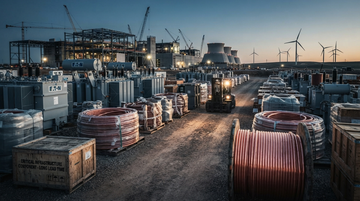
Policy trigger meets physical constraints
A national bulk-power emergency makes equipment supply the gating factor—and metallurgy the hidden driver
On August 26, 2026, the U.S. declared a national emergency to protect the bulk-power system’s security, integrity, and reliability against disruptions in the foreign supply of bulk-power system electric equipment. The order is essentially a mandate to keep critical grid components available—meaning the clock starts at procurement and import continuity, not at the next construction permitting cycle.
For investors, the key is that grid buildouts (and AI/data-center interconnects) don’t fail because utilities lack plans; they fail because grid-critical items—especially transformers and other substation gear—have long manufacturing and logistics lead times. And those lead times are downstream expressions of constraints in the materials chain: copper/aluminum for conductors and transformer windings, and rare-earth inputs for magnet-based electromechanical equipment in the broader electrification buildout.
Copper-to-grid-to-AI is the fastest transmission line
Copper strain hits data centers first because the build requires so much of it—and the refining timeline can’t scale quickly
Copper is the clearest material bridge between AI workloads and the grid upgrade that makes those workloads usable. One supply-chain analysis estimates about 50,000 tons of copper per new hyperscale data center. If power delivery lags, hyperscalers lose the “last mile” to scale, which can convert upstream copper strain into downstream construction delays.
The same source highlights that U.S. copper refining capacity is limited relative to demand (only a small share of consumed copper is fully refined domestically), and that permitting timelines for new mines can stretch over decades. Combine those facts with the emergency framing around grid equipment supply continuity, and copper becomes more than a commodity input—it becomes the bottleneck that can amplify schedule risk across the AI power buildout.
Copper per hyperscale data center build
50,000
tons of copper per new hyperscale data center (company/industry estimate; critical-minerals supply-chain strain coverage)
Projected long-horizon copper gap
10M
metric tons by 2040 if the sector doesn’t see meaningful expansion (critical-minerals supply-chain strain coverage)
Upstream of the turbine: rare-earth magnets matter when wind scales into the grid
Rare-earth magnets sit upstream of “electrification capacity,” not just EVs—so turbine scaling can bottleneck
Even though the declared emergency is about bulk-power equipment availability, the broader AI power buildout often means adding wind and other electrification-capable generation to relieve load growth and improve system resilience. Permanent-magnet designs for wind turbines and many high-torque generators rely on rare-earth elements, linking magnet supply constraints to turbine availability.
In practice, this creates a multi-material synchronization problem: copper shortages can delay grid conductor and transformer delivery, while rare-earth magnet constraints can delay generator completion. The grid then becomes the system-level allocator—deciding what gets energized first—until input-limited segments normalize.
Who’s short on supply: the companies most sensitive to grid-equipment lead times
Listed suppliers with the best “materials-to-backlog” conversion can benefit, even when input costs rise
To identify which listed stocks are likely most levered to this materials-to-equipment bottleneck, we focus on business models where (1) they sell grid-critical electrical equipment or power infrastructure components, and (2) their near-term financials show operating scale that can absorb cost volatility while still translating orders into revenue.
Below, three value-chain touchpoints appear: Eaton and Schneider Electric for power distribution and grid automation; Nucor for steel-linked infrastructure inputs that interact with electrification construction; and MP Materials for rare-earth processing exposure. Prysmian adds an explicit cable-and-grid conductors layer that is materially linked to copper use in the physical network.
Fundamentals screen with evidence-linked figures
Financial durability matters because the materials constraint can keep volumes “tight” before it improves margins
Eaton revenue run-rate
$30.0B
TTM revenue through Jun 30, 2026
Eaton operating momentum
$5.3B
TTM operating income through Jun 30, 2026
Prysmian revenue run-rate
€21.3B
TTM revenue (most recent fiscal period shown in financial statement series)
Prysmian operating profitability
€2.0B
TTM operating income (most recent fiscal period shown in financial statement series)
MP Materials revenue base
$0.42B
TTM revenue through Jun 30, 2026
MP Materials profitability
($0.1B)
TTM net income through Jun 30, 2026
The takeaway isn’t that every supplier wins immediately. The near-term mechanics often look like this: utilities and developers lock in equipment allocations to avoid outage and energization risk; suppliers with scale convert that allocation into backlog and revenue; and the winners are those who can keep execution through long lead times.
That’s why it matters that some grid-equipment-oriented companies show large, stable operating income pools (for absorbing input-cost pressure), while rare-earth processors can be more volatile on the profit line even if demand is structurally strong.
Investor playbook: what moves first vs. what persists
Short-term catalyst: emergency-era procurement momentum. Long-term theme: multi-material synchronization breaks schedules and rewards the converter
- In the next few quarters, allocation-tilted procurement can move contract timing before it shows up as broad volume growth.
- In the next 1–3 years, the buildout’s pace depends on lead-time clearance across conductors/transformers and generator magnetization inputs.
- Copper strain tends to affect grid interconnect schedules earlier than it affects final-installed capacity.
- Rare-earth magnet constraints affect turbine/generator availability even when grid work is ready to energize.
Stocks tied to the copper-to-grid and magnet-linked electrification bottleneck
- Eaton’s scale supports absorbing equipment-related cost pressure while TTM operating income stays at ~$5.3B through Jun 30, 2026 (buffer during allocation-driven demand).
- In coming quarters, grid reliability procurement can bring forward orders for power distribution and protection systems tied to emergency-era equipment continuity.
- Over 1–3 years, tighter electrification schedules can reward suppliers who secure backlog continuity rather than those exposed to single-material spot volatility.
- With grid automation and critical power systems exposure, TTM net margin of ~11.3% through Jun 30, 2026 suggests resilience if input costs rise but volumes remain tight.
- In the next 1–2 quarters, energy transition spending reorients toward reliability-critical deployment where Schneider is a system integrator.
- Over 1–3 years, magnet and conductor bottlenecks can shift value toward power management orchestration rather than pure hardware tonnage.
- Prysmian shows TTM operating income near €2.0B, indicating it can sustain profitability while electrification-driven cable demand stays backed up.
- Near term, cable and network build schedules are sensitive to conductor allocation, making Prysmian a beneficiary of procurement acceleration.
- Over 1–3 years, multi-material constraints can favor suppliers with broad project coverage that can re-balance supply across cable types when copper tightens.
- Nucor’s TTM revenue of about $36.1B suggests it can participate in infrastructure cycles, but steel cost sensitivity can swing with electrification build rates.
- In coming quarters, copper/transformer bottlenecks may delay civil work tie-ins, limiting immediate upside to steel-linked volumes.
- Over 1–3 years, if grid equipment availability improves, Nucor can benefit from electrification capex resumption, but the timing depends on conductor-equipment lead times.
- MP Materials carries a smaller revenue base of ~$416M TTM through Jun 30, 2026, making profitability highly sensitive to rare-earth demand and cost structure.
- Near term, the stock is a watch for magnet and turbine scaling announcements that turn procurement from policy to installed capacity.
- Over 1–3 years, if rare-earth magnet constraints bind turbine buildouts, MP can see operating leverage—but execution and pricing must close the gap on the profit line.