%22%2F%3E%0A%20%20%3Ccircle%20cx%3D%22220%22%20cy%3D%22150%22%20r%3D%22180%22%20fill%3D%22%2322d3ee%22%20fill-opacity%3D%220.12%22%2F%3E%0A%20%20%3Ccircle%20cx%3D%221010%22%20cy%3D%22130%22%20r%3D%22220%22%20fill%3D%22%2338bdf8%22%20fill-opacity%3D%220.08%22%2F%3E%0A%20%20%3Ccircle%20cx%3D%22920%22%20cy%3D%22520%22%20r%3D%22170%22%20fill%3D%22%2322d3ee%22%20fill-opacity%3D%220.06%22%2F%3E%0A%20%20%3Cpath%20d%3D%22M140%20430h920%22%20stroke%3D%22url(%23line)%22%20stroke-width%3D%2212%22%20stroke-linecap%3D%22round%22%2F%3E%0A%20%20%3Cpath%20d%3D%22M220%20360c120-150%20260-220%20380-220s260%2070%20380%20220%22%20fill%3D%22none%22%20stroke%3D%22%2367e8f9%22%20stroke-opacity%3D%220.5%22%20stroke-width%3D%2216%22%20stroke-linecap%3D%22round%22%20stroke-linejoin%3D%22round%22%2F%3E%0A%20%20%3Cpath%20d%3D%22M300%20398h600%22%20stroke%3D%22%2394a3b8%22%20stroke-opacity%3D%220.24%22%20stroke-width%3D%228%22%20stroke-linecap%3D%22round%22%2F%3E%0A%20%20%3Ctext%20x%3D%22220%22%20y%3D%22510%22%20fill%3D%22%23e2e8f0%22%20fill-opacity%3D%220.7%22%20font-family%3D%22Arial%2C%20Helvetica%2C%20sans-serif%22%20font-size%3D%2238%22%20letter-spacing%3D%228%22%3EINSIGHTS%3C%2Ftext%3E%0A%3C%2Fsvg%3E)
Policy-trade · materials supply-chain security
What Australia actually did: it targeted Chinese-linked owners, not just production risk
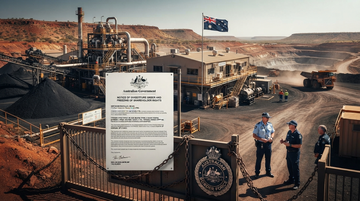
Australia’s enforcement action around rare earths is best understood as an ownership-and-control policy, not a project-permit policy. In mid-2026, the government moved to (1) order Chinese-linked shareholders in Northern Minerals to sell their Northern Minerals holdings, and later (2) freeze the shareholder rights of additional Chinese-linked investors that the Treasurer believed remained registered on the share register.
That sequencing matters for markets: it signals the rules may be applied repeatedly as long as the share registry does not fully comply.
| Action | Company/project | Counterparty type | Timing described | What changed |
|---|---|---|---|---|
| Divestiture order | Northern Minerals Limited (Browns Range rare earth project) | Chinese-linked shareholders | Treasurer Jim Chalmers issued orders “on Monday” (May 2026 cycle, per coverage) | Ordered Chinese-linked shareholders to sell Northern Minerals stakes within a two-week window |
| Rights freeze | Northern Minerals Limited (share register) | Named Chinese-linked investors | Article describes a review of the share register triggered by 2 July 2026, with July 2026 freeze outcomes | Blocked three investors from voting/exercising other shareholder rights at future meetings (including a postponed AGM) |
Supply-chain transmission
How this policy transmits through the rare-earth supply chain (2-step mechanism)
- Step 1 (ownership constraint): Australia can force divestment and restrict voting rights for “Chinese-linked” shareholders, which increases the probability of governance churn, compliance costs, and settlement delays for projects like Northern Minerals.
- Step 2 (capital repricing): governance churn discourages some strategic/financial capital from participating unless they price in additional regulatory uncertainty; that moves funding toward Western, security-friendly ownership structures.
This is second-order versus the older playbook of “build capacity away from China.” Here, the constraint is the investor base that can hold equity in Western critical-minerals projects.
For investors watching listed rare-earth developers (and their downstream customers), this changes the expected distribution of outcomes: timelines become less about metallurgical feasibility and more about whether the project’s ownership can remain compliant through successive FIRB-type decisions.
What investors should measure next
The governance premium lens: 6 metrics that should move when security control tightens
- Shareholder compliance risk: whether major investors are fully disentangled from restricted counterparties, with repeatable proof across time (not just at one settlement date).
- Financing friction: whether equity raise strategies tilt toward Western institutional structures after government enforcement actions (a direct cost of capital shift).
- Voting rights and meeting cadence: whether freezes delay AGMs/approvals and slow development milestones that require board/shareholder approvals.
- Time-to-permit isn’t the only timeline: policy enforcement can create “capital timeline” risk even when technical development continues.
- Project control “stickiness”: projects may need restructuring into more security-aligned ownership to avoid repeated compliance interventions.
- Downstream contracting confidence: buyers may prefer offtake counterparties whose ownership profile is less likely to trigger future forced divestment.
These metrics are the practical bridge between policy enforcement and financial outcomes. If you model critical-minerals development as a capital allocation problem, security-driven ownership constraints become a measurable component of the discount rate—not a narrative factor.
Listed-company implications (data-first)
Why MP Materials, USA Rare Earth, and Lynas are the “re-pricing” set—not Northern Minerals alone
Northern Minerals is where the policy action is visible in the cleanest way (divestiture and rights freezes). But the market impact is likely to appear where investors can actually underwrite production and separation/processing capacity on more predictable security terms.
Using listed-company fundamentals data available in this session, the practical implication is: investors will compare Western producers on both (a) project economics and (b) governance/capital stability risk.
MP Materials FY2024 revenue
$203.9M
FY 2024 reported revenue from data tools
MP Materials FY2024 net income
-$97.1M
FY 2024 bottom-line net income from data tools
USA Rare Earth FY2024 net income
$7.9M
FY 2024 bottom-line net income from data tools (note: income statement fields reflect the company’s reporting line items)
Lynas FY2024 net income
A$84.5M
FY ended Jun 30, 2024 net income from data tools
Fundamentals check
Current fundamentals show why the market will care about “security-controlled” timelines
MP Materials: revenue and net income show high volatility, making timeline risk costlier than in steadier commodity businesses
FY 2022–FY 2024 from data tools
Unit: USD
MP revenue FY2022
USD
527,510,000
MP revenue FY2023
USD
253,445,000
MP revenue FY2024
USD
203,855,000
MP net income FY2022
USD
293,445,000
MP net income FY2023
USD
24,307,000
MP net income FY2024
USD (loss)
-97,107,000
When fundamentals swing like MP Materials’ (profit to loss across FY2023–FY2024 in the data tools), any additional “governance timeline” uncertainty can have outsized valuation impact. This is exactly what security-controlled asset-class policies can amplify: they add a second source of volatility on top of commodity/contracting cycles.
So the core thesis for public-market investors is not “policy helps rare earths.” It is: policy increases the governance discount rate, and that discount rate shows up in cost of capital, financing terms, and therefore equity valuation.
Upstream + downstream supply-chain entities (named linkages)
The security-control lens reshuffles who gets funded upstream and who feels safer buying downstream
- Upstream linkage #1: Northern Minerals’ Browns Range development is a Western rare-earth feedstock potential; when ownership is restricted, its path to financing and continuity becomes part of the “supply security” bargain.
- Upstream linkage #2: Australia’s enforcement increases the likelihood that Western miners and processors will face fewer forced-ownership changes, which supports longer-term offtake planning by buyers.
- Downstream linkage #1: For processors and magnet/material buyers, a more predictable ownership/compliance chain reduces the probability of abrupt project-level disruption due to shareholder rights freezes or divestiture orders.
- Downstream linkage #2: For governments underwriting defense/industrial supply chains, “security-controlled equity” can be treated as an additional assurance layer alongside physical capacity and processing timelines.
Synthesis thesis
The bottom line: the market will start pricing rare-earth projects as regulated security assets
Australia’s foreign investment enforcement against Chinese-linked owners in a rare-earths developer shows a shift toward security-controlled asset classes. The governance mechanism is clear in open reporting: ordered divestment and later freezing of shareholder rights for named Chinese-linked investors on the share register.
For listed rare-earth equities, that means the relevant competitive set isn’t only “who has ore.” Investors will increasingly ask: “Can this asset stay compliant and financing-ready across ownership and regulatory time?” For the winners, security-aligned capital becomes easier to justify even when fundamentals are volatile.
Listed takeaways: who is most likely to feel the governance/time-cost repricing
- MP revenue swung from $527.5M (FY2022) to $203.9M (FY2024), so governance timeline uncertainty hits valuation harder than in steadier producers.
- MP’s FY2024 bottom-line net income was -$97.1M; security-controlled financing stability can matter most when margins compress.
- USA Rare Earth’s FY2024 bottom-line net income was $7.9M while revenue is reported as 0 in the data tool; its equity story is likely more governance/timing sensitive than cash-flow statements suggest.
- A security-controlled capital environment should increase the premium for Western-friendly ownership structures—watch for financing terms changes next.
- Lynas net income was A$84.5M in FY ended Jun 30 2024; it can absorb short-term policy-driven sentiment shocks better than pre-revenue developers.
- If competitors face governance churn, Lynas may see demand preference for compliance-stable offtake—but execution and regulation risks still dominate.
- Australia ordered Chinese-linked investors to sell Northern Minerals stakes and later froze voting/rights for named Chinese-linked investors; this increases near-term control and capital friction.
- If repeated compliance actions occur, the risk is slower financing and slower development milestones versus peers with cleaner registries.