%22%2F%3E%0A%20%20%3Ccircle%20cx%3D%22220%22%20cy%3D%22150%22%20r%3D%22180%22%20fill%3D%22%2322d3ee%22%20fill-opacity%3D%220.12%22%2F%3E%0A%20%20%3Ccircle%20cx%3D%221010%22%20cy%3D%22130%22%20r%3D%22220%22%20fill%3D%22%2338bdf8%22%20fill-opacity%3D%220.08%22%2F%3E%0A%20%20%3Ccircle%20cx%3D%22920%22%20cy%3D%22520%22%20r%3D%22170%22%20fill%3D%22%2322d3ee%22%20fill-opacity%3D%220.06%22%2F%3E%0A%20%20%3Cpath%20d%3D%22M140%20430h920%22%20stroke%3D%22url(%23line)%22%20stroke-width%3D%2212%22%20stroke-linecap%3D%22round%22%2F%3E%0A%20%20%3Cpath%20d%3D%22M220%20360c120-150%20260-220%20380-220s260%2070%20380%20220%22%20fill%3D%22none%22%20stroke%3D%22%2367e8f9%22%20stroke-opacity%3D%220.5%22%20stroke-width%3D%2216%22%20stroke-linecap%3D%22round%22%20stroke-linejoin%3D%22round%22%2F%3E%0A%20%20%3Cpath%20d%3D%22M300%20398h600%22%20stroke%3D%22%2394a3b8%22%20stroke-opacity%3D%220.24%22%20stroke-width%3D%228%22%20stroke-linecap%3D%22round%22%2F%3E%0A%20%20%3Ctext%20x%3D%22220%22%20y%3D%22510%22%20fill%3D%22%23e2e8f0%22%20fill-opacity%3D%220.7%22%20font-family%3D%22Arial%2C%20Helvetica%2C%20sans-serif%22%20font-size%3D%2238%22%20letter-spacing%3D%228%22%3EINSIGHTS%3C%2Ftext%3E%0A%3C%2Fsvg%3E)
The paradox investors should model, not debate
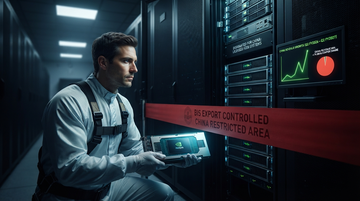
Nvidia tries to be the “neutral AI platform” on the open-model argument while export controls tighten the China line
The investor takeaway from NVIDIA’s Aug 27 messaging is not the soundbite—it’s the structure: it argues for wider openness in AI models while it must still operate inside a shrinking China-compute corridor. That combination matters because it reframes China demand as an ecosystem problem (models, software, and developer adoption) rather than a pure hardware-sale question.
The risk is that regulators will treat ecosystem openness as an accelerant for advanced compute access. The opportunity is that if openness reduces friction for adoption, NVIDIA can defend long-run platform pull even when specific product shipments are constrained by BIS licenses.
Verified factual anchor: what Nvidia disclosed about China under U.S. licensing
The China line is now governed by granular BIS licensing—and the math is already showing up in results
China revenue (incl. Hong Kong), Q2 FY2027
$7,880M
Three Months Ended Jul 26, 2026
China revenue (incl. Hong Kong), Q2 FY2026
$3,985M
Three Months Ended Jul 27, 2025
China revenue growth (YoY), Q2 FY2027 vs Q2 FY2026
+98%
Based on disclosed geography revenue totals
H200 program: inventory/purchase-obligation charge
$0.4B
First half FY2027, associated with H200
H200 shipment share of Data Center revenue
<1%
Most recent quarter disclosed
In its Aug 26, 2026 filing covering the Three Months Ended Jul 26, 2026, NVIDIA reported China revenue (including Hong Kong) of $7,880M for Q2 FY2027, versus $3,985M for the comparable quarter a year earlier. In the same disclosure set, the company described a U.S.-license pathway for small H200 shipments to specific China-based customers—while also disclosing that it incurred a $0.4B charge in the first half of fiscal 2027 tied to H200 excess inventory and purchase obligations when demand diminished.
The key detail for modeling export-control outcomes is that licensed shipments were less than 1% of Data Center revenue in the most recent quarter, meaning the licensing regime can be simultaneously “permissioned” and commercially binding.
What the paradox implies about incentives across the supply chain
Export-control pressure turns “model openness” into a competitive lever—because compute scarcity shifts who captures value
- If the U.S. blocks broad advanced compute access, developers push for alternative training/inference paths; that boosts demand for “platform” components like software stacks and reference implementations.
- Chinese open-model momentum can increase the installed base of workflows that are optimized for NVIDIA acceleration—even when specific high-end SKUs face shipment constraints.
- Downstream integrators (cloud, system builders, and enterprise AI platforms) can still buy and deploy where policy permits, but they may re-route production and capacity planning to licensed or offshore access pathways.
- Suppliers tied to networking, interconnect, and deployment infrastructure benefit when training and inference scale continue under constrained chip flows; margins can shift from GPUs toward the rest of the compute stack.
This is why the Aug 27 “openness vs crackdown” positioning is a trade tell: it signals that NVIDIA expects AI platform capture to survive even if certain direct shipments get squeezed.
The counterweight is regulator logic. In practice, export-control rules can respond to ecosystem effects (how models spread, where they run, and what compute they require) by tightening the permission surface—especially as BIS revises licensing guidance for advanced AI hardware.
Short-term: what moves first in markets and in the filing trail
In the next weeks, watch for two things: China revenue persistence and new export-control phrasing in filings
In the near term, investors should treat China geography results as the earliest checkpoint. If Q3 FY2027 continues to show elevated China revenue despite ongoing licensing outcomes, the market may interpret it as evidence that the platform ecosystem can offset direct shipment constraints.
At the same time, the export-control language in the next SEC filings will matter. Look for whether NVIDIA describes changes to licensing feasibility, inspection conditions, tariff pass-through expectations, or product-specific restrictions—those are the textual leading indicators of future BIS cycles.
Fundamentals check: does Nvidia’s profitability profile look like “optionality,” not “one-quarter trade”?
The financial baseline supports resilience—but the disclosed charges show the export-control regime can still bite
Revenue (TTM through latest reported quarter)
$303.0B
TTM, reported Aug 26, 2026
Operating income (TTM)
$197.6B
TTM, reported Aug 26, 2026
Free cash flow (TTM)
$127.0B
TTM, reported Aug 26, 2026
Gross margin (TTM)
74.7%
TTM, reported Aug 26, 2026
On the surface, NVIDIA’s profitability remains very strong. For the TTM through the latest reported quarter in its Aug 26, 2026 report set, revenue is disclosed at $302.969B, operating income at $197.579B, and free cash flow at $127.006B.
But the H200 disclosure makes clear that even in a high-cash environment, export controls can impose real working-capital damage. The $0.4B charge tied to excess inventory and purchase obligations in the first half of FY2027 is the kind of accounting and cash-flow stress that tends to recur when policy shifts hit product demand timing.
Downside risks and what would break the thesis
What would make the “platform openness” strategy fail
- A policy turn that reduces the effective permission surface so far that H200-like licensed pathways no longer prevent material data-center revenue declines in China.
- A further tightening of product-criteria thresholds (performance density / interconnect / memory bandwidth) that forces NVIDIA to redesign or reclassify offerings for China.
- Tariff or inspection conditions that NVIDIA explicitly says it cannot pass through—raising effective landed costs for customers and accelerating demand shifts away from [NVIDIA](nvda].
- An environment where open-model adoption triggers faster regulator response, leading to broader controls not only on chips but also on enabling tools and deployment architectures.
None of those risks can be ruled out. The good news is that NVIDIA has already given a roadmap of how the regime bites: geography exposure remains meaningful, but product-specific licensing results can be commercially constrained and cash-volatile.
Listed stocks with the clearest transmission channels
- China revenue rose to $7,880M in Q2 FY2027 even with licensing constraints, supporting the platform narrative.
- H200 licensing generated a $0.4B H200 charge in 1H FY2027, showing export controls still damage working capital.
- If next BIS phrasing further shrinks licensed product share, Data Center revenue contribution from licensed SKUs can stay under 1% and pressure margins.
- If the U.S. tightens advanced AI hardware definitions, customer re-qualification cycles could extend across quarters, altering near-term orders.
- Open-model adoption can still expand total AI compute demand, so AMD demand may rise if buyers diversify accelerators (catalyst: next earnings calls).
- Any BIS shift that favors broader “open” ecosystems could benefit Intel’s process- and platform-led strategies only if it can meet performance thresholds.
- If export-control restrictions cap the addressable AI accelerator market in China, Intel’s data-center cadence may slow (watch in upcoming quarters).
- When GPU access is constrained, systems scale still needs networking; AI infrastructure spend can shift toward interconnect and deployment layers where Broadcom participates.
- If China adoption persists, Broadcom’s networking exposure can keep improving even when specific GPU SKUs are licensed.
- Open-model ecosystems can increase the number of deployment use cases, so Palantir can win more integration projects (hinges on enterprise adoption).
- If export controls reduce access to cutting-edge training accelerators, time-to-deploy may rise for the most compute-heavy customer programs.
- China open-model momentum can support ongoing AI infrastructure buildout; Alibaba’s AI platform demand can remain resilient if developers keep shipping models.
- If U.S. controls expand to affect enabling compute supplies, Alibaba’s training/inference costs could rise, pressuring AI unit economics.