%22%2F%3E%0A%20%20%3Ccircle%20cx%3D%22220%22%20cy%3D%22150%22%20r%3D%22180%22%20fill%3D%22%2322d3ee%22%20fill-opacity%3D%220.12%22%2F%3E%0A%20%20%3Ccircle%20cx%3D%221010%22%20cy%3D%22130%22%20r%3D%22220%22%20fill%3D%22%2338bdf8%22%20fill-opacity%3D%220.08%22%2F%3E%0A%20%20%3Ccircle%20cx%3D%22920%22%20cy%3D%22520%22%20r%3D%22170%22%20fill%3D%22%2322d3ee%22%20fill-opacity%3D%220.06%22%2F%3E%0A%20%20%3Cpath%20d%3D%22M140%20430h920%22%20stroke%3D%22url(%23line)%22%20stroke-width%3D%2212%22%20stroke-linecap%3D%22round%22%2F%3E%0A%20%20%3Cpath%20d%3D%22M220%20360c120-150%20260-220%20380-220s260%2070%20380%20220%22%20fill%3D%22none%22%20stroke%3D%22%2367e8f9%22%20stroke-opacity%3D%220.5%22%20stroke-width%3D%2216%22%20stroke-linecap%3D%22round%22%20stroke-linejoin%3D%22round%22%2F%3E%0A%20%20%3Cpath%20d%3D%22M300%20398h600%22%20stroke%3D%22%2394a3b8%22%20stroke-opacity%3D%220.24%22%20stroke-width%3D%228%22%20stroke-linecap%3D%22round%22%2F%3E%0A%20%20%3Ctext%20x%3D%22220%22%20y%3D%22510%22%20fill%3D%22%23e2e8f0%22%20fill-opacity%3D%220.7%22%20font-family%3D%22Arial%2C%20Helvetica%2C%20sans-serif%22%20font-size%3D%2238%22%20letter-spacing%3D%228%22%3EINSIGHTS%3C%2Ftext%3E%0A%3C%2Fsvg%3E)
What changed
The policy shift is not open or closed. It is selective access with narrower lanes.
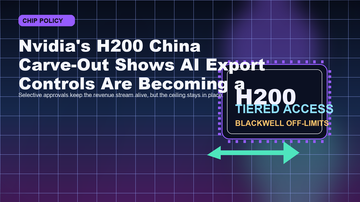
The clearest signal from the latest H200 reporting is that export controls are becoming a tiered market. Nvidia is not simply shipping chips to China at scale, and China is not simply cut off. Access is being differentiated by chip generation, customer approval, and compliance scrutiny.
That matters because the H200 is still a powerful Hopper-class accelerator, but it is not Blackwell. The market is learning to price a hierarchy: top-end systems can still be restricted, older or less advanced parts can be conditionally sold, and the approved customer list becomes part of the product.
In practice, policy is shaping revenue mix and gross margin mix at the same time.
Why it matters
A tiered market is still a market, but it is slower, more expensive, and less scalable.
A pure ban would have been simpler to model. A selective licensing regime is harder because it preserves some revenue while keeping the strategic ceiling in place.
The FT reporting that the authorized buyer list was cut by more than half is the key second-order signal. It means compliance is becoming part of the supply chain, not a footnote.
Chinese buyers that cannot get the newest U.S. chips will continue leaning harder into domestic accelerators. That keeps geopolitics embedded in semis valuation.
Export-control tiers around Nvidia AI chips
Analyst-coded tier map using the headline policy facts from the latest reports.
Unit: count / binary / relative scale
Approved firms (approx.)
Named buyers with permission
10
Buyer list reduction (%)
More than half removed
50
H200 access
Limited access remains
1
Blackwell access
Still off-limits
0
Shipments scale
Described as small
1
Compliance intensity
High relative to a normal channel sale
3
Read-through
Every China exception now gets priced as a special case.
China is no longer an all-or-nothing swing factor. It is a special-case revenue stream with policy friction attached.
That is why the H200 carve-out matters for Nvidia itself and for the broader AI semiconductor group. If access can be carved up by generation and customer, the market should think in terms of product tiers, approval tiers, and region-specific gross margins rather than a single global TAM.
The cleanest read-through is not 'China is back.' It is 'the chip war is now administered.'
| Tier | What it means | Investor implication |
|---|---|---|
| Blackwell | Still restricted | Upside constrained by policy ceiling |
| H200 / Hopper | Selective approvals | Some revenue preserved, but not normalized |
| Approved buyer list | Only named firms can participate | Compliance becomes part of the moat |
| Domestic China chips | Fills the gap where U.S. supply is blocked | Longer-term competition rises |