%22%2F%3E%0A%20%20%3Ccircle%20cx%3D%22220%22%20cy%3D%22150%22%20r%3D%22180%22%20fill%3D%22%2322d3ee%22%20fill-opacity%3D%220.12%22%2F%3E%0A%20%20%3Ccircle%20cx%3D%221010%22%20cy%3D%22130%22%20r%3D%22220%22%20fill%3D%22%2338bdf8%22%20fill-opacity%3D%220.08%22%2F%3E%0A%20%20%3Ccircle%20cx%3D%22920%22%20cy%3D%22520%22%20r%3D%22170%22%20fill%3D%22%2322d3ee%22%20fill-opacity%3D%220.06%22%2F%3E%0A%20%20%3Cpath%20d%3D%22M140%20430h920%22%20stroke%3D%22url(%23line)%22%20stroke-width%3D%2212%22%20stroke-linecap%3D%22round%22%2F%3E%0A%20%20%3Cpath%20d%3D%22M220%20360c120-150%20260-220%20380-220s260%2070%20380%20220%22%20fill%3D%22none%22%20stroke%3D%22%2367e8f9%22%20stroke-opacity%3D%220.5%22%20stroke-width%3D%2216%22%20stroke-linecap%3D%22round%22%20stroke-linejoin%3D%22round%22%2F%3E%0A%20%20%3Cpath%20d%3D%22M300%20398h600%22%20stroke%3D%22%2394a3b8%22%20stroke-opacity%3D%220.24%22%20stroke-width%3D%228%22%20stroke-linecap%3D%22round%22%2F%3E%0A%20%20%3Ctext%20x%3D%22220%22%20y%3D%22510%22%20fill%3D%22%23e2e8f0%22%20fill-opacity%3D%220.7%22%20font-family%3D%22Arial%2C%20Helvetica%2C%20sans-serif%22%20font-size%3D%2238%22%20letter-spacing%3D%228%22%3EINSIGHTS%3C%2Ftext%3E%0A%3C%2Fsvg%3E)
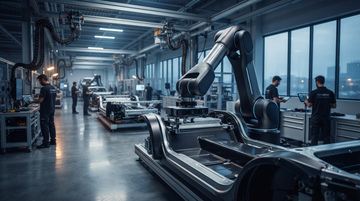
BlackBerry’s bet is simple: stop treating QNX like a legacy automotive software supplier, and start treating it like the operating layer for physical AI in cars and robots. On Aug. 25, 2026, BlackBerry CEO John Giamatteo publicly positioned QNX as already embedded in 275 million vehicles and discussed a $950 million royalty backlog, with robotics described as part of that upside—setting up an “installed-base monetization” narrative rather than a phone-vendor narrative.
What matters for investors is whether the installed base can turn into a growth engine quickly enough to justify today’s valuation, where sentiment still appears to be anchored to BlackBerry’s historical product trajectory rather than QNX’s role in AI workloads.
The pivot
BlackBerry is moving QNX’s sales story from cars-only to AI cars + robotics
The strategic shift is that QNX is no longer framed only as a safety-critical automotive OS. Instead, BlackBerry is marketing QNX as the runtime layer for AI-enabled “physical” systems—cars and robots—where software must be deterministic, real-time, and certifiable under safety constraints.
Load-bearing claims to anchor the thesis
QNX installed base
275M vehicles (company CEO commentary)
Supported by CNBC interview commentary, Aug. 25, 2026.
Royalty backlog
~$950M (company CEO commentary)
Supported by CNBC interview commentary, Aug. 25, 2026.
If BlackBerry is right, the economic advantage is not “who has the best AI model,” but who can get certified software stacks deployed across many OEM platforms. That creates switching friction: replacing an OS/runtimes layer after certification is costly for OEMs and integrators.
The monetization math investors must test
Installed base helps—only if royalty growth keeps up with “AI workload” complexity
A vehicle-per-install count can create a compelling narrative, but it is not enough by itself. The real question is whether the company’s licensing/royalty model benefits from (1) higher software value per vehicle as AI workloads increase, and (2) faster expansion into robotics/industrial environments where certification and real-time guarantees are similarly required.
BlackBerry revenue trend
$580.3M
TTM through May 31, 2026 (reported as TTM by market data providers; fundamentals context)
BlackBerry gross margin
77.1%
TTM through May 31, 2026
BlackBerry operating margin
10.8%
TTM through May 31, 2026
Valuation pressure
83.1x
TTM P/E (market data context)
| What must improve | Why it matters | What would falsify the thesis |
|---|---|---|
| Royalty/embedded software economics rise with AI deployments | AI workloads tend to increase software value per platform, supporting higher royalties | If royalty growth stays flat while installed base claims grow |
| Operating margin holds or expands | Higher-value licensing plus low incremental cost should expand margins if mix improves | If margins compress due to rising R&D/S&M without revenue acceleration |
| Robotics becomes a measurable contributor | Robotics is the growth lever BlackBerry is using to widen the platform story beyond cars | If robotics remains “included in backlog” but never converts to reported revenue |
Supply-chain and competitive positioning
QNX competes for the “certification layer,” while the compute stack competes for the “AI layer”
The investors’ trap is assuming this is a direct contest with AI compute incumbents. The more realistic view is a layered stack:
1) Compute and accelerators (where Nvidia and others try to win performance per watt), 2) Autonomy perception stacks and toolchains (where companies like Mobileye try to own the driving pipeline), and 3) The safety-critical runtime/OS layer (where QNX aims to own determinism, security, and certification readiness).
BlackBerry’s pitch is that physical AI needs (3) as much as it needs (1) and (2).
- If OEMs adopt AI compute modules, QNX can remain stable while models change—reducing OS-level replacement risk.
- If robotics expands across warehouses, hospitals, and industrial sites, QNX’s “mission-critical embedded” positioning becomes relevant beyond automobiles.
- If certification cycles stay the bottleneck, the platform that is already integrated and proven can win faster incremental deployments.
Short-term catalysts vs. long-term proof points
The next 1–2 quarters test conversion; the next 1–3 years test whether robotics can become a growth engine
In the near term, the market will likely focus on whether guidance and quarterly reporting show (a) royalty/recurring software strength and (b) operating leverage. In the long term, investors should focus on robotics: not just as an aspirational category, but as a recurring monetization stream that can diversify demand away from purely vehicle program ramps.
Because QNX is already embedded in millions of vehicles, the “time to scale” question becomes: how quickly AI/robotics programs upgrade from pilots to production, and how much of that upgrade is priced as OS/runtime licensing rather than only as application-layer integration.
What to conclude now
A cheap OS can be the right trade—if BlackBerry can prove it without waiting for full autonomy to land
BlackBerry’s public messaging shifts QNX from a fading legacy OS interpretation to a physical-AI platform interpretation. The core investor value proposition is that an OS with safety certification credibility and an enormous embedded base can monetize incremental AI workloads across both cars and robots.
However, the burden of proof is on conversion. The re-rate won’t come from installed-base claims alone; it will come from how those claims show up in revenue recognition, royalty growth, and margin discipline.
Listed stocks most exposed to the “physical AI stack” reallocation
- QNX’s installed base and backlog give a path to recurring monetization, but investors must see conversion into reported revenue within quarters.
- If operating leverage remains intact, TTM operating margin ~10.8% can rise, supporting a valuation re-rate beyond turnaround-only expectations.
- In the short term, any backlog-to-revenue acceleration should move sentiment faster than long-cycle OEM procurement.
- Nvidia can still benefit because AI compute remains the demand driver, but QNX’s OS layer can reduce software switching, limiting incremental share for AI toolchains at the OS level.
- If physical-AI deployments accelerate in cars/robots, AI platform utilization can rise—a positive for compute revenue.
- Over 1–3 years, deterministic certification stacks can favor platform stability, potentially shifting bargaining power between compute and OS providers.
- Qualcomm’s edge SoCs can gain content in AI-enabled cockpits, but QNX’s runtime stickiness can cap how much software value accrues to chip vendors.
- Near term, production deployment cycles (not pilots) are what should determine whether handset-style adoption narratives spill into automotive.
- Long term, if robotics scales, edge compute demand per robot may increase, supporting upside even if OS-level economics remain with QNX-like providers.
- If OEMs treat QNX as the stable safety-certified foundation, autonomy stack differentiation may shift slower than investors expect, pressuring Mobileye multiples.
- Mobileye’s upside depends on winning application-layer share, but the OS layer can become the gating item that slows replacement of incumbents.
- Over the next 1–2 quarters, updates on production scaling matter more than partnership headlines.
- Automotive and robotics share secure microcontroller/edge security demand, but OS-level reuse can shift value away from component-level software integration toward licensing and toolchain stability.
- If AI expands vehicle/robot BOMs, embedded secure element and MCU content could rise, supporting upside.
- Long term, certification-driven deployments can benefit vendors with strong safety/security portfolios, but the winners depend on program design cycles.