%22%2F%3E%0A%20%20%3Ccircle%20cx%3D%22220%22%20cy%3D%22150%22%20r%3D%22180%22%20fill%3D%22%2322d3ee%22%20fill-opacity%3D%220.12%22%2F%3E%0A%20%20%3Ccircle%20cx%3D%221010%22%20cy%3D%22130%22%20r%3D%22220%22%20fill%3D%22%2338bdf8%22%20fill-opacity%3D%220.08%22%2F%3E%0A%20%20%3Ccircle%20cx%3D%22920%22%20cy%3D%22520%22%20r%3D%22170%22%20fill%3D%22%2322d3ee%22%20fill-opacity%3D%220.06%22%2F%3E%0A%20%20%3Cpath%20d%3D%22M140%20430h920%22%20stroke%3D%22url(%23line)%22%20stroke-width%3D%2212%22%20stroke-linecap%3D%22round%22%2F%3E%0A%20%20%3Cpath%20d%3D%22M220%20360c120-150%20260-220%20380-220s260%2070%20380%20220%22%20fill%3D%22none%22%20stroke%3D%22%2367e8f9%22%20stroke-opacity%3D%220.5%22%20stroke-width%3D%2216%22%20stroke-linecap%3D%22round%22%20stroke-linejoin%3D%22round%22%2F%3E%0A%20%20%3Cpath%20d%3D%22M300%20398h600%22%20stroke%3D%22%2394a3b8%22%20stroke-opacity%3D%220.24%22%20stroke-width%3D%228%22%20stroke-linecap%3D%22round%22%2F%3E%0A%20%20%3Ctext%20x%3D%22220%22%20y%3D%22510%22%20fill%3D%22%23e2e8f0%22%20fill-opacity%3D%220.7%22%20font-family%3D%22Arial%2C%20Helvetica%2C%20sans-serif%22%20font-size%3D%2238%22%20letter-spacing%3D%228%22%3EINSIGHTS%3C%2Ftext%3E%0A%3C%2Fsvg%3E)
Verified event
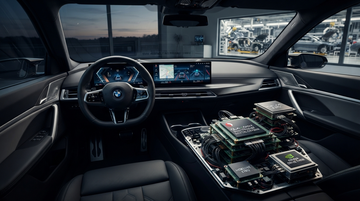
BMW picked Qualcomm as its lead compute silicon provider for digital cockpit + next-gen ADAS through the next decade
What BMW explicitly bought (per the primary announcement)
Supplier role
Lead compute silicon provider
BMW Group selected Qualcomm for digital cockpit + ADAS compute
Compute architecture scope
Snapdragon Digital Chassis
Includes Snapdragon Cockpit + Snapdragon Ride platforms
Time horizon
“Through the next decade”
Duration language used in the press release
Why this matters in the 2026-2028 chip war
The “central compute” wave moves value from sensors to chips—and Qualcomm’s cockpit/ADAS stack is where it lands first
Auto OEMs are consolidating dozens of electronic control units into fewer, higher-performance “central compute” domains. In that world, the economic battleground shifts from raw perception algorithms to the silicon that has to run cockpit + ADAS workloads on a unified compute backbone—with qualification timelines that tend to lock in multi-year platform winners.
Supply chain mechanics
Full stack view: the BMW win implies Qualcomm’s compute stack needs (1) leading-edge manufacturing capacity (2) packaging + test (3) ramp logistics—before software revenue shows up
- Qualcomm’s central compute selection means BMW is betting on Snapdragon Cockpit + Snapdragon Ride silicon as the platform’s compute foundation for both UX and ADAS workloads.
- Multi-year “through the next decade” language implies a qualification and ramp path that stresses manufacturing yield and reliability rather than one-off prototyping.
- Cockpit/ADAS compute consolidation increases silicon content per vehicle (fewer ECUs, more compute) and raises the share of value captured by compute suppliers relative to traditional ECU-per-feature designs.
This is where supply-chain awareness changes the story. Even if the long-term value is “more revenue,” the near-term investor read-through is whether the win tightens the control of compute silicon supply—because that’s what allows OEM platform lock-in to translate into sustained production shipments.
Who loses (or at least gets challenged) and why
The real competitive tension is not mobile phones vs. AI—it’s three silicon philosophies competing to own the vehicle compute layer
BMW’s choice sets up a direct competitive comparison across the three “compute ownership” archetypes: (a) vision/control stacks centered on Mobileye’s platform approach, (b) general-purpose accelerated central compute associated with NVIDIA’s Drive/Thor ecosystem, and (c) Qualcomm’s Snapdragon Digital Chassis designed for cockpit + ADAS central compute under automotive validation requirements.
Qualcomm fundamentals vs. the auto-silicon thesis
Qualcomm’s cash engine can fund the edge-to-auto bet—but investors should still verify whether automotive becomes a bigger slice of profits
The point is not that BMW alone moves the needle in one quarter. It’s that Qualcomm already produces meaningful free cash flow (~$12.82B in FY2025)—which gives it budget flexibility to keep investing in automotive-qualified compute and to accelerate the software stack needed to convert design wins into paid content.
5 research angles to monitor (2026-2028)
What to track next: design-win conversion, compute content per vehicle, and evidence that automotive turns into “repeatable cash,” not one-off PR
- Track whether BMW discloses which Snapdragon Digital Chassis elements are covered at ramp—because that determines how much compute silicon content is actually shipped per vehicle program year.
- Watch for competitor pushback in OEM design cycles—because if Mobileye (MBLY) or NVIDIA (NVDA) reasserts deals, then this win becomes platform-specific rather than category-defining through the decade.
- Verify whether Qualcomm’s automotive-related revenue trend and operating leverage improve—because investors need evidence that auto-silicon wins raise margin or stabilize cash generation beyond cyclical phone demand.
- Monitor ecosystem dependencies: ADAS central compute usually needs camera/vision processing, interconnect, and reliable software updates—so the key milestone is program OTA and validation rollouts that prove sustained performance.
Causal chain (non-obvious): why this deal is more than a logo win
Why BMW’s “lead compute silicon through the next decade” wording is a strategic leverage point
Deal language matters because “lead compute silicon provider” and “through the next decade” increase the probability that Qualcomm owns not just one chip, but the update cadence and platform compute roadmap. That makes the win a mechanism for locking software portability and performance targets—so software + silicon co-optimization becomes harder for competitors to displace mid-cycle.
| Verified fact | Investor mechanism | What to look for next |
|---|---|---|
| BMW selected Qualcomm as lead compute silicon provider | Qualcomm is positioned as the compute backbone supplier for cockpit + ADAS | Design-in disclosures, platform architecture diagrams, content expansion |
| Agreement spans Snapdragon Digital Chassis (Snapdragon Cockpit + Snapdragon Ride) | Qualcomm is tied to multiple central compute domains, not a single MCU task | Proof that both domains ship together on the ramp schedule |
| “Through the next decade” duration language | Raises competitive switching friction via validation and roadmap continuity | Subsequent OEM wins that mirror the same breadth/duration terms |
Short-term vs. long-term horizons
Near-term: narrative and sentiment. Long-term: whether automotive becomes a repeatable cash-generating franchise
Qualcomm’s operating scale and cash generation context (FY2023-FY2025)
Used to anchor the “can fund the pivot” argument—not to quantify BMW revenue impact (not disclosed).
Unit: $B
FY2023 revenue ($B)
Income statement FY2023
35.8
FY2024 revenue ($B)
Income statement FY2024
39
FY2025 revenue ($B)
Income statement FY2025
44.3
- Short-term (days–quarters): expect market focus on whether this deal changes the auto-semiconductor narrative for Qualcomm, even though volumes are not disclosed.
- Short-term: the absence of unit/revenue disclosure means confirmation will come via later program updates, not this announcement alone.
- Long-term (1–3 years): the key milestone is whether Qualcomm’s automotive wins start to show measurable improvements in revenue mix, operating leverage, or cash conversion attributable to automotive compute.
Listed-market transmission channels (what investors should watch)
- Qualcomm's Snapdragon Digital Chassis scope ties it to BMW cockpit + ADAS central compute shipments, supporting multi-year revenue visibility (volumes not disclosed).
- Qualcomm already generated $12.82B of FY2025 free cash flow, giving funding capacity for automotive ramp and software enablement.
- If follow-on OEM design wins mirror the breadth/duration language, then automotive can become a repeatable cash franchise rather than a small edge add-on (needs future reporting).
- BMW’s choice of Qualcomm as lead compute silicon for cockpit + ADAS raises switching friction away from Mobileye’s platform-centric approach in at least this program cycle (no explicit “loss” stated).
- Mobileye reported FY2025 net income of -$392M, so losing or delaying additional design wins would likely pressure perceived path to profitable scale.
- Over 1–3 years, the key test is whether Mobileye’s backlog converts into shipments fast enough that losses stop widening during central-compute centralization.
- By selecting Qualcomm for lead central compute silicon, BMW signals OEMs can centralize compute without defaulting to NVIDIA’s Drive/Thor-style stack (at least for this platform).
- NVIDIA still benefits indirectly if centralized compute increases total vehicle compute demand, but this deal specifically does not increase NVIDIA exposure with disclosed numbers.
- If Qualcomm’s automotive central compute uses leading-edge nodes, the BMW ramp could increase steady demand for advanced wafer capacity via foundry supply chains (chip process specifics not disclosed).
- Near-term confirmation requires later teardown/spec or supply-chain disclosures; until then, this is a potential capacity tailwind, not a quantified forecast.
- Automotive central compute increases the need for robust automotive connectivity, security, and control-adjacent silicon; BMW’s compute consolidation could raise incremental content for edge and IO components (not disclosed in the deal).
- Over 1–3 years, the thesis becomes testable if NXP reports automotive design wins that coincide with central compute program ramps.