%22%2F%3E%0A%20%20%3Ccircle%20cx%3D%22220%22%20cy%3D%22150%22%20r%3D%22180%22%20fill%3D%22%2322d3ee%22%20fill-opacity%3D%220.12%22%2F%3E%0A%20%20%3Ccircle%20cx%3D%221010%22%20cy%3D%22130%22%20r%3D%22220%22%20fill%3D%22%2338bdf8%22%20fill-opacity%3D%220.08%22%2F%3E%0A%20%20%3Ccircle%20cx%3D%22920%22%20cy%3D%22520%22%20r%3D%22170%22%20fill%3D%22%2322d3ee%22%20fill-opacity%3D%220.06%22%2F%3E%0A%20%20%3Cpath%20d%3D%22M140%20430h920%22%20stroke%3D%22url(%23line)%22%20stroke-width%3D%2212%22%20stroke-linecap%3D%22round%22%2F%3E%0A%20%20%3Cpath%20d%3D%22M220%20360c120-150%20260-220%20380-220s260%2070%20380%20220%22%20fill%3D%22none%22%20stroke%3D%22%2367e8f9%22%20stroke-opacity%3D%220.5%22%20stroke-width%3D%2216%22%20stroke-linecap%3D%22round%22%20stroke-linejoin%3D%22round%22%2F%3E%0A%20%20%3Cpath%20d%3D%22M300%20398h600%22%20stroke%3D%22%2394a3b8%22%20stroke-opacity%3D%220.24%22%20stroke-width%3D%228%22%20stroke-linecap%3D%22round%22%2F%3E%0A%20%20%3Ctext%20x%3D%22220%22%20y%3D%22510%22%20fill%3D%22%23e2e8f0%22%20fill-opacity%3D%220.7%22%20font-family%3D%22Arial%2C%20Helvetica%2C%20sans-serif%22%20font-size%3D%2238%22%20letter-spacing%3D%228%22%3EINSIGHTS%3C%2Ftext%3E%0A%3C%2Fsvg%3E)
AI search funding • compute leverage
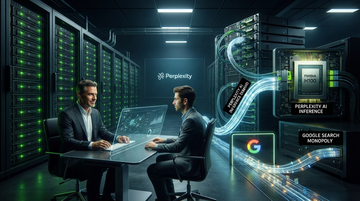
What’s actually being discussed: an Nvidia anchor position in a $30B+ Perplexity equity round
The central claim in the topic framing—Nvidia seeking an equity seat in Perplexity tied to a valuation above $30B—has a clean confirmation from reporting attributed to The Information: Nvidia is discussing investing in Perplexity as part of an equity round that would value the company at more than $30 billion.
The same report also indicates the round would increase Perplexity’s valuation by more than 50% versus its prior financing a year earlier. That combination matters because it implies investors are treating AI search as an investable winner-takes-most platform, not a short-lived “LLM wrapper.”
Signal check • what we can and can’t verify
Why this may be more than headline noise: Perplexity is already building at inference scale
Even without the rumored round closing, Perplexity’s product already runs at a scale where inference efficiency becomes a strategic advantage. Nvidia’s own public customer-story material (hosted on its site and mirrored across web indexes) has been used in industry writeups to support the idea that Perplexity serves hundreds of millions of queries—an order of magnitude where hardware, networking, and inference-serving software are not “supporting actors.”
However, in this research run, the specific Nvidia customer-story page containing the exact query figure could not be reliably opened end-to-end (a load/crawl gap). Because the exact number cannot be anchored to an opened primary document here, the article treats inference-scale as a qualitative premise rather than a numeric claim.
Supply chain • from chips to answer delivery
Full supply-chain view: where an AI search equity stake can create an advantage
- Upstream compute: an equity seat can tighten Nvidia’s feedback loop on inference-serve performance as Perplexity pushes for lower cost per answer.
- Platform glue: deeper co-design around serving stacks reduces time-to-iteration for latency, caching, and routing strategies that determine unit economics.
- Capex acceleration: if answer-generation grows faster than indexing-only search, GPU demand can shift from training-led to inference-led over time.
- Distribution leverage: an AI-native browser or app can change the customer acquisition funnel, so hardware wins are increasingly tied to product wins.
The economic point is simple: in AI search, every incremental user action can mean multiple inference steps. Equity makes the “cost reduction” story and the “growth” story converge—because the hardware vendor benefits whether Perplexity scales by spending more compute or by spending less per answer.
Competitive economics • Google’s ad flywheel
What changes for Google: the product surface shifts from links to answers
Google’s core search monetization has historically been tightly tied to click-through behavior—ads and organic results both ride on the link-list interface. AI answer engines try to break that link-list dependency by producing a response directly.
If Perplexity’s monetization (ads, subscriptions, or enterprise services) improves while user intent increasingly starts in “answer search,” Google faces a structural question: does fewer-click behavior reduce ad inventory value, or do advertisers re-train around new placements and formats?
Numbers that anchor the thesis • listed-company fundamentals (context)
Why the public-market look matters: Nvidia’s profitability profile is built for inference scale
Nvidia profit margin (TTM)
63.0%
NVIDIA Corporation metrics as reported in the latest available trailing window (gross margin and operating margins shown as trailing; no Perplexity-specific revenue disclosed in public filings).
Alphabet operating profit margin (TTM)
33.1%
Alphabet Inc. Class A metrics as reported in the latest available trailing window (search monetization is not broken out in the provided dataset).
Oracle enterprise infrastructure footprint (context)
25.4%
Oracle Corporation operating profit margin (TTM context; cloud and advertising services may interact with AI workloads, but no Perplexity-specific linkage is disclosed here).
The investment implication is not that public filings mention Perplexity directly. It’s that Nvidia’s business model and margins are consistent with a world where customers must scale inference infrastructure to serve new AI-native interfaces.
Short-term vs long-term • what moves first
What to watch next if this equity seat story is real
Decision timeline: what investors should monitor over weeks vs. quarters vs. years
This is a watchlist of catalysts implied by the equity-stake hypothesis; it is not a guarantee.
Unit: catalyst intensity
Funding confirmation and terms
Closing, investor list, and governance terms.
90
Inference-unit economics (proxy signals)
Any disclosed engagement growth paired with improved cost-to-serve.
75
Monetization shift (ads/subscriptions/enterprise)
Evidence that answer search drives repeat value, not just usage.
70
Competitive response in AI search UI
Alphabet product changes tied to “answer-first” experiences.
65
Inference-led infrastructure capex cycle
Longer-term shift toward serving as the dominant spend lever.
80
- Near-term (days–quarters): watch for round confirmation and whether Nvidia gets board-level influence, because governance changes how quickly co-optimization happens.
- Near-term (quarters): watch for evidence that Perplexity’s monetization rises with engagement, because equity only pays if the platform scales in dollars.
- Long-term (1–3 years): watch for inference cost per answer to keep falling; that’s where Nvidia’s “compute + platform” advantage compounds.
Synthesis • investor takeaway
Thesis in one line: Nvidia wants to own the query loop, not just sell the GPU
If Nvidia truly anchors a $30B+ Perplexity equity round, it’s a signal that the market is treating AI search like an infrastructure category. The core causal chain is:
Reported equity stake → stronger incentives to co-optimize inference serving → lower cost per answer and faster product iteration → improved monetization and higher query volumes → incremental pressure on Google’s search-ad click model.
What makes this investable is that it reframes the supply chain. Nvidia is not only a component supplier; it becomes a pick-and-shovel candidate for the interface layer—if Perplexity wins users and converts them into durable revenue.
Listed-market ways to express the bet (and what could go wrong)
- An Nvidia anchor position would increase the probability of sustained inference demand, reinforcing the inference-led cycle over the next 1–3 years.
- If Perplexity’s answer product scales, Nvidia’s economics would benefit from higher GPU/accelerator utilization rather than only training cycles.
- If inference workloads increase and enterprise AI deployments expand, Oracle could win more infrastructure and database consumption, but the linkage to Perplexity is not disclosed here.
- If AI search inference traffic shifts toward AWS-hosted deployments, Amazon could benefit from higher cloud inference utilization within quarters.
- Counterforce: If compute demand is serviced more by on-prem or alternative clouds, AWS-specific upside could be muted.