%22%2F%3E%0A%20%20%3Ccircle%20cx%3D%22220%22%20cy%3D%22150%22%20r%3D%22180%22%20fill%3D%22%2322d3ee%22%20fill-opacity%3D%220.12%22%2F%3E%0A%20%20%3Ccircle%20cx%3D%221010%22%20cy%3D%22130%22%20r%3D%22220%22%20fill%3D%22%2338bdf8%22%20fill-opacity%3D%220.08%22%2F%3E%0A%20%20%3Ccircle%20cx%3D%22920%22%20cy%3D%22520%22%20r%3D%22170%22%20fill%3D%22%2322d3ee%22%20fill-opacity%3D%220.06%22%2F%3E%0A%20%20%3Cpath%20d%3D%22M140%20430h920%22%20stroke%3D%22url(%23line)%22%20stroke-width%3D%2212%22%20stroke-linecap%3D%22round%22%2F%3E%0A%20%20%3Cpath%20d%3D%22M220%20360c120-150%20260-220%20380-220s260%2070%20380%20220%22%20fill%3D%22none%22%20stroke%3D%22%2367e8f9%22%20stroke-opacity%3D%220.5%22%20stroke-width%3D%2216%22%20stroke-linecap%3D%22round%22%20stroke-linejoin%3D%22round%22%2F%3E%0A%20%20%3Cpath%20d%3D%22M300%20398h600%22%20stroke%3D%22%2394a3b8%22%20stroke-opacity%3D%220.24%22%20stroke-width%3D%228%22%20stroke-linecap%3D%22round%22%2F%3E%0A%20%20%3Ctext%20x%3D%22220%22%20y%3D%22510%22%20fill%3D%22%23e2e8f0%22%20fill-opacity%3D%220.7%22%20font-family%3D%22Arial%2C%20Helvetica%2C%20sans-serif%22%20font-size%3D%2238%22%20letter-spacing%3D%228%22%3EINSIGHTS%3C%2Ftext%3E%0A%3C%2Fsvg%3E)
India is becoming the real funnel test for AI search monetization
Perplexity’s India land-grab used telecom scale, not advertising, to jump-start AI-search adoption
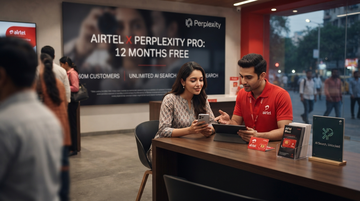
Perplexity is leveraging Bharti Airtel’s massive customer base to distribute its paid AI-search experience at near-zero upfront cost to users. In July 2025, Airtel partnered with Perplexity to offer a 12-month Perplexity Pro subscription (normally priced at ₹17,000 for a year) to Airtel customers, targeting a potential audience of 360 million users.
The key investor takeaway isn’t the headline “free AI” marketing—it’s the measurable impact on app behavior during the giveaway window. A TechCrunch report citing Sensor Tower/Appfigures-style analytics says Perplexity’s India downloads spiked during the promo period, with monthly active users rising sharply while the promotion was live.
Airtel rollout scale
360M customers
Airtel partnership reach reported alongside the Perplexity Pro promotion (offer announced in mid-2025)
Promo length
12 months
Complimentary Perplexity Pro subscription offered to eligible Airtel users
Free plan value
₹17,000/year
Stated Perplexity Pro annual value used for the Airtel free offer framing
The growth signal is real; the monetization attribution is not yet clean
Downloads and active usage surged—then the monetization question turned into cohort conversion, not acquisition
- Perplexity’s India downloads spiked during the Airtel promotion window rather than growing gradually month to month, consistent with a telecom distribution shock.
- Even when downloads later fell sharply after the giveaway window closed, Perplexity’s India monthly active users stayed meaningfully higher than pre-promo averages—suggesting continued engagement beyond the initial entitlement.
- The monetization indicator during the promo was revenue up ~60% (in India) even as new downloads later contracted, but the reporting also notes attribution limits (promo vs. non-promo payers).
During the promotional period, the reported direction of travel supports a comforting narrative for AI-search operators: free-tier distribution can scale usage without immediately destroying willingness-to-pay signals. A TechCrunch report (citing Sensor Tower analytics) states that estimated in-app purchase + subscription revenue in India rose about 60% during the relevant period when the Airtel offer was available to new users.
But investors should treat that as an early monetization “signal,” not the final verdict. The same reporting emphasizes that the measurement cannot cleanly separate Airtel-driven new subscribers from existing paying users, and it cannot fully disentangle whether higher revenue came from users choosing to pay versus users failing to cancel quickly enough before billing triggers.
Supply chain logic for AI search: distribution beats product tweaks—until monetization caps it
What this means for the broader supply chain: telecom bundles can out-distribute search incumbents, but payment mechanics decide durability
AI search monetization is not just about model quality. The supply-chain reality is that the “front door” is often controlled by distribution partners (telecom, app stores, browser defaults, and device-level surfaces). Perplexity’s Airtel offer is a textbook example: the product is delivered through a telecom channel that can place an AI assistant directly into the daily habits of hundreds of millions of users.
In that model, the competitive fight vs. Alphabet’s core search ecosystem shifts from ranking games to funnel economics. Free distribution can increase query volume and data flywheel activity, but monetization depends on whether users cross the threshold from “entitled curiosity” to recurring payment.
So the real strategic question is: does the funnel have a stable conversion rate when subsidies end, or does it collapse back toward baseline—leaving only a short-lived usage spike?
Investor framing: monetization is a conversion math problem, not an acquisition celebration
The monetization test Perplexity hasn’t fully passed outside the US is conversion after the subsidy ends
| Dimension | What the promo period suggests | What remains uncertain |
|---|---|---|
| User acquisition | Airtel-bundled distribution drove a step-change in downloads and MAUs during the giveaway window | Whether growth continues without ongoing telecom subsidies |
| Engagement quality | MAUs stayed well above pre-promo levels even after downloads fell | How much of engagement is “habit” vs. periodic curiosity |
| Revenue mechanics | Estimated in-app/subscription revenue increased (reported ~60%) while the offer was live | How much of that revenue is true paid conversion vs. billing/cancellation timing and attribution limits |
| Long-term monetization durability | Early evidence is compatible with conversion potential in India | The conversion rate of the newly exposed cohort once the complimentary year expires |
Short-term vs. long-term: what to watch next
Near-term catalysts are cohort renewal behavior; long-term outcomes depend on whether query volume turns into recurring revenue
- In the next few quarters, investors should watch whether Perplexity sees paid retention improve after new cohorts’ free periods expire rather than only during subsidy windows.
- If Perplexity’s ads launch (reported previously) scales, the near-term revenue mix may shift away from subscription dependence, changing how “free users” translate into profitability.
- Over 1–3 years, the key question is whether AI search distribution in emerging markets becomes a repeatable playbook—not a one-off telecom partnership lift.
A major reason this matters to Alphabet and other search incumbents is that emerging markets magnify distribution leverage. When users are price sensitive, charging for AI answers early can suppress adoption. Subsidized access can raise query share fast—but only recurring monetization determines whether that query share becomes durable revenue.
Until Perplexity demonstrates stable cohort conversion after freebies end, the most investment-relevant interpretation is that Perplexity is proving distribution capability, while the monetization engine remains under a strict validation clock.
Who is most exposed to this India AI-search distribution vs. monetization tension?
- India’s telecom-bundled AI-search can steal top-of-funnel query attention from classic search surfaces over the next several quarters.
- If Perplexity proves post-subsidy conversion, Alphabet faces tougher retention economics in emerging markets where price sensitivity is high.
- If conversion disappoints, Alphabet gains breathing room as free-tier usage fails to become recurring revenue.
- Airtel’s partnership strategy can increase engagement/ARPU-linked stickiness by bundling AI subscriptions into telco offers.
- If Perplexity monetization depends on continued distribution subsidies, Airtel may face ongoing partner economics pressure after renewals.
- Over 1–3 years, successful bundling could expand Airtel’s value-added services mix beyond connectivity.
- If AI-search rivals build consumer funnels outside the US, cloud/AI demand can broaden over the next 1–3 years.
- If monetization remains fragile after giveaways, new consumer AI-search budgets could slow near term.
- Microsoft benefits if ecosystem monetization shifts to enterprise seats where spending is steadier.
- Amazon can benefit if AI-answer products increase traffic and downstream commerce discovery, but this depends on monetization converting into retail intent.
- If AI-search usage rises without durable payments, the ad/commerce linkage may take longer to materialize.