%22%2F%3E%0A%20%20%3Ccircle%20cx%3D%22220%22%20cy%3D%22150%22%20r%3D%22180%22%20fill%3D%22%2322d3ee%22%20fill-opacity%3D%220.12%22%2F%3E%0A%20%20%3Ccircle%20cx%3D%221010%22%20cy%3D%22130%22%20r%3D%22220%22%20fill%3D%22%2338bdf8%22%20fill-opacity%3D%220.08%22%2F%3E%0A%20%20%3Ccircle%20cx%3D%22920%22%20cy%3D%22520%22%20r%3D%22170%22%20fill%3D%22%2322d3ee%22%20fill-opacity%3D%220.06%22%2F%3E%0A%20%20%3Cpath%20d%3D%22M140%20430h920%22%20stroke%3D%22url(%23line)%22%20stroke-width%3D%2212%22%20stroke-linecap%3D%22round%22%2F%3E%0A%20%20%3Cpath%20d%3D%22M220%20360c120-150%20260-220%20380-220s260%2070%20380%20220%22%20fill%3D%22none%22%20stroke%3D%22%2367e8f9%22%20stroke-opacity%3D%220.5%22%20stroke-width%3D%2216%22%20stroke-linecap%3D%22round%22%20stroke-linejoin%3D%22round%22%2F%3E%0A%20%20%3Cpath%20d%3D%22M300%20398h600%22%20stroke%3D%22%2394a3b8%22%20stroke-opacity%3D%220.24%22%20stroke-width%3D%228%22%20stroke-linecap%3D%22round%22%2F%3E%0A%20%20%3Ctext%20x%3D%22220%22%20y%3D%22510%22%20fill%3D%22%23e2e8f0%22%20fill-opacity%3D%220.7%22%20font-family%3D%22Arial%2C%20Helvetica%2C%20sans-serif%22%20font-size%3D%2238%22%20letter-spacing%3D%228%22%3EINSIGHTS%3C%2Ftext%3E%0A%3C%2Fsvg%3E)
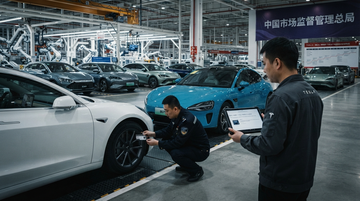
Policy + consumer safety
What happened: SAMR disclosed a record multi-brand EV recall campaign in China
China’s State Administration for Market Regulation (SAMR) disclosed what multiple outlets describe as the largest-ever single-round auto recall in China’s history, with filings spanning several EV makers and a single underlying safety theme tied to interior emergency door escape.
| Issuer / authority (as cited) | Cycle described | Scale cited | Affected Tesla models | Remedy mix cited | Timeline cited |
|---|---|---|---|---|---|
| SAMR (China market regulator) | Single round / record campaign | Tesla: 2.98 million vehicles in the door-release escape-risk remedy | Model 3, Model Y, Model S, Model X | Free warning labels; software update adding post-crash window-lowering strategy (OTA) | Recall starting Sep. 25 |
| SAMR (China market regulator) | Single round / record campaign | Multi-brand combined: more than 7 million vehicles | Multiple Chinese EV brands in the same day’s recall plans | Labels plus OTA remedies; some brands limited to label changes | Various effective dates per brand (same campaign) |
In the Tesla piece cited by major outlets, SAMR-linked disclosure described a door-release escape-identification risk in severe crashes and the use of (1) free warning labels and (2) an OTA software update that automatically lowers windows after a collision—aiming to preserve occupant egress and improve rescue conditions.
Supply chain + policy mechanics
Why it matters: China’s recall regime is moving software-defined safety into the enforcement lane
The structural shift is not that “recalls happen”—it’s that the enforcement target is increasingly the behavior of software-defined vehicle functions and the human-action pathway regulators expect occupants and first responders to follow under stress.
- Labels + OTA together reduce the burden on inspections, shifting enforcement from dealer checks toward remote compliance reporting.
- Severe-crash scenarios turn user-interface clarity into a regulated safety function, not a design preference.
- Multi-brand scale increases pressure on common suppliers (ECUs, door systems, camera/monitoring modules) because fixes must be executed at speed and breadth.
This changes how investors should think about China EV economics: safety enforcement now behaves like a demand-side and reputation-side shock (consumer trust), but it is delivered through supply-chain execution (rapid firmware, label logistics, and service readiness).
Company-level transmission
Tesla: compliance cost is the near-term headline, but the bigger risk is margin durability in China
For Tesla, the recall described by outlets covers millions of vehicles tied to escape safety in severe crashes and also includes a second, separate Tesla recall line tied to assisted-driving attention monitoring. Even if the software fixes are remote, the operational load is non-trivial: coordination across software releases, customer communications, and service/label handling.
Tesla revenue (FY2024)
$97.7B
FY2024, reported Jan 30, 2025
Tesla gross profit (FY2024)
$17.5B
FY2024, reported Jan 30, 2025
Tesla net income (FY2024)
$7.1B
FY2024, reported Jan 30, 2025
The investor-relevant logic: China EV pricing is already competitive and margin-sensitive; recall-driven compliance can force (a) extra warranty/service costs, (b) marketing and goodwill spend to defend brand perception, and (c) engineering prioritization that competes with product refresh and cost-down programs.
Peers and substitutes
BYD, Xiaomi, and XPeng: the recall is multi-brand, so the “winners” depend on who can turn enforcement into a feature advantage
SAMR-linked disclosure described remedies across multiple brands, with some companies’ plan focusing on warning labels and others combining labels with software. That matters because the cheapest compliance path differs by architecture: label-only fixes are logistics-light but may be less technologically “sticky,” while OTA fixes require software release discipline and post-deployment monitoring.
For BYD, the recall regime’s competitive angle isn’t “BYD vs. Tesla”—it’s whether BYD can protect vehicle trust and avoid forced margin erosion. For Xiaomi, which is comparatively newer to scale/quality expectations, software-defined vehicle behaviors are a reputational risk if enforcement becomes frequent. For XPeng (and other premiumization-seeking makers), recalls can change the perceived reliability of their ADAS-related and cabin-monitoring approaches.
| Brand / maker | Role in the campaign (as described) | Remedy style described |
|---|---|---|
| Tesla | Largest participant in the cited door-escape escape-risk remedy; plus another attention-monitoring related recall line | Free labels + OTA (including a window-lowering strategy); additional OTA for monitoring |
| Xiaomi | Included in the multi-brand recall filings | Labels plus OTA logic updates |
| XPeng | Included in the multi-brand recall filings | Labels-only remedy described |
| BYD | The broader campaign is multi-brand; BYD is in the China EV complex but not always singled out in the same headline summaries | Not specified in the opened Tesla-focused outlet; details not disclosed in the primary sources reviewed here |
Evidence-based fundamentals read-through
Fundamentals check: Tesla and BYD have very different cash/earnings profiles going into a compliance shock
Even without assigning a dollar value to this specific recall (not disclosed in the primary sources reviewed), the balance between profits, operating resilience, and cash flexibility is the key for how painful enforcement becomes.
BYD revenue (FY2024)
CNY 777.1B
FY2024, reported in the underlying annual financials set
BYD net income (FY2024)
CNY 40.3B
FY2024, reported in the underlying annual financials set
BYD profitability (FY2024 net margin proxy)
~5.2%
FY2024 net income / revenue (company-reported financials set)
Tesla’s publicly reported profit base is smaller in scale than BYD’s in China, but Tesla’s margins and cost structure are also highly sensitive to volume and pricing. BYD’s larger revenue base can buffer single events, but OEMs with high unit throughput can see enforcement costs accumulate faster if regulators widen coverage.
Horizon framing
What moves first vs. what changes over 1–3 years
- In days to weeks, consumer perception and regulator scrutiny can move first, because multi-brand headlines raise perceived industry-wide risk.
- Over the next quarter, engineering re-prioritization can show up as slower non-safety feature iteration while OTA rollouts and label distribution scale.
- Over 1–3 years, the “safety operating system” becomes a moat: OEMs that design for regulator-defined scenarios may avoid repeated recall loops.
Synthesis
Bottom line thesis: safety enforcement in China is now a competitive lever on software-defined vehicles
China’s record EV recall campaign shows a new enforcement pattern: regulators can force OEMs to deliver safety fixes that are half logistics (free labels) and half software behavior (OTA window-lowering and monitoring changes). For investors, the key implication is that recall scale can become a proxy for how tightly an OEM’s engineering process matches regulator expectations—and that affects margins, not only brand headlines.
The immediate crosshair is the OEMs already highest in China unit visibility—especially those with large installed bases and software-heavy feature sets. The longer-term scoreboard is which companies reduce repeat findings fastest, because “compliance cost” is only temporary if enforcement intensity falls; otherwise, it behaves like a recurring tax on earnings.
Investable read-through: listed EV players most exposed to China enforcement optics
- The campaign puts Tesla under immediate China compliance visibility at millions of units, with near-term cost and perception risk.
- Tesla’s larger profit base means it can fund safety engineering while still shipping new vehicles, but pricing pressure can magnify margin drag.
- Over 1–3 years, the winner is the OEM that prevents recurrence by redesigning for regulator-defined crash/escape scenarios.
- BYD’s scale means enforcement costs can compound across units if SAMR repeats this pattern, even if individual fixes are cheap.
- BYD’s FY2024 earnings base shows it has capacity to absorb compliance spend, but unit throughput raises recurrence risk.
- Over 1–3 years, BYD benefits if it turns safety behavior into a trust advantage that supports pricing resilience.
- A recall in the same multi-brand round raises Xiaomi’s execution credibility risk in software-defined remedies.
- Near-term, OTA/label changes can increase customer-support and brand-reputation costs versus peers with deeper recall playbooks.
- Over 1–3 years, Xiaomi needs repeat-proof engineering to avoid higher-frequency enforcement.
- If XPeng’s remedy is more label-centric, immediate cost may be lower than OTA-heavy peers—reducing margin hit.
- Still, inclusion in a record headline can pull forward brand-risk discounting in the next quarter.
- Over 1–3 years, XPeng’s upside depends on tightening ADAS/cabin monitoring validation to reduce repeat findings.
- Geely-linked brands in the campaign make supplier-level and platform-level risk relevant for future recall frequency.
- Near-term, investors should watch whether cost and messaging complexity increase versus peers in the next earnings cycle.
- The catalyst to monitor is whether SAMR expands to additional model families after this round.