%22%2F%3E%0A%20%20%3Ccircle%20cx%3D%22220%22%20cy%3D%22150%22%20r%3D%22180%22%20fill%3D%22%2322d3ee%22%20fill-opacity%3D%220.12%22%2F%3E%0A%20%20%3Ccircle%20cx%3D%221010%22%20cy%3D%22130%22%20r%3D%22220%22%20fill%3D%22%2338bdf8%22%20fill-opacity%3D%220.08%22%2F%3E%0A%20%20%3Ccircle%20cx%3D%22920%22%20cy%3D%22520%22%20r%3D%22170%22%20fill%3D%22%2322d3ee%22%20fill-opacity%3D%220.06%22%2F%3E%0A%20%20%3Cpath%20d%3D%22M140%20430h920%22%20stroke%3D%22url(%23line)%22%20stroke-width%3D%2212%22%20stroke-linecap%3D%22round%22%2F%3E%0A%20%20%3Cpath%20d%3D%22M220%20360c120-150%20260-220%20380-220s260%2070%20380%20220%22%20fill%3D%22none%22%20stroke%3D%22%2367e8f9%22%20stroke-opacity%3D%220.5%22%20stroke-width%3D%2216%22%20stroke-linecap%3D%22round%22%20stroke-linejoin%3D%22round%22%2F%3E%0A%20%20%3Cpath%20d%3D%22M300%20398h600%22%20stroke%3D%22%2394a3b8%22%20stroke-opacity%3D%220.24%22%20stroke-width%3D%228%22%20stroke-linecap%3D%22round%22%2F%3E%0A%20%20%3Ctext%20x%3D%22220%22%20y%3D%22510%22%20fill%3D%22%23e2e8f0%22%20fill-opacity%3D%220.7%22%20font-family%3D%22Arial%2C%20Helvetica%2C%20sans-serif%22%20font-size%3D%2238%22%20letter-spacing%3D%228%22%3EINSIGHTS%3C%2Ftext%3E%0A%3C%2Fsvg%3E)
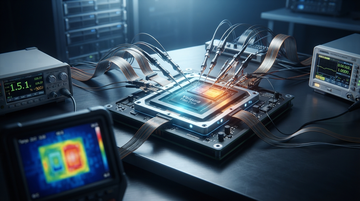
Event: power efficiency gets silicon-first funding
A $110M Series A signals investors believe “performance-per-watt” can be engineered at the chip level, not just the facility level
Velaura AI, a private chip-design company, announced a $110M Series A that values the company at more than $1B.
The market read is straightforward: hyperscalers are paying for AI compute in electricity, cooling, and capital tied to power limits. Velaura is trying to move that bottleneck “upstream” into the silicon itself—its Titan Core platform is positioned as an IP and design approach that reduces total chip power for AI accelerators.
What Velaura actually disclosed (core claims)
Funding & valuation
$110M Series A; >$1B valuation
Company-reported; see Velaura AI Series A announcement.
Chip-level power reduction
Up to 2x lower overall chip power
Titan Core platform claim; see Titan Core announcement.
Illustrative GPU-class savings
Up to ~500W saved on a typical 1000W GPU/XPU
Titan Core platform claim; see Titan Core announcement.
Compute kernel energy reduction
MATMUL energy reduced by 2–4x
Titan Core platform claim; see Titan Core announcement.
Electricity-savings example
~1,300 (electricity savings) over 3 years per XPU
Titan Core platform claim; see Titan Core announcement.
Technology & supply chain
Titan Core’s “licensable efficiency” model tries to plug into customer chip designs without forcing a full hardware swap
Velaura describes Titan Core as an IP and design foundation that customers can integrate into their own SoC/accelerator architectures.
The integration framing matters for economics: if the silicon efficiency can be realized as an optimization on top of a customer’s RTL/design flow (rather than requiring a bespoke GPU or a brand-new vendor compute stack), the switching cost drops and the adoption curve can be faster.
Velaura also claims it starts from the customer’s RTL and uses proprietary libraries and physical-design methodology to deliver an optimized physical layout, with an emphasis on lower-voltage operation and seamless integration into existing design flows.
- Titan Core is positioned as a silicon/IP layer that can fit into customers’ existing SoC design flows (rather than a full system replacement).
- Velaura claims it can reduce overall chip power up to 2x for AI accelerators, which is the lever that facility teams can translate into lower energy and potentially less capacity pressure.
- The company ties its energy savings to matrix-multiplication work, reducing MATMUL energy by 2–4x—the dominant kernel in most dense AI workloads.
Supply-chain mapping
If efficiency licensing spreads, it changes who captures value across the AI data-center power stack
To reason about impact, split the power bottleneck into three layers: (1) the accelerator’s electrical power draw, (2) the data-center’s electrical distribution and thermal management, and (3) the grid/capacity planning that constrains build-outs.
Velaura’s bet is that (1) can be materially improved via silicon-level changes that customers can integrate. That creates second-order effects on (2) and (3): even if rack cooling and power delivery don’t change immediately, their capacity and upgrade pacing can soften.
| Supply-chain layer | Default bottleneck focus (prior framing) | Velaura’s silicon-first lever | Investor read-through |
|---|---|---|---|
| Accelerator silicon | Improve raw performance and rely on facility scaling | Reduce overall chip power up to 2x and MATMUL energy 2–4x | Licensable efficiency becomes a new value-capture layer |
| Rack/power/thermal hardware | Increase power density and cooling capacity | Lower power per accelerator class (~500W saved vs 1000W GPU/XPU) | Slower replacement cycles possible, but efficiency products still benefit from higher utilization |
| Grid/capacity planning | Pay for MW access, transformers, and build timing | Unlock more compute within the same power envelope | More capacity-per-site can compress the timeline to revenue per MW |
Fundamentals bridge (what it implies for listed players)
The funding itself is a signal: investors may start pricing “custom efficiency” as a competitive moat alongside compute throughput
Velaura’s claims imply a different competitive axis for AI chip platforms: not just FLOPs or memory bandwidth, but how quickly you can spend power and still deliver useful work.
For incumbent compute and networking ecosystems, that can affect system design in both directions:
- If customers can buy efficiency via licensing or IP, they may discount the necessity of certain “brute-force” performance scaling.
- But they still need networking, power conversion, and thermal systems sized to real deployments—so the winners are not automatically the silicon-only players.
Velaura’s power lever
Up to 2x lower chip power
Titan Core claim.
Illustrative savings
Up to ~500W saved
vs a typical 1000W GPU/XPU.
Kernel-level claim
2–4x MATMUL energy reduction
Titan Core claim.
Horizons
What to watch next: adoption proof and where the savings show up in customer purchasing decisions
- Within quarters, expect customer design-win signals (e.g., adoption in new silicon revisions or IP licensing progress), not just marketing performance figures.
- Over 12–36 months, the key milestone is whether efficiency licensing expands across accelerator generations enough to alter procurement patterns for compute racks and power infrastructure.
A practical checklist for investors:
1) Did customers publicly confirm integration into production chips? 2) Do reported results cite power at board/rack level (not only chip) under realistic utilization? 3) Does efficiency translate into measurable savings (electricity, cooling, capex pacing) rather than only “per operation” metrics?
One thing Velaura did disclose that helps the timeline: it describes large-scale validation and shipping of energy-efficient ASICs at scale, which—if accurate—should shorten the gap between lab claims and customer adoption readiness.
Listed companies with direct transmission channels (silicon → rack → infrastructure)
- If Velaura-style efficiency becomes standard, NVIDIA’s platform value could tilt toward throughput-per-watt rather than raw throughput, compressing pricing on incremental GPU upgrades.
- In the next 1–2 quarters, NVIDIA’s risk is mainly customer design scrutiny of power envelopes—not immediate unit-share loss without named deployments.
- Efficiency at the silicon layer can raise acceptable density per rack, potentially increasing demand for Broadcom’s data-center connectivity and infrastructure silicon.
- If customers reduce power/thermal costs, it may also slow infrastructure refresh cycles—a partial headwind to networking capex intensity.
- Higher compute-per-rack inside the same power envelope can increase scale-up/network utilization, supporting Marvell’s data-center interconnect positioning.
- Over 12–36 months, if silicon efficiency unlocks more deployment growth, Marvell may benefit from greater demand for high-speed interconnect silicon alongside accelerator fleets.
- If hyperscalers can run more work within fixed power limits, Arista’s fabrics can see higher utilization per deployed rack—a demand tailwind for switching capacity.
- In the next 1–2 quarters, the near-term catalyst is any evidence of accelerated fleet scaling tied to power efficiency procurement.
- Lower accelerator power can let SMCI’s server designs support higher effective compute density without re-derating thermals as often.
- But if customers can buy efficiency via licensing instead of platform refresh cycles, SMCI could face slower server BOM replacement cadence until next-gen designs.
- Even if silicon lowers per-accelerator power, hyperscalers may still expand total deployments; Vertiv can benefit from higher throughput per MW via continued demand for power and cooling systems.
- Over 12–36 months, the upside is that efficiency can de-risk capacity growth inside power-constrained sites, supporting Vertiv’s lifecycle services and upgrades.