%22%2F%3E%0A%20%20%3Ccircle%20cx%3D%22220%22%20cy%3D%22150%22%20r%3D%22180%22%20fill%3D%22%2322d3ee%22%20fill-opacity%3D%220.12%22%2F%3E%0A%20%20%3Ccircle%20cx%3D%221010%22%20cy%3D%22130%22%20r%3D%22220%22%20fill%3D%22%2338bdf8%22%20fill-opacity%3D%220.08%22%2F%3E%0A%20%20%3Ccircle%20cx%3D%22920%22%20cy%3D%22520%22%20r%3D%22170%22%20fill%3D%22%2322d3ee%22%20fill-opacity%3D%220.06%22%2F%3E%0A%20%20%3Cpath%20d%3D%22M140%20430h920%22%20stroke%3D%22url(%23line)%22%20stroke-width%3D%2212%22%20stroke-linecap%3D%22round%22%2F%3E%0A%20%20%3Cpath%20d%3D%22M220%20360c120-150%20260-220%20380-220s260%2070%20380%20220%22%20fill%3D%22none%22%20stroke%3D%22%2367e8f9%22%20stroke-opacity%3D%220.5%22%20stroke-width%3D%2216%22%20stroke-linecap%3D%22round%22%20stroke-linejoin%3D%22round%22%2F%3E%0A%20%20%3Cpath%20d%3D%22M300%20398h600%22%20stroke%3D%22%2394a3b8%22%20stroke-opacity%3D%220.24%22%20stroke-width%3D%228%22%20stroke-linecap%3D%22round%22%2F%3E%0A%20%20%3Ctext%20x%3D%22220%22%20y%3D%22510%22%20fill%3D%22%23e2e8f0%22%20fill-opacity%3D%220.7%22%20font-family%3D%22Arial%2C%20Helvetica%2C%20sans-serif%22%20font-size%3D%2238%22%20letter-spacing%3D%228%22%3EINSIGHTS%3C%2Ftext%3E%0A%3C%2Fsvg%3E)
Market event • Policy trade • Materials and shipping transmission
The new macro risk isn’t oil—it’s wheat logistics rewriting the price of “one month away” food inflation
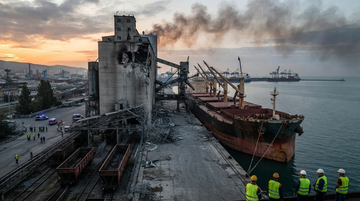
What changed is simple: Ukraine targeted Russia’s Black Sea grain-export chokepoint. In US economic terms, that matters because food is a direct input into consumer baskets (and many producer baskets) with shorter pricing lags than industrial components—so food can stall disinflation even when core goods inflation looks calm.
What the primary reporting actually establishes
Russia’s Black Sea port hit
Novorossiysk; two major grain export terminals damaged
Reported in UK outlet coverage of the overnight attack (terminal damage + operational disruption language).
US inflation backdrop (July)
Final demand inflation was 0.0% m/m; final-demand food fell -0.9% m/m
From the US Bureau of Labor Statistics PPI release covering July 2026.
Global wheat replacement constraint
Potential shortfall: 30–35 million metric tons (~15% of global wheat trade)
From Reuters quoting Russia’s grain exporters warning of corridor shutdown risk and inability to fully replace volumes elsewhere.
Event verification • Black Sea corridor
The reported strike is on Novorossiysk, and it’s aimed at the export mechanism—not the farms
Reuters’ framing is that corridor disruption can shut down the Black Sea export path and force a global wheat pricing reset when alternative exporters can’t cover the missing tonnage. That’s the mechanism investors should connect to the terminal strikes: the battlefield effect flows into scheduling, insurance, and physical turnaround at ports—then into FOB pricing and retail pass-through.
- The port named in the strongest reporting is Novorossiysk, with two grain export terminals described as damaged after an overnight attack.
- Local logistics were reported as constrained, with redirecting cargo flows to alternative routes mentioned as a response under operational limits.
- If corridor throughput drops meaningfully, the market can re-price wheat futures quickly because the “where can buyers reroute?” answer becomes slower and more expensive.
Inflation math • July PPI vs. the food shock channel
July PPI was friendly—yet food is the one category that can reassert itself fast if the corridor breaks
Final demand (m/m)
0.0%
July 2026, seasonally adjusted (PPI release covering July 2026).
Final demand foods (m/m)
-0.9%
July 2026, seasonally adjusted (PPI release covering July 2026).
The key investor takeaway is timing. July’s print shows the disinflation trade still had momentum in early months. But the corridor-risk story is about a new transmission window that can hit prices before the next disinflation narrative fully resets: when physical capacity constraints emerge at the same time food is still “down” on the margin, markets can swing from relief to risk pricing abruptly.
Macro-to-markets mapping • Wheat tonnage → shipping premiums → input costs
A corridor hit can ripple through three price layers: wheat, fertilizer, and war-risk freight
A Black Sea terminal disruption can matter beyond wheat because fertilizer supply and application calendars are tightly coupled to commodity price expectations and to the cost of moving inputs. In practice, the chain investors should watch is: reduced export throughput → tighter near-term wheat availability → higher wheat-linked benchmarks → firmer nitrogen demand and pricing expectations → more expensive freight/insurance for bulk inputs and outputs.
| Layer | What changes if corridor capacity drops | What tends to move first | Why it feeds inflation debates |
|---|---|---|---|
| Wheat (global benchmark) | FOB pricing and basis adjust to constrained loading schedules | Wheat futures and cash bids | Pass-through can reappear even if other categories stay soft |
| Fertilizer (nitrogen complex sensitivity) | Higher wheat economics can support fertilizer affordability/coverage | Nitrogen-linked contract expectations | Input cost pressure can show up in later food-chain months |
| Shipping & insurance | War-risk premiums rise with route uncertainty and port operating risk | Freight and insurance components embedded in offers | Higher all-in logistics costs can lift delivered prices |
Fundamentals • Listed agribusiness exposure
For agribusiness equities, the question is whether margin protection beats volatility
In a corridor-break scenario, margins can move in two opposing directions. Higher commodity prices can support revenues at processors and merchandisers, but logistics frictions and inventory timing can compress effective margins. For Archer-Daniels-Midland, CF Industries, and Bunge Global S.A., the investor question is which effect dominates—especially over the next 1–2 quarters.
Revenue scale and recent earnings context (TTM basis)
Used to frame how much operating leverage exists if commodity-linked volumes re-price quickly; not a forecast of margins.
Unit: USD
Archer-Daniels-Midland TTM revenue
ADM revenue, TTM through the latest quarter reported (income statement period shown by the filings dataset).
82,099,000,000
CF Industries TTM revenue
CF Industries revenue, TTM through the latest quarter reported.
7,739,000,000
Bunge Global S.A. TTM revenue
Bunge revenue, TTM through the latest quarter reported.
91,815,000,000
Investment thesis • Winners and losers
If food risks re-price, the winners are the firms that can pass through—while the risk is “earnings that depend on timing”
- Upside case: higher wheat-linked pricing can support trading and processing economics for Archer-Daniels-Midland and Bunge Global S.A., but only if inventory and contract terms don’t lag too far.
- Selective upside in inputs: if higher wheat economics improve the willingness to secure nitrogen coverage, CF Industries can see firmer pricing—yet freight/insurance volatility can also raise delivered-cost friction.
- What would disprove the scare: a rapid shift of volumes to alternative corridors/land routes that avoids a persistent basis blowout (the key is persistence, not a one-day headline).
Horizons • What changes in days vs. what matters by 1–3 years
Short-term: watch basis, freight/insurance, and prompt wheat; long-term: structural risk premium to Black Sea routes
Short-term, the market will trade the prompt picture: whether terminal damage materially constrains loading and raises delivered offers. Long-term, if the corridor repeatedly comes under strikes, insurers and operators price in a persistent risk premium, which can keep wheat and fertilizer logistics structurally more expensive—even if occasional windows reopen.
Related listed stocks with evidence-backed linkage to the wheat → food → fertilizer → logistics channel
- A Black Sea throughput shock can lift wheat-linked revenue opportunities while the stock’s large diversified scale can reduce single-corridor concentration risk (ADM revenue TTM shown in its income statement disclosure).
- If July softness reverses, ADM’s earnings volatility may rise; investors should watch contract timing vs. spot exposure when shipping conditions tighten.
- A food-inflation repricing can support fertilizer demand economics through wheat-linked affordability, but CF’s cost of delivered inputs can also rise if freight/insurance tightens (CF revenue TTM context from its income statement disclosure).
- Near-term returns depend on whether nitrogen pricing offsets any logistical cost pressure; otherwise margin can compress faster than volumes grow.
- If wheat basis firms after corridor disruption, Bunge can benefit from re-priced global flows as commodity-linked merchandising economics improve (Bunge TTM revenue from its income statement disclosure).
- Risk remains that logistics frictions raise delivered-costs; investors should monitor whether spread capture beats freight inflation over the next 1–2 quarters.