
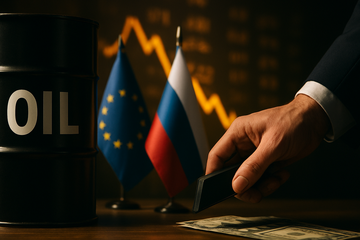
Two disclosures landed within 24 hours of each other and together they expose a fault line that no amount of US executive-order craft can paper over. On Saturday Oct 17, Secretary of State Marco Rubio told reporters that the Graham Act sanctions package President Trump had just waived would remain on ice for up to 60 days while Washington \"analyses\" the global economic impact. The next day, Sunday Oct 18, Treasury Secretary Scott Bessent told NBC that he had personally asked European allies to impose secondary tariffs on India and China for buying Russian oil — and they refused. Bessent then drove the point home by reminding viewers that Europeans had themselves waived their own embargo on Russian diesel and jet fuel in May 2026. The transcript reads less like diplomacy than like a Treasury secretary warning the administration in public that the allied coalition it counted on was never there.
The European refusal was always the plan's weak link
Bessent's most consequential sentence was not about Russia. It was about who wouldn't be enforcing the secondary tariff. The Graham Act was sold as a multilateral pressure tool — Section 113 would impose 100% duties on the five largest importers of Russian crude and gas, but only the United States could write that check. Brussels, London, and the EU's own biggest Russian-oil buyers — Hungary, Slovakia, and the bloc's largest LNG customers in France and the Netherlands — had no intention of matching it. EU foreign policy chief Kaja Kallas had already spent the previous week publicly rebuking the Trump-Putin energy ceasefire and urging Washington to enforce the Graham Act; the sanctions episode confirms the EU was asking Trump to act, not volunteering to act alongside him. When Bessent then admitted Europe had quietly opened its Russian-diesel market back up in May, the picture sharpened: the secondary-tariff tool now requires unilateral US enforcement with no allied cover, exactly the configuration its authors warned against.
- Bessent confirmed the US asked Europe to impose secondary tariffs on India and China for Russian oil purchases — Europe refused.
- Bessent pointed to May 2026, when EU member states carved out Russian-origin diesel and jet fuel from import bans — proof, he said, that Europe is \"gorging\" on Russian energy while asking the US to do the sanctioning.
- Rubio framed the pause as a global-impact review citing the Iran war, Houthi attacks on Saudi Arabia, and the Ukraine conflict as \"crashing into each other\" on energy prices.
- The 60-day window has no fixed expiry under the Graham Act: Section 4(d) lets the waiver stand until the president or secretary of state decides \"further action is warranted.\"
What the Graham Act was designed to do — and what Trump suspended
Lindsey O. Graham Sanctioning Russia and Iran Act of 2026 — key sections
Section 112
Up to 500% tariff on Russian-origin goods
Required to be implemented by Oct 18, 2026; waived Oct 16 by executive order.
Section 113
Up to 100% tariff on top 5 Russian oil/gas importers
Targets top importers of Russian crude and top facilitators of sanctions evasion; natural-gas carve-out for<15% of Russia's gas exports.
Section 115
National-interest waiver authority
Authorizes the president to waive any provision on national-interest grounds with written certification to Congress.
Section 4(c)
Restrictions on Russian officials, banks, SOEs, energy activities
Also suspended in Trump's Oct 16 order.
Section 109
Ban on US persons purchasing Russian sovereign debt
Had taken effect Sept 18, 2026; included in the Oct 16 waiver.
Sunset
Sept 18, 2031
Statutory termination of the Act, subject to exceptions.
The Act Trump signed on Sept 18 — then suspended six weeks later via Section 115 — was the toughest Russia sanctions framework since2022. Section 113 alone would have rewritten global energy trade: a100% tariff on goods from China, India, and the next three largest importers of Russian crude is, by design, a tariff no buyer can absorb. Waiving it before it ever took effect preserved the legal option of re-imposing it, but it also signaled to every refiner in Asia that the US has run out of stomach for the confrontation.
Energy markets read the news first
Brent crude, Oct 18 settle
$108.43/bbl
Down 1.30% on day; Friday Oct 17 settled at $109.95, highest since May 19.
Urals–Brent discount, Sept 2026
$23/bbl (21%)
Unchanged from August, per CREA monthly analysis.
Russian fossil-fuel revenue, Sept 2026
~$625M/day
Up sharply from July2026's EUR 683M/day run-rate; CREA monthly.
India's share of Russian crude imports, Sept 2026
~35% of basket
Down from 50%+ in July and 44% in August, per Kpler.
China's share of Russian crude imports
~30% of basket
Stable through2026; China is Russia's single largest customer.
The market reaction said the loudest thing Bessent didn't. Brent fell $1.43 — 1.30% — on Monday Oct 18, the first trading day after both disclosures, settling at $108.43/bbl after closing Friday at its highest since May. Refiners and traders had been front-running a tightening of the secondary tariff, expecting more Russian barrels to be locked out of Asia; Trump's waiver told them those barrels are coming back. The IEA's October Oil Market Report now projects an annual supply decline of 5.8 mb/d to 100.7 mb/d for 2026, but the agency is already flagging a 7.7 mb/d reversal into 2027 — exactly the period Rubio's 60-day review straddles.
Russian fossil-fuel export revenue, monthly (CREA)
Russian export revenue in EUR millions per day, Jan–Sept 2026. The September rebound coincides with Trump's Oct 16 waiver and the EU diesel carve-out in May.
Unit: EUR mn/day
May
670
Jun
685
Jul
683
Aug
720
Sep
737
Upstream: Russia keeps its war chest, India and China keep the discount
| Buyer | Total Russian fossil-fuel imports | Of which crude oil | Note |
|---|---|---|---|
| China | EUR 9.1B | EUR 6.0B | Largest single buyer; 55% of Russia's top-5 revenue. |
| India | EUR 4.1B | EUR 3.6B | Cut share from 50%+ in July to ~35% in Sept (Kpler). |
| Turkey | EUR 1.0B | EUR 172M | Largest buyer of Russian oil products (26% share). |
| Hungary + Slovakia | EUR 290M | n/d | Combined; both hold Trump-era exemptions; EU's largest Russian-energy buyers. |
| EU total since 2022 | $320.7B | n/d | $21.3B in the first nine months of 2026 alone. |
With the 100% Section 113 tariff shelved for60 days, the upstream math reverts to what it was in early 2026. India paid ~$3.6B for Russian crude in September alone — roughly 30% of its import basket — at a $23/bbl discount to Brent. That spread is the single most valuable margin lever available to Indian refining, and the waiver locks it in place for two more months. China, meanwhile, has absorbed $9.1B of Russian fossil fuels in a single month with no policy reversal at all. The transaction is essentially back to a buyer's market: Russia must clear barrels, India and China hold the pricing power, and the only thing keeping the discount from widening further is the implied threat that the waiver could be revoked at any moment under Section 4(d).
Downstream: Indian refiners get a 60-day margin shield
Indian refiners had already started running for cover in August. Reliance Industries, historically responsible for roughly half of all Russian crude shipped to India, halted Russian crude into its Jamnagar SEZ refinery in November 2025 to comply with the EU ban on Russian-crude-derived products. The other state-owned refiners — Indian Oil Corporation, Bharat Petroleum and Hindustan Petroleum — bought discounted Russian barrels whenever sanctions-compliant supply was available, with IOC alone importing around 598,000 barrels per day of Russian crude in January 2026. By September, Kpler data shows India's Russian share had dropped to ~35% of the import basket from more than 50% in July, as Indian refiners pre-positioned for a tariff regime that has now been postponed.
- IOC, BPCL and HPCL had been paying premium for non-Russian barrels through Q3 — the Granger-won waiver now lets them re-enter the Urals market at the $23/bbl discount.
- Reliance can resume routing Russian crude to its domestic-refining unit (the SEZ remains under EU product rules) at scale, lifting O2C segment margins.
- India's Russian crude share of 35% can plausibly snap back to 40%+ by year-end if the waiver sticks through Q4, adding ~$700M-$900M of annualized margin tailwind across the four refiners.
- Crack-spread economics work both ways: the same waiver that protects Indian refiners from a 100% US tariff caps the upside on Brent by ~$15/bbl versus a fully-acted-on scenario.
European refiners: winners of the supply-chain reshuffle, with a compliance asterisk
| Company | Q2 revenue | Q2 net income | European refining margin guide | Russia-energy stance |
|---|---|---|---|---|
| TotalEnergies | $57.1B | $5.4B | Q3 marker ~$33.2/bbl (vs $13.5 in Q1) | LNG exposure; moderate Russian-history writedowns. |
| Eni | EUR 22.7B | EUR 3.4B | Throughput up; refining margins in upper decile | CEO publicly opposed EU ban on Russian LNG through 2026. |
| Shell | n/d | n/d | Trading division outperforming on crude differentials | Exited Russian equity JVs in 2022-2023; no direct exposure. |
| BP | n/d | n/d | Refining margins ~$25/bbl (Q3 guide) | Rosneft minority writedown booked; structural exposure largely cleared. |
| MOL Hungarian Oil and Gas | n/d | n/d | Domiciled Russian-crude pipeline; EU's #1 Russian-fossil importer | Holds full Trump-era one-year exemption; pressed for extension. |
The waiver's downstream economics run strongly through European refining margins. TotalEnergies guided Q3 FY2026 European refining margins to $33.2/bbl, up from $13.5 in Q1 and the highest in the post-2022 era. With more Russian barrels unlocked and diesel trade re-routed around the EU carve-out, the European refining complex is structurally tight. But the supply chain reward carries a tail risk: the same Russia-energy flows that fill European tanks today are the ones Bessent is publicly accusing Europe of \"gorging\" on. Any future US Treasury enforcement action — and the 60-day review is, by design, a setup for one — would land on MOL first, given its Italian promoter favors exemption renewal through 2027.
The 60-day clock: what investors are actually pricing
The most important line in Rubio's Saturday press appearance was the qualifier — \"up to 60 days,\" not \"exactly 60 days.\" Under Section 4(d) of the Graham Act, the waiver remains operative until the president or secretary of state determines \"further action is warranted.\" That language gives Trump the option to keep the secondary tariff shelved indefinitely while still preserving the threat of re-imposition as a bilateral bargaining chip with India and China. Markets are pricing the threat: Brent fell 1.30% the next session, not10%, and the Urals discount held at 21%. Investors are not pricing an end to Russian oil flows; they are pricing a faster resolution than the Graham Act originally implied. The bond market, per Bessent's own framing, is the place this matters most: every month the waiver holds is a month the US fiscal trajectory keeps a Russian-oil-shaped input stable.
- Short-term (0-60 days): Brent trades in a $100-$115/bbl corridor; Indian refiners buy Russian crude at the $23/bbl discount; MOL holds its US exemption.
- Short-term (60-day catalyst): the waiver can be revoked unilaterally on any day; that binary is what keeps the risk premium compressed.
- Long-term (1-3 years): structural EU phase-out of Russian LNG by end-2026 (long-term contracts) and end-2027 (short-term contracts) is unchanged; the Graham Act remains on the books with a Sept 2031 sunset.
- Long-term risk: a future administration re-imposes Section 113 in full — without allied coordination, the bite is one-sided, but the bite is still real for India.
Stocks the new Russia-secondary-tariff reality actually touches
- Q3 FY2026 European refining margin guide of $33.2/bbl benefits from more Russian diesel flowing through the carve-out, with TTM EBITDA of $46.6B (through Jun 30, 2026) already at post-2022 highs.
- Risk: any future Treasury re-imposition of Section 113 would tighten the global crude market and squeeze trading-segment margins within 1-3 quarters.
- Long-term (1-3 yr): EU's 2026-2027 phase-out of Russian pipeline gas and LNG removes structural Russian exposure from the upstream mix, supporting the multiple.
- Eni CEO publicly called for suspension of the EU's planned Russian gas import ban — the Trump waiver aligns with Eni's strategic preference, supporting upstream optionality.
- Q2 FY2026 net income of EUR 3.4B (filed Aug 6, 2026) already reflects the trading-environment tailwind; refinancing of legacy Russian-asset writedowns is now on a faster track.
- Bear case: tighter EU sanctions enforcement within 60 days could reverse the Russian-gas carve-out and pressure the gas division's 2027 guidance.
- MOL's Trump-era one-year exemption from Russian-energy sanctions (granted Nov 2025) is now explicitly endorsed by the Graham Act waiver; the company pressed for extension into 2027.
- The EU's largest Russian-fossil-fuel buyer (EUR 486M in July 2026) becomes the structural winner of every day the US does not act unilaterally.
- Watch the 60-day clock: any Treasury enforcement action lands on MOL first given its size in the EU Russian-oil import basket.
- Shell's trading division outperforms on the wider Brent–Urals differential; refining margins remain in the upper decile of European peers.
- No direct Russian-equity exposure since 2022-2023, so the political tail risk is limited; the company is a clean play on European refining tightness, not on Russia flows.
- Risk: if Brent retraces toward $90/bbl on a fully-resolved waiver, the trading-segment windfall compresses within 2-4 quarters.
- BP's Q3 FY2026 refining-margin guide of ~$25/bbl captures the current tightness, with the Russia-waiver supporting diesel-heavy product spreads.
- Rosneft minority-interest writedowns were largely taken in 2022-2023; structural exposure to Russian flows is now minimal, limiting upside but also limiting tail risk.
- Long-term (1-3 yr): the more important catalyst is BP's portfolio rationalization, not Russia flows — which the Graham Act waiver neither helps nor hurts.
- The 60-day waiver shields Indian refiners (Reliance, IOC, BPCL, HPCL) from a 100% Section 113 tariff — a structural overhang that has weighed on Indian energy equities since September.
- India's Russian crude share can snap back toward 40% of the import basket within 60-90 days, lifting energy-sector earnings weight in the MSCI India index by Q12027.
- Watch for the next round of EU/US coordination signals — a re-imposed tariff would reverse the relief within a single quarter.