
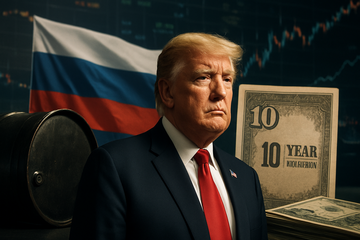
Russia goods tariff suspended
500%
Section 112 ad valorem, per White House executive order Oct. 16, 2026
Secondary tariff suspended on top Russian-oil buyers
100%
Section 113, applied to top-5 importers and top-5 facilitators
Russian 10-year OFZ yield, Oct. 17, 2026
16.63%
vs. 16.85% on Oct. 11; Bank of Russia key rate 14.0%
U.S. 10-year Treasury yield, Oct. 16, 2026
5.09%
vs. 5.24% on Oct. 9; off 24-year high touched Oct. 7
Brent crude, Oct. 17, 2026
$109.69
Five-month high; +3.95% intraday on the day
India seaborne Russian crude, Sept. 2026
1.82M bpd
Largest seaborne importer; Kpler tracks Oct. at 1.8–1.9M bpd
EU new Russia listings, Oct. 12, 2026
1,569
21st sanctions package: 826 entities, 743 individuals
The 28-Day Reversal
President Trump signed the Lindsey O. Graham Sanctioning Russia and Iran Act of 2026 into law on Sept. 18, 2026, codifying a 500% ad valorem tariff on Russian-origin goods and a 100% secondary tariff on any country among the top five importers of Russian crude oil or natural gas, plus the top five facilitators of sanctions evasion. Twenty-eight days later, on the night of Friday, Oct. 16, he issued an executive order invoking Section 115 of his own law — a national-interest waiver that lets the president suspend any sanctions, restriction, or duty in the act simply by certifying to Congress that doing so serves U.S. interests.
The law gave the administration until Oct. 18 to impose the new measures — or waive them. Trump chose the second option two days early. The White House order cites \"national interests\" but offers no detailed rationale, and Treasury Secretary Scott Bessent has privately described the move as \"narrow and short-term.\" Russia's presidential envoy Kirill Dmitriev called the decision \"significant and truly historic,\" while Ukrainian President Volodymyr Zelenskyy said Trump was \"rewarding Putin.\"
What the Waiver Actually Suspends — and What It Doesn't
| Section | Measure | Status under waiver | Source |
|---|---|---|---|
| 112 | 500% ad valorem tariff on Russian-origin goods | Waived | White House EO §4(a) |
| 113 | 100% tariff on top-5 Russian crude/gas importers and top-5 evasion facilitators | Waived | White House EO §4(a) |
| 102(d) | Sanctions on listed foreign persons and restrictions on U.S. persons dealing with them | Waived | White House EO §4(b) |
| 102(a), 102(e), 103–111, 117 | Statutory sanctions on Russian financial institutions, energy, shipping, evasion networks, Iran-linked activity | Waived | White House EO §4(c) |
| Pre-Sept. 2026 Russia EOs | Sanctions issued under earlier executive orders (since 2022) | Preserved — explicitly carved out of the waiver | White House EO §4(b) |
The carve-out for pre-existing executive-order sanctions is the politically important ceiling. Anyone already on the OFAC Specially Designated Nationals list — Rosneft, Sberbank, VTB, the major Russian state banks and most shadow-fleet operators — remains sanctioned. The waiver surgically removes only the new statutory layer Congress imposed 28 days earlier, leaving the executive-branch architecture untouched.
Why the Bond Market Hasn't Repriced
If a sitting president suspending his own secondary-tariff regime were a true regime change for Russian sovereign risk, the Russian 10-year OFZ yield would have collapsed. It didn't. The 10-year was16.85% on Oct. 11, ticked to 16.51% on Oct. 16 — the day the waiver was signed — and rose back to 16.63% by Oct. 17, with the Bank of Russia's policy rate still at 14.0%. Foreign holders cannot meaningfully trade OFZs anyway because the ruble bond channel was effectively closed in 2022, so the relevant price discovery happens offshore in Russia's Eurobond default restructuring and in the dollar/ruble cross — set at 83.62 rubles per dollar for Oct. 17 by the Bank of Russia, barely changed.
- Russian OFZ 10Y held in a 16.4–16.9% band for six trading days around the news — a classic \"wait for it to be reversed\" pattern, not a relief rally.
- U.S. 10-year Treasury yields drifted from 5.24% on Oct. 9 to 5.09% on Oct. 16, but the move traces to a solid 30-year auction and softer Fed pricing, not to a Russian sanctions trade.
- Brent crude hit $109.69 — a five-month high — on the same Friday. A waiver that opens up Russian oil supply should pressure crude; the opposite happened, confirming traders read the news as political, not commercial.
The EU Coherence Fracture
What makes the bond market's non-repricing rational is the parallel move in Brussels. Five days before Trump's waiver, on Oct. 12, 2026, EU foreign ministers adopted nearly 1,569 new sanctions listings under the bloc's 21st package — 826 entities and 743 individuals tied to Russia's military-industrial complex, shadow fleet, and crypto-evasion rails. The European Council on Oct. 15–16 then reaffirmed its commitment to \"increasing pressure on Russia\" and, separately, rejected a Trump-envoy proposal to unfreeze roughly €260 billion in immobilized Russian sovereign assets as part of a Ukraine-financing arrangement.
For U.S. and European banks operating dual compliance regimes — JPMorgan Chase, Citigroup, Bank of America — that split creates a two-track enforcement environment that won't ease even if Washington reopens the OFAC door. EU and UK rules bind ship insurers and correspondent banks regardless of U.S. posture, which is why shadow-fleet vessel owners and tanker insurers see little daylight from any single-jurisdiction waiver.
The Brent Paradox — Supply Relief Meets Demand Crunch
The 100% secondary tariff was designed to push India and China off Russian crude by taxing their exports to the United States. India imported roughly 1.82 million barrels per day of seaborne Russian crude in September — the single largest buyer — while China took about 1.49 million bpd, per CREA and Kpler tracking. With the tariff suspended, Indian state refiners — Indian Oil Corporation, Bharat Petroleum, Hindustan Petroleum — and private buyers like Reliance Industries have an unambiguous green light to keep discounted Urals barrels flowing through 2027.
- India is forecast to import 1.8–1.9 million bpd of Russian crude in October — a fresh 2026 high — directly under the shadow of the suspended secondary tariff.
- Brent at $109.69 reflects a separate squeeze: U.S. shadow-fleet amnesty talks, a Middle East infrastructure scare, and an API-reported 11.1 million-barrel crude draw for the week ending Oct. 9.
- Sanctioned shadow-fleet tankers carried 57% of Russia's seaborne oil and 67% of its crude in September. Any parallel easing of those vessel-level sanctions — floated Oct. 15 by U.S. officials — would mechanically expand effective supply at exactly the wrong moment for crude bulls.
Near-Term Catalysts vs. Structural Implications
Days to quarters: the most actionable catalyst is a possible reactivation of the tariff by Trump himself if a Ukraine-Russia negotiation collapses or if midterms (Nov. 3) pressure gasoline prices. Treasury Secretary Bessent's \"narrow and short-term\" framing telegraphs an administration that views the waiver as a tactical lever. Any new public criticism of Putin, any Russian strike on Ukrainian energy infrastructure, or any inflation print above 3% on core CPI reopens Section 115 in the opposite direction.
One to three years: even if Washington ultimately codifies the waiver into policy, the EU21st package and the Oct. 15–16 summit rejection of asset unfreezing set a floor under transatlantic sanctions architecture. Sberbank, Rosneft, and Gazprom — whose U.S.-listed ADRs are already in deep freeze — stay priced for exclusion. The honest long-horizon read is bifurcation: U.S. enforcement thins, European enforcement thickens, and any global firm with cross-border Russian exposure absorbs both ends.
Investable names tied to the Graham Act waiver
- OFAC compliance perimeter narrows in the U.S. but the EU's Oct. 12 package of 1,569 listings keeps the global file size flat, leaving net compliance spend unchanged through Q1 2027.
- Q3 FY2026 EPS of $23.84 (TTM) and 17.9% return on equity already price in steady fee income; a sanctions-light U.S. regime is not an incremental catalyst, but a sanctions reversal would re-impose project-cost overhangs.
- Horizon split: short-term (days–quarters) — no move from the waiver; long-term (1–3 years) — bifurcation of U.S./EU enforcement creates operational complexity the stock is not currently priced for.
- Citi's Securities Services and Treasury & Trade Solutions unit has the largest correspondent-banking exposure to EU and U.S. Russia-linked routing — a dual-jurisdiction compliance file that the Oct. 16 waiver does not shrink.
- Forward P/E near 10.2x and a $124 share price (Oct. 16 close) leave the stock priced for execution on the existing restructuring; sanctions relief does not unlock the multiple.
- Watch trigger: any EU move to align shadow-fleet enforcement with the U.S. posture, or a Trump reactivation of Section 112/113 tariffs, would reprice Citi's compliance tail risk by 50–150 bps on the multiple.
- BAC's U.S. retail-heavy mix means it carries less direct correspondent-bank Russia exposure than JPM or Citi, but the Oct. 13 Treasury enforcement action against the bank reminds investors that U.S. sanctions fines are a one-sided tail.
- Lower OFAC case load in the U.S. frees compliance spend for the AI build-out — a positive on margins that is partially offset by the EU keeping pressure on.
- Short-term (days–quarters): waiver is a non-event for the stock; long-term (1–3 years): bifurcation raises the floor on compliance reserves, not the ceiling.
- ADR trades on U.S. OTC but is structurally frozen — neither the Graham Act nor its waiver changes the SDN listing status of Sberbank itself.
- Russia's largest state lender is the principal counterparty for any future asset-unfreeze deal; the EU's Oct. 15–16 rejection of Trump's €260 billion proposal is the binding constraint, not U.S. policy.
- Catalyst watch: a U.S.–EU agreement on reparations financing via immobilized Russian assets could mechanically lift the ADR floor; absent that, the position remains uninvestable.
- Rosneft remains the single largest supplier of seaborne Russian crude to India (1.82M bpd) and China (1.49M bpd); the suspended 100% secondary tariff mechanically extends its discount-pricing window through 2027.
- Yet the price-cap architecture, G7 shipping-insurance bans, and EU 21st package keep refiners' effective dollar-revenue channel constrained — the upside from the waiver accrues to volume, not realized price.
- Bearish because the ADR cannot capture the volume benefit: the structural sanctions perimeter is unchanged for Rosneft regardless of Section 115.
- The Graham Act's Section 117 also hits Iran energy sanctions, and the Oct. 16 waiver explicitly covers that section — a small but explicit de-risking for cross-jurisdiction gas trade.
- European pipeline volumes remain capped by the EU's REPowerEU plan and the 21st package; the U.S. waiver does not reopen European gas revenue.
- Watch: any Russia-Ukraine transit deal signed under the same diplomatic window would reprice the ADR; absent that, the position is a long-dated option on geopolitical settlement.
- PetroChina is the listed proxy for the Chinese seaborne Russian-crude trade (1.49M bpd in September); the suspended 100% secondary tariff on Chinese goods removes a tariff overhang that had priced into the ADR.
- Section 117 Iran sanctions expansion — now waived — would have hit Chinese state refiners' cross-border payment rails; relief here is incremental but real.
- Short-term (days–quarters): the waiver is a clean relief catalyst; long-term (1–3 years): the EU's continued pressure on Russian oil keeps the geopolitical risk discount in place.