
Meta stock purchased
$5M–$25M
Aug 21, 2026; largest single August trade
SpaceX bonds purchased
$1M–$5M
5.35% senior unsecured notes due 2031, purchased Aug 18, 2026
August transactions total
517
Aggregate reported value $74.3M–$273.3M
Filing signed / released
Sept 17 / Oct 8, 2026
OGE Form 278-T, posted by Office of Government Ethics
President Trump's August financial disclosure — 517 transactions worth a reported $74.3M to $273.3M, signed September 17 and posted publicly by the Office of Government Ethics on October 8, 2026 — adds a new public-company equity to his portfolio (Meta Platforms) while expanding a credit-market line into SpaceX. It is the simultaneous disclosure of both, in the same calendar week as an active antitrust appeal, a fresh national space policy, and a White House medal ceremony for the affected CEOs, that turns a routine278-T filing into a market-structure question.
The Trades: A Re-Entry Into Meta and a Switch to SpaceX Debt
On August 21, 2026 — three weeks after the August 1 closure of Meta's Q2 earnings window — Trump bought between $5 million and $25 million of Meta Platforms common stock. The transaction was the single largest purchase in his 517-trade August log, per CNBC's analysis of the disclosure. It was a re-entry: Trump's June disclosure, made public August 22, showed him selling $1M–$5M of Meta on June 18, alongside sales of Palantir and Motorola.
- Meta stock purchase: $5M–$25M on Aug 21, 2026 (the largest single August trade)
- SpaceX 5.35% senior unsecured notes due 2031: $1M–$5M on Aug 18, 2026
- Nvidia and AMD shares sold in August per the same disclosure
- Total August purchases ≥ $44.2M; sales ≥ $30.1M, per CNBC
On August 18, 2026 — two days before he signed a new National Space Transportation Policy — Trump bought between $1M and $5M of SpaceX 5.35% senior unsecured notes due 2031. The notes are part of SpaceX's $25 billion inaugural bond offering priced June 23, 2026, the company's first investment-grade debt sale following its June 12 Nasdaq IPO. Trump previously traded SpaceX stock in July — bought $15,001–$50,000 on July 10 and sold $1,001–$15,000 on July 17, per the disclosure signed September 8 — but the August move marks the first time the portfolio has held SpaceX debt.
The Collision: Federal Policy Files That the Disclosure Overlaps
The August21 Meta buy lands eight business days before the FTC filed its reply brief in Meta's appeal of the November 2025 antitrust loss at the U.S. Court of Appeals for the D.C. Circuit. The appellate brief was due September 29, 2026; the deferred appendix was filed October 6. Oral arguments have not yet been scheduled. The case — No. 26-5028, FTC v. Meta Platforms, Inc. — turns on Judge James Boasberg's November 18, 2025 finding that Meta does not presently hold monopoly power in personal social networking because of TikTok and YouTube. The FTC's appeal, the American Antitrust Institute's amicus brief, and a Washington Legal Foundation amicus brief all target the market-definition question.
The August 18 SpaceX bond purchase landed two days before National Security Presidential Memorandum 17, the \"National Space Transportation Policy,\" which Trump signed on August 20, 2026. The NSPM coordinates interagency commercial space transportation policy across the new Assistant President for Space Transportation, sitting under Executive Order 14369 (\"Ensuring American Space Superiority,\" December 18, 2025). SpaceX's Falcon 9, Falcon Heavy and Starship vehicles are the primary U.S. orbital launch capability the policy operationalizes. On August 28, 2026, Trump signed a separate executive order creating a Presidential Commission on the United States Space Academy.
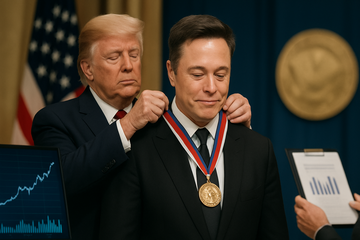
On October 8, 2026 — the same day the August disclosure was released — the White House hosted the \"Science: A New Golden Age Summit.\" Trump awarded the National Medal of Science to SpaceX/Tesla CEO Elon Musk, Google co-founder Sergey Brin, Nvidia CEO Jensen Huang and AMD CEO Lisa Su. He separately awarded the National Medal of Technology and Innovation to Dell's Michael Dell and Microsoft CEO Satya Nadella. Trump sold Nvidia and AMD in August per the same disclosure, while simultaneously adding new positions in Microsoft (per Bloomberg's read of the filing). Musk and the medal cohort occupy the disclosure's center of gravity.
Why Meta Specifically: Capex, Antitrust Risk, and an Earnings Calendar Right Behind the Disclosure
Meta Platforms is not a marginal name to the Trump trade book. The company is the second-largest U.S. digital ad platform by revenue and the most aggressive hyperscaler on capex. Its 2026 capital expenditure guidance was raised to $130B–$145B from $115B–$135B at the Q1 2026 update, and Q2 FY2026 revenue of $60.8 billion (+28% YoY) set the floor. Q2 operating income of $18.78 billion funded an EPS of $6.18 diluted, even as the company's TTM operating margin held at roughly 38%. The Q3 FY2026 report is scheduled for October 28, 2026 — twenty days after the disclosure release — and the consensus Q3 revenue estimate is in the $61B–$64B band Meta itself guided in late July.
The single most consequential supplier relationship in Meta's capex stack is Broadcom. On April 14, 2026, Meta extended its custom AI silicon partnership with Broadcom through 2029, committing to deploy one gigawatt of Meta Training and Inference Accelerator (MTIA) chips co-developed with Broadcom — the industry's first 2-nanometer AI compute accelerator. Analyst models place the contract value above $35 billion over its life. Broadcom is also a Trump portfolio link: CEO Hock Tan agreed in April 2026 to leave Broadcom's board, freeing him for what CNBC framed as a closer advisory role. That same week, Trump also sold Nvidia — the incumbent GPU supplier whose chips Meta is partly replacing with MTIA silicon. The rotation reads as a deliberate tilt toward the in-house-silicon thesis.
Why SpaceX Debt Instead of Stock: A Coupon That Aligns With the Policy Calendar
Trump's SpaceX exposure has evolved across three disclosures in three months — and the trajectory shows a portfolio consciously moving from equity to credit at the moment SpaceX became a federal procurement anchor. The July disclosure (signed September 8, released September 22) showed him buying $15,001–$50,000 of SpaceX shares on July 10 and selling $1,001–$15,000 on July 17 — a small, round-trip trade. The August disclosure replaced that equity exposure with $1M–$5M of SpaceX 5.35% senior unsecured notes due 2031, purchased August 18. Two days later, Trump signed NSPM-17.
The bond itself is a piece of SpaceX's $25 billion inaugural investment-grade offering priced June 23, 2026, eleven days after SpaceX's record $75 billion Nasdaq IPO on June 12. Demand for the offering reached $89 billion, per Bloomberg. The 2031 tranche — the shortest maturity — priced at 5.35% on $7 billion of notes, the lowest coupon in the five-tranche structure (5.35% in 2031 stepping up to 6.65% on the 30-year bonds). At issue, the 2031 notes yielded modestly above comparable Treasuries. By August 18 — the date of Trump's purchase — secondary market yields on the 2031 notes had risen into the high-5% range, per fixed-income trackers. Trump bought while the bonds were still close to par, capturing the 5.35% coupon while NSPM-17 was being finalized for signature.
SpaceX (SPCX) After the Post-IPO Crash: Where Trump's Aug 18 Bond Buy Sits
SPCX closed at $135 on IPO day June 12, opened at $150, peaked above $200 in late June, troughed near $108 in early August, then recovered to ~$172 by Oct 7 — the bond coupon pays regardless of equity volatility.
IPO price (Jun 11)
Largest IPO in history, $75B raised
135
First-day open (Jun 12)
11% above IPO
150
June peak
52-week high, June 2026
225.6
August trough
Below IPO price, early Aug
104.8
Oct 7 close
Recovered on AI/Starship narrative
171.9
The Framework Test: 45-Day Window, Range Disclosure, and a Law That Exempts the President
U.S. federal ethics law requires presidents, vice presidents and certain senior officials to publicly disclose stock transactions exceeding $1,000 within 45 days of the trade. Trump's August 21 Meta purchase was disclosed October 8 — 48 days later; his August 18 SpaceX bond purchase was disclosed 51 days later. Both exceed the 45-day window. In May 2026, the Office of Government Ethics assessed Trump a $200 late-filing fee for missing earlier 45-day windows. The penalty is statutory; it is also nominal relative to the size of the trades it covers. The Stop Insider Trading Act (H.R. 7008), which would have banned Members of Congress, their spouses and dependent children from trading individual stocks while in office, failed Senate cloture on September 30, 2026 — every Senate Democrat voted no. The bill, as written, deliberately excludes the president and vice president from its scope.
There is no federal blind-trust requirement for the president. Executive Order 13770 (January 2017) imposed a broad ethics pledge that included a recusal framework, but it does not mandate divestment of public equities, and Trump's own CLARITY Act ethics compromise (September 2026) — which forced divestiture of significant crypto holdings above a threshold to advance a market-structure bill — applied only to crypto, not to public-company equity. The president's trades are public, eventually; the disclosure window and the dollar-range reporting together mean the market sees the trade weeks after the trade sees the market.
This is the structural point. A sitting president can buy between $5M and $25M of a company that is in active appellate litigation against an independent agency under his constitutional supervision, and the disclosure lands after the appellate brief cycle is mostly closed. He can buy $1M–$5M of debt from a launch provider whose primary customer is the U.S. government, two days before he signs a national space transportation policy, and the disclosure is published on the same day he awards that provider's CEO the National Medal of Science. None of it is illegal. None of it is opaque. The OGE form works exactly as designed — and the design is the gap.
Market-Structure Transmission: What the Disclosure Day Actually Moved
The price tape around the disclosure release was muted — partly because the trades themselves were a month old, partly because the August retail rotation was already in market memory. Meta closed at $721.31 on October 7, down 2.4% on the day per Polymarket's tracking; the stock traded between $717.89 and $724.76 on October 8 and closed around $719.90, per Yahoo Finance historical data. Some outlets reported a >1% intraday pop on the disclosure headline itself; the close-to-close move was effectively flat. SpaceX traded between $165.69 and $171.92 in the same window, with the bond market showing no observable reaction — the 5.35% 2031 notes are held primarily by institutional accounts and Treasury/agency-style desks, not retail flow.
The more interesting transmission is not to Meta or SpaceX directly, but to the second-order linkages the disclosure creates. Broadcom's MTIA co-development agreement with Meta — extended through 2029 and committed to one gigawatt of 2nm custom AI silicon — is now an indirect beneficiary of a U.S. presidential equity endorsement of Meta's stock. Nvidia, sold by Trump in August, sits on the opposite side of the same trade thesis: Meta's in-house silicon roadmap substitutes for Nvidia GPUs at scale. The medal ceremony placed Trump publicly adjacent to both Nvidia's Jensen Huang and AMD's Lisa Su on the same day the disclosure showed him exiting both names.
| Company | Trump's Aug action | Trump Oct 8 medal? | Listed ticker |
|---|---|---|---|
| Meta Platforms | Bought $5M–$25M (Aug 21) | No | meta |
| SpaceX | Bought $1M–$5M bonds (Aug 18) | Yes — Musk | spcx |
| Nvidia | Sold | Yes — Huang | nvda |
| AMD | Sold | Yes — Su | amd |
| Alphabet | Traded (per Bloomberg) | Yes — Brin | googl |
| Microsoft | Bought ≥$1M (per Bloomberg) | Yes — Nadella | msft |
| Dell Technologies | Not disclosed as traded | Yes — Michael Dell | Private |
| Tesla | Traded (per Yahoo) | Yes — Musk | tsla |
The horizontal read across the medal cohort is a portfolio of companies the sitting president holds debt, equity or active trades in — with one notable absence. Dell Technologies is private, and Trump's August disclosure contains no Dell-related entries per the public read of the filing. Of the seven CEOs Trump honored on October 8, four (SpaceX's Musk, Nvidia's Huang, AMD's Su, Alphabet's Brin) are tied to Trump's August transactions, one (Microsoft's Nadella) is tied to a disclosed new buy, and one (Tesla's Musk) overlaps with Musk's SpaceX exposure. The medal set is, in effect, the disclosure's beneficiary list.
Horizons: What Moves in Days-Quarters and What Defines the 1–3 Year Arc
Over the next several quarters, the binary catalyst is the FTC v. Meta appeal. Oral arguments have not yet been scheduled, but the briefing cycle closed on October 6, 2026 (deferred appendix). A D.C. Circuit decision in 2027 would either affirm Judge Boasberg's November 2025 ruling — removing the antitrust overhang from Meta's multiple — or vacate it and remand, which would put the case back in district court and add12–24 months of litigation uncertainty. A second-order catalyst is Meta's Q3 FY2026 report on October 28, 2026: any Q3 capex guide above $145B, or any slip in revenue against the $61B–$64B guide, will recalibrate the AI capex narrative the presidential endorsement effectively amplifies.
On the SpaceX side, the near-term tape depends on the equity, not the bond. SpaceX stock recovered from an August $108 trough to $171 by early October, and Trump's $1M–$5M bond purchase gives him no equity beta — but the optics of a sitting president holding SpaceX debt while signing national space policy and awarding Musk a national medal is the kind of structural signal that, in the next federal procurement cycle, materially shapes how the U.S. government and its commercial partners price SpaceX contract risk. Over a 1–3 year arc, the open question is whether the Stop Insider Trading Act re-emerges with presidential coverage, whether the CLARITY Act's blind-trust framework expands from crypto to public equities, and whether the Office of Government Ethics narrows the 45-day window or the dollar-range reporting tolerance that lets the disclosure arrive after the trade sees the market.
Investable Read-Across
- Presidential $5M–$25M equity endorsement and $130B–$145B capex thesis re-anchor Meta as the AI hyperscaler with White House political alignment.
- Q3 FY2026 print on October 28 is the next catalyst: Q2's $60.8B revenue (+28% YoY) and $18.78B operating income set the bar.
- FTC v. Meta D.C. Circuit appeal oral arguments not yet scheduled — a2027 affirmance removes the antitrust overhang, but a remand adds 12–24 months.
- 5.35% 2031 senior unsecured notes — held by Trump — trade close to par despite equity volatility ($108 trough to $172 recovery).
- Bond coupon captured while NSPM-17 was being finalized; signals durable credit access as the U.S. government's primary launch anchor.
- Post-IPO equity at $171.92 (Oct 7) leaves the 52-week $225.64 high within reach on any Starship cadence acceleration.
- Meta's 1-gigawatt MTIA co-development commitment through 2029 is the most concrete AI silicon roadmap outside Nvidia — and Trump's August disclosure rotates from NVDA toward this thesis.
- Analyst contract value estimates range $35B+ through 2029; Trump Medal of Science to Hock Tan (announced April 2026) reinforces the personal-level White House alignment.
- Stock already trades at premium multiples; the marginal upside is in capture rate on Meta's $130B–$145B 2026 capex.
- Trump sold NVDA in August per the disclosure — same trade book that bought Meta and SpaceX debt — signaling preference for in-house silicon (Broadcom/MTIA) over incumbent GPU.
- Counter-force: Meta still buys Nvidia GPUs for training; TTM capex is large enough to absorb both. The rotation is signal, not substitution.
- Medal to Jensen Huang on Oct 8 suggests the relationship is intact; the trade was portfolio-level, not policy-level.
- Q2 FY2026 revenue of $1.7M (+89% YoY) and net loss of $238M (reported Aug 10) — the equity is a meme-driven vehicle, not an earnings story.
- $6B all-stock merger with TAE Technologies (nuclear fusion) targeted to close Q4 2026 — the catalyst is the merger close, not the disclosure.
- Truth Social competes directly with Meta in the social-graph market that is at the heart of the FTC v. Meta appeal.
- If FTC v. Meta appeal succeeds at narrowing the personal-social-networking market definition, YouTube (Alphabet) is the precedent the FTC would cite — putting Alphabet inside the next antitrust question.
- Trump's August trades included Alphabet per Bloomberg's read of the filing, and Sergey Brin received the National Medal of Science on Oct 8.
- Binary exposure to the FTC appeal outcome — but the antitrust case is currently Meta-specific.