
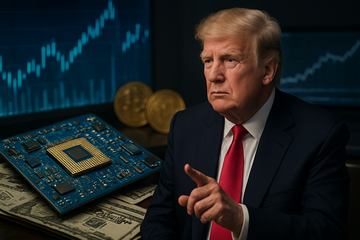
The Intel Trade Is the Valuation Model Now
Every claim about a US government stake in OpenAI or Anthropic starts with the same counterfactual: the August 2025 Intel deal. On Aug. 22, 2025 the Trump administration converted $8.9B of unpaid CHIPS Act and Secure Enclave funding into 433.3M Intel shares at $20.47 — a 9.9% passive stake, no board seat, paired with a five-year warrant for an additional 5% if Intel gives up control of its foundry. Treasury paid in chips grants; it got equity.
Fifteen months later, Intel closed Sep 30 at $120.23 and traded $121.10 on Oct 2, putting the Treasury block at roughly $52B — within shouting distance of the $60B figure Trump cited in the Time interview as his rationale for repeating the structure in AI. The implicit multiple on the position is 5.8x in 14 months. That is the number every frontier-lab banker will use when pitching the same deal to Treasury and to private-market investors.
Mark-to-market at $120
~$52B
Yahoo Finance / Robinhood quote, Oct 2, 2026
Trump's interview figure
$60B
Time interview, Oct 1, 2026
Implied multiple
5.8x
In roughly 14 months, including the Apple-foundry catalyst
What 'Might' Actually Means in the Time Interview
Trump's remarks came in a Time interview the day after Anthropic CEO Dario Amodei and his wife dined privately with him. Trump explicitly ruled out nationalizing the labs, then said: 'I might. Maybe I could do that. I have many deals like that — I do that.' OpenAI had floated a 5% gift to Treasury in a July 2026 proposal; Anthropic and the administration have publicly denied any ongoing stake talks. Yet Trump added he 'liked' Amodei and praised his intelligence — the political conditions for a deal are not hostile.
Two days before the interview, Trump hosted the 'White House Accord on Super Intelligence' — a voluntary, 'morally binding' self-policing pledge signed by OpenAI, Anthropic, Meta, Alphabet, Nvidia and xAI. The accord is the carrot; the equity stake is the stick. Together they amount to a coordination regime in which political alignment buys both regulatory forbearance and a Treasury balance-sheet backstop — exactly the structure Trump used to monetize the Intel CHIPS position.
The Pre-IPO Math Has to Reprice
Both labs are inside the IPO window. Anthropic confidentially filed in June 2026, targets a $1.8–2T valuation in a $100B raise before Thanksgiving, and is already lining up Nvidia as a $10B anchor from its November 2025 partnership. OpenAI is leaning toward a 2027 listing at $852B–$1.5T, with the March 2026 round valuing the OpenAI Foundation's stake alone above $180B. These are the two largest private assets in history, and Treasury is being offered a piece of both.
| Lab | Latest private mark | 5% slice | Implied Treasury stake at IPO | Strategic precedent |
|---|---|---|---|---|
| OpenAI | $852B (Mar 2026 round) | $42.6B | $50B – $75B at $1T–$1.5T | Altman publicly proposed a 5% gift in Jul 2026 |
| Anthropic | $965B (Series H, May 2026) | $48.3B | $90B – $100B at $1.8–2T target | Discussions publicly denied; Trump-Amodei dinner, Sep 30 |
For Microsoft, which already owns 27% of OpenAI (worth roughly $228B at the March 2026 round per Forbes), a Treasury seat at the same table reframes the cap table. Adding Foundation (26%) plus Treasury (5%) puts a quasi-public bloc above 30% alongside Microsoft's 27% — a governance event regardless of who actually votes the Treasury shares.
The Supply Chain Reprices Too
The reason this matters for listed equities is that both labs sit on top of a public-market supply chain that is already booked at scale. Oracle signed a $300B, five-year compute deal with OpenAI in September 2025; Anthropic's IPO prospectus discloses $518B of total cloud and infrastructure commitments through 2029, including an $84.5B SpaceX compute agreement. Sovereign backing extends the cash runway on those contracts and lowers the discount rate buyers should apply to Oracle's backlog and to Nvidia's $10B Anthropic anchor.
- Nvidia: the $10B Anthropic anchor (Nov 2025 partnership) now sits inside a Treasury-aligned listing — the same political protection that lifted Intel 5.8x.
- Microsoft: the 27% OpenAI stake faces a new co-shareholder; royalty-share economics on a sovereign-backed OpenAI may compress if Treasury seeks maximum compute spend.
- Oracle: the $300B OpenAI Stargate deal becomes less likely to be repriced if Treasury is a residual claimant on the same revenue stream.
- CoreWeave: 5GW capacity buildout funded partly by Nvidia's $2B January 2026 investment gains a sovereign-customer credit tailwind.
- Micron and TSMC: the HBM and foundry content behind every sovereign-backed GPU order sits underneath the Treasury play.
- Intel: the precedent itself — every incremental Treasury stake validates the Intel thesis and the warrant.
Treasury stake value, cost basis vs. mark-to-market
Intel is the live valuation model: chips-paper revenue looks authoritative when the same structure shows up in AI.
Unit: USD billions
Sovereign Risk Has Two Sides
The bullish read is mechanical: a Treasury shareholder is a long-only holder with a multi-year mandate, no exit pressure and a clear incentive to support compute spending. That is exactly the profile that turned Intel from a $20.47 entry to a $120 print. But the bearish read is governance. A regulator that is simultaneously a shareholder sets the discount rate, audits the lab, and decides which export controls apply. The same government that demanded the Anthropic Pentagon dispute be resolved can now use its equity to dictate terms — a feature, not a bug, for some investors and a sovereign allocation concern for foreign LPs.
The second risk is conflict-of-interest optics. Trump has personally traded Alphabet, Meta, Nvidia and xAI through2026; Senator Andy Kim publicly flagged the AI-stock activity in the hours after the Time interview. A Treasury position inside the same names is a separate matter for the GAO and the Office of Government Ethics. Even if every filing is clean, the perception discount is non-zero, and it lands hardest on the IPOs themselves — Anthropic's Thanksgiving window and OpenAI's 2027 debut.
Horizons — Days to Quarters, and 1 to 3 Years
Near-term: the Anthropic pre-Thanksgiving IPO is the binary catalyst. A confirmed Treasury anchor (or even a credible rumored one) tightens the $1.8–2T target band; a denial pushes the deal back to a $1.2–1.5T range and forces Nvidia to defend a smaller anchor position. Either outcome re-rates CoreWeave and Oracle on the demand side and Micron / TSMC on the supply side inside days.
Long-term: the structural read is that the US has built a sovereign AI ownership layer in 18 months — chips grants → Intel equity → AI safety accord → OpenAI/Anthropic anchor. By 2027 the model is likely to extend to X/Tesla, SpaceX, and any IPO-bound frontier lab with national-security exposure. The winners are the listed suppliers inside the loop; the question is whether foreign capital accepts the sovereign premium or reroutes to non-US domiciles.
The Investor Take
Stocks with the read on this trade
- The9.9% Treasury block is the precedent every frontier-lab model repeats, lifting the valuation to ~$120 and the warrant to ~$142.35 strike.
- The $10B Anthropic anchor (Nov 2025) gains sovereign-credit cover, but political risk on the sovereign front puts a 5–10% overhanging supply discount on the capital stack.
- The 27% OpenAI block faces a new Treasury co-shareholder, diluting the corporate governance of the royalty stream inside the $135B OpenAI position by 2030.
- The $300B OpenAI Stargate deal becomes less likely to be repriced if Treasury is a residual claimant on the same revenue stream, anchoring the valuation re-rating.
- 5GW capacity buildout gains sovereign-customer credit cover when Anthropic's $518B compute commitments are Treasury-anchored at IPO.
- HBM content per Treasury sits beneath every sovereign-validated GPU order, locking in HBM3E/HBM4 capacity run-rate through 2028.
- Foundry demand from sovereign-validated labs anchors TSMC's 2nm/3nm capacity book through 2027, pending TSMC's Q4 2026 capex disclosure.