
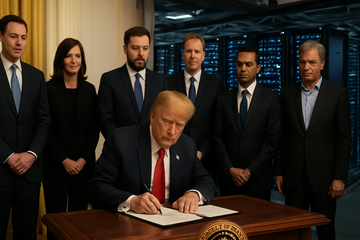
What happened in the White House Rose Garden on Tuesday, Sept. 29, 2026, looks like a safety announcement. It is actually a deregulation announcement — and a green light for the largest infrastructure buildout in modern U.S. history. President Trump gathered six frontier-AI chief executives, signed a one-page pledge framed as a 'constitution,' renamed the technology 'Super Intelligence,' and used the podium to push back against bipartisan voter anger over data centers. Investors should read the document for what it does not contain: enforcement, deadlines, third-party verification standards, or any path to binding federal rules.
Accord signatories
6 companies
Alphabet, Anthropic, Meta, OpenAI, xAI (now part of SpaceX), NVIDIA — signed Sept. 29, 2026
U.S. data-center projects stalled or blocked, H1 2026
~$200B
120+ projects across 49 states, per Data Center Watch research
Meta Platforms 2026 capex guidance
$130B–$145B
Raised in Aug 2026; up from $115B–$135B at start of year
Proposed AI-oversight committee
~10 people
Trump floated a board 'to watch over the whole enterprise'; members not named
The Accord
A 308-word pledge with no enforcement clause
The document, formally the White House Accord on Super Intelligence: Joint Commitment on Frontier Responsibilities, was posted by Trump to Truth Social after the White House luncheon. It commits signatories to 'four layers of controls and audits' — internal safeguards on training and deployment, an internal oversight team, an independent external auditor, and an independent board committee — covering cybersecurity, biosecurity, and chemical-threat risk. It also states companies will 'meet regularly to establish standards and best practices' and notes that 'over time, it may make sense to codify these steps into laws or regulations.'
The signatories are six, not seven: Alphabet CEO Sundar Pichai, Anthropic CEO Dario Amodei, Meta Platforms CEO Mark Zuckerberg, OpenAI president Greg Brockman, xAI/SpaceX CEO Elon Musk, and NVIDIA CEO Jensen Huang. Microsoft and Amazon were present but did not sign. The accord is one page long; the Forbes copy of the text runs to 308 words.
The Executive Order
Trump rebrands AI as 'Super Intelligence' — but leaves the underlying law untouched
Alongside the accord, Trump signed an executive order titled 'Inaugurating the Era of Super Intelligence.' Section 1 directs the executive branch to use 'Super Intelligence' and 'SI' in place of 'Artificial Intelligence' and 'AI' in official correspondence, public communications, websites, reports, and policy documents. Section 2 makes that direction binding within60 days for non-statutory documents. Section 3, critically, ties 'Super Intelligence' to the existing statutory definition of AI under 15 U.S.C. § 9401(3) and asks the Office of Science and Technology Policy, within 60 days, to propose a federal statutory definition that may 'modify, expand, or supersede' the current one.
- The EO does not create a new regulator, an enforcement body, or a mandatory pre-release review process.
- It explicitly does not amend any prior statute, regulation, contract, or grant — the rebrand is administrative only.
- Section 4 leaves implementation subject to appropriations and existing law, keeping the order narrow.
- The June 2, 2026 Executive Order 14409, 'Promoting Advanced AI Innovation and Security,' remains the operative cybersecurity directive; it built a voluntary framework for federal access to frontier models and expressly bars the administration from imposing a 'mandatory governmental licensing, preclearance, or permitting requirement.'
- Trump told reporters he will name an 'AI czar' in coming days and is considering a ~10-person committee to 'watch over the whole enterprise' — neither has a roster.
The Hidden Deal
The data-center pipeline just got a federal backstop
The most consequential half of Trump's podium remarks was not about AI at all. With the Nov. 3 midterms five weeks out and 70% of Americans in Gallup polling opposing new AI data centers, Trump used the press conference to publicly endorse rapid data-center expansion and warned executives they must 'make massive contributions to communities' to neutralize bipartisan backlash. He told reporters that if local opposition continues, data centers 'will be forced to go overseas or other locations.'
Q1 2026 projects blocked/delayed by opposition
$130B
At least 75 projects, per Data Center Watch, the largest single-quarter total on record
Q2 2026 projects blocked/delayed
$68B
At least 45 projects; majority of large proposed developments in the quarter
States with active data-center opposition groups
49
Per Data Center Watch, via Capacity Global, Sept. 30, 2026
Data-center-related state bills in 2026
300+
Progressed through 30+ state legislatures, per Capacity Global
House vote on Ratepayer Protection Act
417–3
Passed earlier in September; limits utility cost allocation to data-center ratepayers
Who's Absent
Microsoft and Amazon sat this one out — and that signal matters
Microsoft and Amazon attended the lunch but are not signatories. Their absence is the most telling feature of the day. Microsoft just completed the unwinding of its exclusive OpenAI cloud arrangement in April 2026 and is now routing internal workloads to its own models rather than paying Anthropic; OpenAI in turn spent2026 inking new Azure commitments through 2030 worth a reported $250B, even as Microsoft's Azure topped $100B for the first time in fiscal Q4 2026 (revenue $90.0B, +18% year-over-year). Amazon's AWS, the largest cloud by revenue, faces its own Jassy-vs.-Trump friction that was not resolved at the table.
The structural consequence: the six signatories — five of which are model developers and one of which is the dominant chip supplier — now own the standard-setting process. Anthropic's $965B post-money valuation and $65B revenue run rate (Series H, May 2026) and OpenAI's $852B valuation with a $40B run rate (March 2026 funding round) are now backed by a Trump-era 'in our image' framework rather than binding oversight. Smaller frontier-model startups and open-weight advocates — the constituencies that pushed back on a similar2023 Biden accord — were not invited.
The Supply Chain
The accord is bullish for the AI utility and infrastructure complex, neutral-to-bullish for chips
The Sept. 29 deal layers an explicit White House endorsement over a buildout that hyperscalers and AI labs were already financing. NVIDIA's Q2 FY2027 (quarter ended Jul 26, 2026) printed $96.2B of revenue with $89.0B from Data Center, up 117% year-over-year — the segment now accounts for ~92% of company revenue. Meta Platforms raised2026 capex to $130B–$145B in August; Microsoft's capex-to-revenue was 34.9% TTM through June 30, 2026; and Oracle's capex-to-revenue hit 105% TTM through Aug. 31, 2026. CoreWeave, the only pure-play AI infrastructure stock that reports results, posted Q2 2026 revenue of $2.575B (+112% YoY) against a $104.2B contracted backlog and guided2026 capex to $35B–$39B.
| Company | Ticker | Latest capex / 2026 guidance | Latest revenue | Period |
|---|---|---|---|---|
| NVIDIA | nvda | DC rev $89.0B in Q2 (segment, not capex) | $96.22B | Q2 FY27, qtr end Jul 26, 2026 |
| Microsoft | msft | Capex/rev 34.9% TTM | $90.0B (+18%) | FY26 Q4, qtr end Jun 30, 2026 |
| Meta Platforms | meta | $130B–$145B 2026 guidance (Aug update) | $228.2B TTM | Q2 2026 / Aug 2 update |
| Alphabet | googl | Capex/rev 29.7% TTM | $445.9B TTM | Q2 2026, qtr end Jun 30, 2026 |
| Oracle | orcl | Capex/rev 105% TTM | $71.8B TTM | Q1 FY27, qtr end Aug 31, 2026 |
| CoreWeave | crwv | $35B–$39B 2026 guidance | $2.575B (+112% YoY) | Q2 2026, qtr end Jun 30, 2026 |
On the power side, three listed names absorb the marginal kilowatt. Constellation Energy operates 32.4 GW of nuclear, gas, wind, solar, and hydro capacity and signed a 20-year power purchase agreement with Microsoft for the Three Mile Island restart in 2024. Vistra has 38.7 GW including nuclear, gas, coal, solar, and battery storage and is the largest U.S. independent power producer by capacity. NRG Energy operates 18 GW plus retail energy across six million customers. Equinix, the digital-infra REIT, runs $9.9B TTM revenue at a 65x trailing P/E — the market is already pricing AI tenancy into the colocation multiple.
The Risks
Three ways this thesis can break before2027
- The 10-person committee turns real. Trump told reporters he is thinking about a ~10-person board to 'oversee' AI safety and will name an AI czar — neither has members yet. A committee with state attorneys general, federal safety experts, or bipartisan congressional appointees could draft the de facto AI rule Trump says he will not write, and a single high-profile model incident (a biosecurity escape, a cyberattack) would accelerate that path.
- The chip-tariff Phase 2 lands. The administration was weighing a second semiconductor tariff round in late August that would eliminate the data-center, startup, and consumer-device exemptions that have kept AI server imports cheap; tariffs that land on HBM, advanced-node logic, or networking silicon would compress margins across the same signatories who signed the accord.
- Midterm backlash overrides Trump. Republicans trail Democrats by 12 points on the generic House ballot, per The Hill's Sept. 30 report, and data centers are polling 70% negative. If the GOP loses the House on Nov. 3, congressional action on the Ratepayer Protection Act (already 417–3 in the House) and AI safety legislation becomes a 2027 certainty — and the voluntary accord becomes the floor, not the ceiling.
Investor Takeaway
Buy the infrastructure, watch the policy timeline
The market was already pricing the AI infrastructure complex on volume, not on regulation. The Sept. 29 deal removes the binding-regulation tail risk that has lingered since 2023 and replaces it with an industry-friendly baseline. The structural winners are the AI utility complex (Constellation Energy, Vistra, NRG), the data-center landlords (Equinix), and the credit-leveraged pure-play builder (CoreWeave). The structural winners on the silicon side are NVIDIA — now both an accord signatory and the gating supplier — and the foundry ecosystem (TSMC, Applied Materials). Hyperscalers (Microsoft, Alphabet, Meta Platforms) get the cleanest regulatory clarity, with Oracle the most exposed to balance-sheet risk if capex monetization slips.
Stocks the Sept. 29 accord touches
- Accord signatory and sole supplier of the GPU silicon running every frontier model listed — Q2 FY27 data-center revenue hit $89.0B, up 117% YoY, the gating constraint on the entire buildout.
- Short-term: Trump's Sept. 19 'AI Force' and AI czar pledge do not touch chip exports; the deal keeps Phase-2 chip tariffs from being announced at the accord table.
- Long-term: the 'four-layer controls' framework raises the bar for new model entrants and entrenches the NVIDIA-integrated hyperscaler stack as the de facto certified architecture for compliance-grade AI.
- Trump's podium endorsement of rapid data-center expansion converts a state-level permitting fight into a federal priority — 32.4 GW of nuclear-led capacity makes CEG the marginal baseload supplier for any AI hyperscaler signing onto the accord.
- Q2 2026 results showed 23% YoY revenue growth even as quarterly earnings declined 47%; consensus 2026E EPS recovery hinges on data-center PPAs clearing local opposition, now backed by presidential rhetoric.
- Long-term: a federal AI czar or 10-person safety committee that mandates 'clean' power for hyperscalers would tilt the data-center load toward CEG's nuclear fleet and away from gas peakers.
- 38.7 GW of gas, nuclear, coal, solar, and battery capacity positions Vistra as the largest IPP to monetize the AI load — TTM revenue $19.2B and EV/EBITDA 10.3x leave room for re-rating if data-center opposition breaks.
- Forward P/E of 13.3x against 23.4x trailing implies the market is pricing in flat earnings; any acceleration in 2027 hyperscale PPAs flips the multiple.
- Long-term: like Constellation Energy, the Trump data-center priority statement reframes state rate-payer fights as a federal-level issue, supporting Vistra's request for cost-recovery mechanisms for new generation.
- Q2 2026 revenue of $2.575B (+112% YoY) against a $104.2B contracted backlog and 59% adjusted EBITDA margin makes CoreWeave the cleanest pure-play on the buildout the accord blesses.
- Capex of $6.4B in Q2 and 2026 guidance of $35B–$39B means CoreWeave carries the largest balance-sheet risk in the cohort if local opposition stalls construction — debt/equity is 10.3x TTM.
- Long-term: as a non-signatory, CoreWeave depends on the six signatories' model deployments to convert backlog into revenue; if the 10-person committee imposes compute-provenance rules, CoreWeave's GPU-leasing model could face new audit requirements.
- Microsoft is the conspicuous non-signatory on a deal that legally binds nothing — it gains regulatory clarity without ceding control of its in-house safety stack, and FY26 Q4 Azure revenue topped $100B for the first time at $90.0B total revenue, +18% YoY.
- Short-term: Microsoft's absence removes it from the 'good-corporate-citizen' photo-op but also from any voluntary audit obligations the accord imposes.
- Long-term: if Trump names an AI czar with enforcement authority, Microsoft is the most exposed of the hyperscalers because its restructured OpenAI agreement eliminates exclusive cloud rights but still leaves $250B of Azure commitments through 2030.
- 2026 capex guidance raised in August to $130B–$145B (from $115B–$135B) puts Meta Platforms at the high end of the hyperscaler spend cohort; Trump's data-center priority statement reduces execution risk on that build.
- TTM revenue of $228.2B and a 27.0x trailing P/E leave room for re-rating if Q3/Q4 prints show AI-monetization revenue offsetting capex drag — the accord's safety framework does not constrain open-weight releases.
- Long-term: Zuckerberg's seat at the table and Reality Labs overlap with Trump-administration priorities on American AI leadership mean Meta Platforms is the most politically aligned hyperscaler in the cohort.
- Trump's data-center endorsement directly underwrites colocation demand — Equinix's $9.9B TTM revenue, $1.07B quarterly earnings (+28.8% YoY), and 65x P/E price in AI tenancy that the accord's voluntary standards do not constrain.
- Short-term: opposition in 49 states is the binding constraint, and the accord reframes that opposition as against a presidential priority.
- Long-term: if data-center load shifts further toward colocation (vs. hyperscaler-owned), Equinix collects the rent on every kilowatt — and the accord's 'meet regularly to establish standards' clause could create a regulatory moat favoring established, audit-ready operators.
- Sundar Pichai signed for Alphabet; Google Cloud's TTM revenue is embedded in the $445.9B total at 17.3x P/E — the lowest multiple in the Magnificent Seven, the clearest expression of the accord's regulatory relief.
- Trump's AI rebrand EO leaves the 15 U.S.C. § 9401(3) statutory definition intact for 60 days — no immediate compliance rework for Google's Gemini deployments.
- Long-term: Alphabet's Google Cloud backlog and YouTube AI inference workloads anchor demand for the NVIDIA-Applied Materials-TSMC supply chain that the accord implicitly blesses.