%22%2F%3E%0A%20%20%3Ccircle%20cx%3D%22220%22%20cy%3D%22150%22%20r%3D%22180%22%20fill%3D%22%2322d3ee%22%20fill-opacity%3D%220.12%22%2F%3E%0A%20%20%3Ccircle%20cx%3D%221010%22%20cy%3D%22130%22%20r%3D%22220%22%20fill%3D%22%2338bdf8%22%20fill-opacity%3D%220.08%22%2F%3E%0A%20%20%3Ccircle%20cx%3D%22920%22%20cy%3D%22520%22%20r%3D%22170%22%20fill%3D%22%2322d3ee%22%20fill-opacity%3D%220.06%22%2F%3E%0A%20%20%3Cpath%20d%3D%22M140%20430h920%22%20stroke%3D%22url(%23line)%22%20stroke-width%3D%2212%22%20stroke-linecap%3D%22round%22%2F%3E%0A%20%20%3Cpath%20d%3D%22M220%20360c120-150%20260-220%20380-220s260%2070%20380%20220%22%20fill%3D%22none%22%20stroke%3D%22%2367e8f9%22%20stroke-opacity%3D%220.5%22%20stroke-width%3D%2216%22%20stroke-linecap%3D%22round%22%20stroke-linejoin%3D%22round%22%2F%3E%0A%20%20%3Cpath%20d%3D%22M300%20398h600%22%20stroke%3D%22%2394a3b8%22%20stroke-opacity%3D%220.24%22%20stroke-width%3D%228%22%20stroke-linecap%3D%22round%22%2F%3E%0A%20%20%3Ctext%20x%3D%22220%22%20y%3D%22510%22%20fill%3D%22%23e2e8f0%22%20fill-opacity%3D%220.7%22%20font-family%3D%22Arial%2C%20Helvetica%2C%20sans-serif%22%20font-size%3D%2238%22%20letter-spacing%3D%228%22%3EINSIGHTS%3C%2Ftext%3E%0A%3C%2Fsvg%3E)
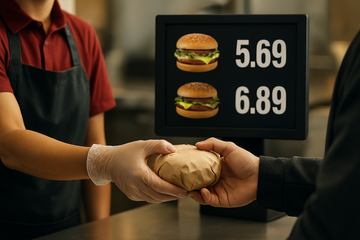
The 21% gap
Two Fresno Big Macs, two dollars apart — and a Reuters engine exposed behind them
A Sept. 29 Reuters investigation reviewed pricing interfaces that McDonald's shares with its franchisees and found the chain's machine-learning engine recommending a different \"optimal price\" for the same Big Mac at virtually identical locations. The cleanest example sits in Fresno, California: a company-run store on one side of town posts $5.69, while a McDonald's two miles down the road rings up $6.89, a 21% premium Reuters could not confirm was directly caused by the algorithm but that franchisees say the tool has steadily widened.
The pricing system itself is blunt in tone. Screenshots reviewed by Reuters show messages such as \"Your restaurant is showing MEDIUM SENSITIVITY to Price\" calibrated on \"customer willingness to pay in your area.\" The model ingests millions of daily transactions across nearly 14,000 U.S. restaurants plus online menus of nearby competitors including Wendy's and Restaurant Brands International-owned Burger King, and forwards suggested prices to franchisees at least three times a year. Five franchisees told Reuters the company pressured them to use the tool, and on the August earnings call CEO Chris Kempczinski tied \"pricing non-compliance\" to business-review conversations.
Why now
The algorithm is being pushed hardest at the moment value menus stopped working
The willingness-to-pay rollout is happening as McDonald's cycles through its weakest stretch in five years. U.S. comparable sales grew just 0.8% in Q2 FY2026 — the slowest pace since early 2025 — even as the chain layered on McValue (January 2025), Extra Value Meals (fall 2025) and McValue 2.0 (April 2026). Q2 systemwide sales still climbed5% to $37 billion and consolidated revenue rose 4% to $7.10 billion, but Kempczinski explicitly attributed the U.S. traffic slip to franchisees not following recommended prices, not to the price points themselves.
U.S. comparable sales (Q2 FY2026)
+0.8%
lowest since early 2025; vs. +3.9% in Q1 FY2026
Global systemwide sales (Q2 FY2026)
$37B
+5% reported, +4% in constant currencies
Consolidated revenue (Q2 FY2026)
$7.10B
vs. $6.84B in Q2 FY2025
Adjusted EPS (Q2 FY2026)
$3.38
reported Aug. 4, 2026
Stock decline from Feb. 2026 high
≈31%
worst annual return on track since 2002
Franchised share of U.S. stores
~95%
royalty + ad fund + rent collected on franchisee sales
For a franchisor that collects roughly 5% royalty plus 4% ad fund plus 8–10% rent as a percentage of franchisee sales, every price the algorithm nudges upward lands partly in Oak Brook. The economics make the tool's adoption near-incentive-compatible for the franchisor even when the franchisee absorbs the customer-facing fallout — and they make Kempczinski's August language (\"pricing non-compliance is part of business review conversations\") read less like a suggestion than an enforcement mechanism.
The franchisor–franchisee fault line
The 95% who own the stores, the 5% who don't — and a 'Bill of Rights' that includes pricing
Friction inside the McDonald's system has been building for months. In January 2026 the National Owners Association, an independent franchisee group, circulated a \"Bill of Rights\" that led with \"the right to set prices without fear of reprisal.\" By September 1, the trade press reported that 95% of McDonald's franchisees had seen profits fall in Q1 2026 as $8.5 billion in mandated remodels loomed from 2027 onward. The Reuters Sept. 29 piece slots directly into that fault line: it documents three-times-a-year AI-driven pricing guidance, performance reviews that flag deviation, and an internal portal whose terms warn owners \"may be competitors\" — language Reuters interprets as antitrust hedging.
| Store type | Share of U.S. system | Who captures the extra $1.20 | Who's exposed if the algorithm is banned |
|---|---|---|---|
| Company-operated (e.g., the $6.89 Fresno store) | ~5% | McDonald's keeps the full margin uplift | Direct — HQ owns the customer-facing decision |
| Conventional franchised | ~95% | McDonald's takes ~5% royalty + 4% ad fund + ~8.5% rent on the higher sales line | Indirect — HQ still earns more on bigger franchisee receipts even if franchisee margins compress |
| Developmental licensed / affiliates | Remaining | Royalty only | Lower direct exposure; political risk concentrates on the U.S. |
The regulatory horizon
FTC flagged the play in August. Three states already wrote the rules.
On Aug. 19, 2026 the FTC opened a public-comment period (docket FTC-2026-1057) on a proposed enforcement policy statement on personalized pricing. The proposal does not ban the practice — the FTC explicitly says it lacks that authority in all cases — but it warns that companies using personal data to set individualized prices without \"clear and conspicuous\" disclosure of the practice, the data used, and the basis for the price are likely violating Section 5 of the FTC Act. The30-day comment window closed roughly a week before the Reuters investigation landed.
Maryland moved first on April 28, 2026 with the Protection From Predatory Pricing Act, prohibiting food retailers and third-party delivery platforms from using personal-data-driven dynamic pricing for groceries. California, Delaware, and Michigan have broad algorithmic-pricing or surveillance-pricing statutes, and New Jersey became the third grocery-specific state in August 2026. None of those laws targets QSRs explicitly, but the FTC's named hypotheticals — a grocery chain charging more for milk because children live in the home; a food-delivery company charging more because customers seem housebound — read like a template that plaintiffs' lawyers can stretch toward a franchisee-mandated pricing portal.
| Action | Date | Reach | Implication for McDonald's AI pricing |
|---|---|---|---|
| FTC proposed enforcement policy | Aug. 19, 2026 | Federal; disclosure-focused under Section 5 | If McDonald's doesn't disclose, complaints become Section 5 cases |
| Maryland Protection From Predatory Pricing Act | Apr. 28, 2026 | Grocery & food delivery only | Doesn't yet cover QSRs but signals the legislative form |
| California, Delaware, Michigan algorithmic-pricing laws | 2025–2026 | Broader personal-data use | Possible disclosure or consent triggers |
| New Jersey grocery surveillance-pricing ban | Aug. 2026 | Groceries only | Third state to pass; pattern matters more than scope |
QSR peers
Wendy's tried this and flinched. Yum and Starbucks are still in the planning room.
The closest precedent is Wendy's, which floated AI-driven digital menu boards with time-of-day pricing in early 2024 and pulled the \"surge\" word out of its blog within days after a consumer backlash. Today Wendy's trades around $6.54 on Nasdaq, a market cap near $1.25 billion, with investors already pricing in a slow-growth, no-pricing-tool story. Yum Brands is running the other experiment in plain sight: its Byte by Yum platform (Feb. 2025) and a March2025 partnership with NVIDIA are pushing AI into voice ordering and menu boards at Taco Bell and KFC, but CFO Ranjith Roy publicly told analysts the AI menu-board pilot is about insights on a \"car-by-car basis\" — explicitly not pricing.
Starbucks sits closer to the McDonald's path than peers admit. Its Deep Brew personalization engine has been live for years, and the chain has AI-driven ordering, loyalty, and inventory tools it calls \"supporting the moments that matter.\" But Starbucks has also publicly pulled back from full AI automation in stores after 2025 customer-experience damage, making a willingness-to-pay roll-out less likely near-term and more expensive when it comes. Restaurant Brands International — owner of Burger King, Tim Hortons, Popeyes, and Firehouse Subs — runs the closest cousin to McDonald's's franchise model and is the obvious follower if the McDonald's tool survives its first regulatory cycle.
QSR traffic and multiple in the AI-pricing era
Index of trailing P/E and recent U.S. traffic commentary, Q3 FY2026
Unit: Trailing P/E (x)
McDonald's (MCD)
TTM P/E; ~31% off Feb high
19.2
Yum Brands (YUM)
TTM P/E; Byte by Yum AI live
26.5
Chipotle (CMG)
TTM P/E; high-multiple, no franchise
46
Starbucks (SBUX)
TTM P/E; AI pullback in 2025
33
RBI (QSR)
TTM P/E; franchise-heavy peer
19
- Wendy's 2024 surge-pricing reversal is the closest playbook — and it ended in retreat, not revenue
What it means
Short-term catalysts and the long-term competitive question
Three things move first. The Q3 FY2026 print, expected in late October, will be the first earnings call where Kempczinski has to defend the willingness-to-pay rollout in front of analysts while the Reuters story is still circulating; a same-store-sales beat of >1% in the U.S. would validate the algorithm's pricing logic even as critics pile on. Second, any FTC staff response to the closed Aug.–Sept. comment window — even an informal guidance update — could force a UI change inside the franchisee portal within a quarter. Third, the National Owners Association and franchisee counsel will likely pivot from the January 2026 \"Bill of Rights\" into formal grievances or arbitration, especially given the 95% profit-fall figure they published in September.
Over a one- to three-year horizon, the question is whether willingness-to-pay pricing becomes a QSR table-stake — a feature every multi-unit operator is expected to deploy — or a McDonald's-specific liability that competitors exploit in their value messaging. The bull case for McDonald's is that AI pricing lifts blended check just enough to offset traffic softness in a way the McValue menu structurally cannot, restoring the royalty stream that is the core of the P&L. The bear case is that the FTC turns disclosure language into a Section 5 enforcement trigger, three or four states extend grocery surveillance-pricing bans to QSRs, and a franchisee-led lawsuit under the 2026 Bill of Rights forces the algorithm's deprecation — leaving McDonald's holding the political cost of a tool its competitors never had to deploy.
Investable takeaway
- Willingness-to-pay tool is being pushed hardest during a -31% YTD stock drawdown and 0.8% Q2 U.S. comp; near-term: any Q3 read above 1% U.S. comps validates the algorithm over the McValue narrative
- Long-term: with ~95% of stores franchised, every algorithmic price lift flows to McDonald's royalty, ad-fund, and rent line faster than to franchisee margins
- Bear risk: if the FTC's Aug. 19 enforcement proposal is followed by even informal Section 5 guidance, the franchisee portal's undisclosed data use becomes a near-term compliance redesign
- Three states (MD, NJ, and a third) have already banned grocery-level surveillance pricing; QSR-specific extensions are the highest-probability adverse-policy shock
- Byte by Yum platform and March 2025 NVIDIA partnership put AI inside Taco Bell drive-thrus today, but management is explicitly framing it as menu-INSIGHT, not menu-PRICING — a defensible line if the FTC tightens
- Watch the Q3 FY2026 call (late October) for any change in tone around AI-driven menu-board pilots at Taco Bell and KFC; any pivot to pricing tests is the cleanest read-across from McDonald's
- Long-term: Yum is the franchise-heavy peer most likely to copy McDonald's if the rollout survives, and most exposed to franchisee blowback if it doesn't
- QSR owns Burger King, Tim Hortons, Popeyes and Firehouse Subs — the franchise-heavy cousin to McDonald's; Reuters noted McDonald's engine scrapes Burger King online menus
- Near-term: QSR is a follower, not a leader; the Q3 print will be a barometer of whether Burger King traffic is leaking to a McDonald's that can now tune price per neighborhood
- Long-term: QSR has the second-largest QSR franchisee base in North America and the most parallel exposure if the FTC adopts disclosure rules
- Deep Brew AI is live across ordering and loyalty; willingness-to-pay is the next logical layer, and Starbucks has higher-frequency habit data than any QSR peer
- Bear: 2025 customer-experience backlash already forced Starbucks to pull back from full AI automation — adding willingness-to-pay on top risks reopening that wound
- Bull: regulatory clarity from the FTC's Aug. 19 proposal would give Starbucks a faster compliance path than McDonald's, since its AI personalization is already partial-disclosed
- Chipotle is fully company-operated and uniform — no franchisees to push back, but also no per-store price differentiation to capture with willingness-to-pay math
- High P/E (~46x TTM) makes Chipotle the cleanest beneficiary if McDonald's's reputation takes the hit and value-conscious diners shift toward a simpler price story
- Long-term: if QSR AI pricing becomes a regulatory flashpoint, Chipotle gains a structural marketing edge by never having deployed it
- Feb. 2024 surge-pricing reversal is the precedent McDonald's investors should weigh most heavily — Wendy's retreated within days of backlash
- Wendy's trades at ~$6.54 with a market cap near $1.25B, already pricing in slow-growth; a clean AI-pricing story is no longer in the bull case
- Long-term: Wendy's gains if McDonald's takes the regulatory heat, since its competitor menu data was being scraped by the algorithm anyway
- Mastercard bought Dynamic Yield from McDonald's in 2021 for ~$320M — that2019 acquisition is the AI-personalization engine the chain just redeployed at scale
- If QSR willingness-to-pay becomes an industry practice, Mastercard's Dynamic Yield becomes the obvious rails for everyone else — including Yum Brands, RBI and Starbucks
- Long-term: Mastercard is the cleanest non-QSR beneficiary; the McDonald's story validates the AI-pricing thesis Mastercard paid for