
The event
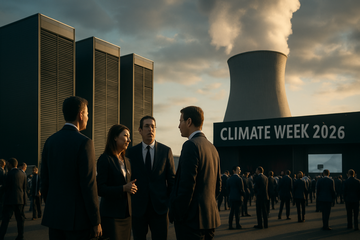
AI Was the Loudest Voice at Climate Week NYC2026
Climate Week NYC ran September 20–27, 2026, organized by Climate Group alongside the UN General Assembly, with more than 1,500 events across the city. For the first time, AI and digital infrastructure was treated as its own headline theme — not a side panel — and the program explicitly named it as a driver of demand for electricity, water, and grid capacity. The U.S. Department of Energy sent its Office of Energy Dominance Financing to a 'Mobilizing American Capital' panel that discussed public-offerings in next-generation nuclear and geothermal as direct financing answers to AI load.
The week's defining tension surfaced at the Hub Live on September 22, when Phoenix Mayor Kate Gallego drew the line most plainly: 'Cities are open for business, but not for sale.' She was speaking about data centers, water, and electricity rates — and the room was full of hyperscaler executives. The next day, former DOE Loan Programs Office director Jigar Shah told the Nest Campus audience that 70 GW of new AI data-center capacity is already in the pipeline through 2028, and that the technology to manage its grid impact exists — the constraint is deployment.
The data
The Numbers Behind the Fork
Global hyperscaler AI capex, 2026
~$700B
Amazon, Microsoft, Alphabet, Meta combined; CNBC tally, Feb 2026
Microsoft Q4 FY26 capex
$41B
+70% YoY; FY2026 press release, Jul 29, 2026
Data centers online added by Microsoft, FY26
88
31 added in Q4 across 5 continents; FY2026 earnings call
Amazon emissions change, 2025
+16%
To 80.85M tCO2e; 2025 sustainability report
Amazon electricity emissions, 2025
+34%
Driven by data centers; 2025 sustainability report
IEA: global data-center electricity, 2025 → 2030
485 → 950 TWh
~3% of global demand; IEA Electricity 2026
US data-center share of new electricity demand
~50%
Of ~420 TWh added over5 years; IEA
AI data-center pipeline, through 2028
70 GW
Jigar Shah, Nest Campus, Sept 23, 2026
The scale jumps from press release to press release. Microsoft's fiscal 2026 ended June 30 with $331.8 billion in revenue and $175 billion in capital expenditures — most of it data centers, GPUs, and the long-lead power contracts that sit behind them. Amazon's 2025 sustainability report, released in June, disclosed absolute emissions of 80.85 million metric tons of CO2-equivalent, up 16% year-on-year and up sharply from the carbon-intensity glide path it had been on since 2019. The company blamed data centers in one sentence: electricity emissions rose 34% in 2025.
The fork
Two AI Strategies, Two Regulator Responses
The four hyperscalers are splitting into two camps without saying so. Alphabet and Amazon are buying dedicated, behind-the-meter clean energy at unprecedented scale. Microsoft is restarting a mothballed nuclear plant. Meta is extending the life of three existing nuclear facilities. The argument: lock in carbon-free baseload that is invisible to the public grid and therefore insulated from carbon pricing or rate-shock politics.
The other camp — and this is where the policy risk concentrates — is buying power from whatever the grid will deliver. That includes coal, gas peakers, and aging nuclear that runs through PJM, ERCOT, and MISO. As that load grows faster than new transmission, regulators in Dublin and The Hague have already moved to slow new connections, and U.S. state utility commissions are watching electricity bills rise.
| Buyer | Seller / Counterparty | Capacity | Structure | Primary source |
|---|---|---|---|---|
| Microsoft | Constellation Energy (Crane Clean Energy Center, ex-Three Mile Island Unit 1) | 835 MW | 20-year PPA; restart 2027; $1B DOE loan | Constellation press release, Sep 20, 2024 |
| Amazon | Talen Energy (Susquehanna) | 1,920 MW | Through 2042; ~$18B value | Talen SEC filing, Jun 11, 2025 |
| Amazon | Energy Northwest / X-energy | 5 GW (planned) | SMR program; first deliveries 2030s | Amazon IR, Oct 2024 |
| Alphabet | Fortum (Finland) | ~50% of one reactor | 22-year PPA; first ex-US nuclear deal | Reuters, Sep 9, 2026 |
| Alphabet | Kairos Power / TVA | 50 MW initial | SMR; Tennessee & Alabama | Carbon Credits, Aug 2025 |
| Meta | Three US nuclear operators (RFP up to 4 GW) | Up to 4 GW | Plant extensions + new development | Meta Newsroom, Jan 9, 2026 |
Supply-chain read
Who Gets Paid, Who Pays
- Upstream — power producers: Constellation Energy and Talen Energy are the most direct beneficiaries. Constellation's market cap has roughly doubled since the Microsoft-TMI deal in September 2024; the $1 billion DOE loan closed in November 2025 and FERC cleared the grid-connection waiver in June 2026, putting the 2027 restart on track. Vistra, with 38.7 GW of capacity including Texas nuclear and gas, has become the default midcontinent AI-grid play.
- Adjacent — chipmakers and cooling: NVIDIA sells the GPU whose wattage is the underlying driver of every demand forecast. Its24-year server refresh cycle and 75% gross margin make it the structural winner whether AI runs on nuclear or gas, but it carries political exposure: a chip-consuming16% emissions jump is harder to defend than a 22-year nuclear PPA.
- Downstream — data-center REITs and colocation: Equinix, Oracle Cloud, and the captive build-outs inside Amazon and Microsoft are the second-order beneficiaries — every watt contracted upstream pulls their top-line. Manufacturing capacity for power-skid and cooling gear (Trane Technologies, Caterpillar gen-sets, GE Vernova gas turbines) is the third ring.
- Counter-flow — regulated utilities and grids: NextEra Energy and the broader U.S. utility complex sit on the other side of the trade. They benefit from new load but get dragged into rate cases every time AI capex shows up in a residential bill. That is the political surface where the 'fork' gets decided.
Fundamentals
What the Earnings Are Telling You
Microsoft's FY2026 numbers, reported July 29, 2026, are the cleanest read on what AI capex does to a hyperscaler. Revenue of $331.8 billion (+18% in Q4) was offset by a sharp depreciation step-up as 88 new data centers came online. Microsoft Cloud crossed $214 billion; Azure passed $100 billion annual run-rate for the first time. The accounting decision to extend data-center useful life from 15 to 25 years reduced the headline capex guide from $190 billion to $175 billion — a real economic change, but also a sign of how much depreciation pressure is being managed rather than absorbed.
Amazon's AWS segment is doing the same thing one layer down: capex-to-revenue of 22.3% (TTM through Q2 FY2026) and a negative free cash flow yield on TTM operating cash flow, meaning the company is funding data-center growth out of its balance sheet. The 16% emissions jump is the climate bill for that. Meta is the leanest of the four on capex-to-revenue at 39% but is moving fastest: third-quarter capex grew 111% year-on-year. Alphabet carries the cleanest balance sheet of the group — net debt to EBITDA of 0.18x and a 26.5% return on assets, against $445.9 billion in TTM revenue.
| Company | Revenue (TTM) | Operating margin | Capex / revenue | Forward P/E |
|---|---|---|---|---|
| Microsoft | $331.8B (FY26) | 46.8% | 34.9% | 25.1x |
| Amazon | $775.7B | 12.1% | 22.3% | 23.6x |
| Alphabet | $445.9B | 33.1% | 29.7% | 22.8x |
| Meta Platforms | $228.2B | 38.1% | 39.1% | 22.1x |
| NVIDIA | $303.0B | 65.2% | 2.4% | 24.9x |
Horizons
What Moves First, What Defines the Next Three Years
Over the next 6–12 months, the actionable read is in the PPA-driven utilities. Crane's2027 restart, Talen's Susquehanna ramp, and Alphabet's Finnish output put carbon-free megawatt-hours into hyperscaler P&Ls in a way that hardens their 'clean AI' narrative. That narrative is the moat against the carbon-pricing and water-permitting risk that the UNECE report flagged. Watch FERC, PJM interconnection queues, and the next round of EU AI Office guidance as the regulatory triggers.
The 1–3 year question is whether the fork stays a fork or hardens into a regulatory cleavage. If Ireland-style restrictions spread — Dublin is already at moratorium; The Hague has site restrictions — then the cost of building AI capacity inside regulated grids rises, and the value of a dedicated PPA or a co-located SMR campus rises with it. If, instead, regulators treat AI as a clean-energy industrial policy, the same nuclear and geothermal suppliers benefit but with less pricing power. The most likely outcome, given the emissions disclosures Amazon just published, is a partial bifurcation: dedicated clean supply becomes standard for new hyperscaler campuses, while legacy capacity in fossil-heavy regions gets a slower permitting path. That is positive for Constellation, Talen, NextEra Energy, and GE Vernova; it is neutral-to-cautious for the hyperscalers' near-term capex absorption, and it is a clear long for NVIDIA, whose chips are required on either side of the fork.
Stocks with direct exposure to the AI–climate fork
- FY2026 capex of $175B and 88 new data centers commit the company to a 10-year climate bill that markets have not priced into the 25.1x forward P/E
- Crane Clean Energy Center restart in 2027 secures 835 MW of baseload and insulates Microsoft's AI capacity from carbon-pricing risk
- Evelyn Wang's 5-year water-neutral forecast is the regulatory clock that could hit Azure site-permitting timelines first
- 16% emissions jump and 34% jump in electricity emissions in 2025 force a faster net-zero capex than the Talen and X-energy PPAs alone cover
- 1,920 MW Talen PPA through 2042 plus 5 GW SMR roadmap lock in dedicated clean supply that competitors cannot replicate inside their existing footprints
- Capex-to-revenue at 22.3% and negative TTM free cash flow leave little margin if rate-payer backlash materializes in Virginia and Ohio
- $15B Finland AI investment plus 22-year nuclear PPA with Fortum gives Alphabet the cleanest ex-US baseload position of the four hyperscalers
- Tightest balance sheet in the group (net debt / EBITDA 0.18x) and 26.5% return on assets insulate the dividend from any climate-related capex shock
- Kairos / TVA SMR pipeline positions Google as the leading-edge case study that AI scale-up can be cleanly powered
- Three nuclear plant extensions and a 4 GW RFP make Meta the most aggressive nuclear-buyer per dollar of revenue among the four
- Q3 capex grew 111% YoY but margin held at 38.1% operating — proof that the AI-climate trade does not yet show up in income statements
- Lower regulatory exposure than Amazon because Meta owns no carbon-intensive retail or shipping business
- Every Climate Week 2026 number — 70 GW of pipeline, 950 TWh by 2030 — is a downstream demand signal for NVIDIA's data-center GPUs
- 75% gross margin and 0.07x net debt mean NVIDIA does not need to pick a side in the clean-vs-dirty AI fight to keep compounding
- Efficiency roadmap (GPU performance per watt) becomes the political argument that lets the whole sector keep building
- Crane Clean Energy Center restart moves to 2027 after FERC waiver in June 2026 and $1B DOE loan closed November 2025
- 20-year Microsoft PPA at835 MW is the template every other hyperscaler will have to match or outbid
- 32.4 GW of existing nuclear and gas capacity gives CEG the only large-scale, 24/7 carbon-free product on the U.S. market
- 1,920 MW Susquehanna-to-Amazon PPA valued at ~$18B through 2042 is the largest single-asset AI nuclear contract in the U.S.
- First mover in co-located data-center campuses behind a nuclear fence — a regulatory structure competitors are still trying to copy
- Smaller scale than Constellation but higher leverage to one counterparty; any AWS acceleration re-rates the stock quickly
- 38.7 GW of generation capacity, including Texas nuclear, gas, and battery storage, makes Vistra the midcontinent AI-grid utility
- Forward P/E of 13.3x is the cheapest among AI-exposed utilities, with92% institutional ownership signaling the trade is already crowded but not done
- High net debt to EBITDA (3.0x) is the single biggest risk if AI load growth slows before long-term PPAs lock in