
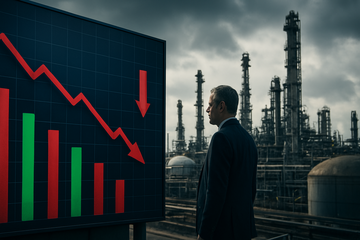
AGM resolutions defeated
52.53% / 52.88%
Shareholders voting against climate-disclosure rollback and virtual-only AGMs, Apr 23, 2026
Chair Manifold support
81.8%
First AGM under new leadership; ousted 33 days later over governance concerns
Capital-discipline resolution
25.85%
Highest-ever support for a management-opposed resolution at BP
BP Q2 2026 dividend
8.66¢/sh
4% sequential increase; buybacks remain frozen
BP Q2 2026 net debt
$22.3B
Down $3.0B sequentially; financial obligations down $6.9B in the quarter
BP TTM EV/EBITDA
3.92x
Cheapest among major integrated peers
The shareholder verdict
Shareholders didn't reject climate — they rejected the pretext
BP's 23 April 2026 AGM produced three numbers that, taken together, look less like an ESG revolt than a discipline vote. The board asked shareholders to revoke the2015 and 2019 climate-disclosure mandates from BP's constitution and to allow virtual-only AGMs; both fell short of the 75% supermajority required. On climate,52.53% of votes were against management; on virtual-only meetings, 52.88% were against. That is not a green mandate — it is a refusal to be rolled back while the company was simultaneously freezing its buyback to fix a balance sheet it had stressed in February.
The most consequential number came on a resolution BP's board had tried to keep off the ballot: a Follow This / ACCR-backed proposal asking BP to disclose how its capital discipline on oil and gas would hold up under falling-demand scenarios. It drew 25.85% support — the highest backing for any management-opposed resolution ever recorded at BP, per Follow This's own tally. Mainstream asset managers do not normally vote with activists; the fact that a quarter of the register did is a signal that the capital-discipline argument had crossed into the generalist pool.
Capital return gap
The peer set kept buying back. BP didn't.
The 2026 dividend cycle makes the divergence unusually visible. Shell declared a Q2 2026 dividend of $0.3906/share and announced $3.0B of new share buybacks plus $1.232B of deferred buybacks — its 19th consecutive quarter of purchases. ExxonMobil returned $9.4B to shareholders in Q2 2026 alone ($4.3B dividends + $5.1B buybacks) and is on track for a $20B annual buyback. Chevron returned $6.5B in the quarter against $12.1B of earnings. TotalEnergies raised its Q2 dividend 5.9% to €0.90/share and bought back $1.5B. BP lifted its dividend 4% to 8.66 cents — and announced no buyback, the third straight quarter without one since suspending the program in February.
| Company | Q2 2026 earnings | Q2 2026 dividend | Q2 2026 buyback |
|---|---|---|---|
| BP | $5.7B underlying RC profit | 8.66¢/sh (+4%) | $0 (suspended) |
| Shell | $9.84B adjusted | $0.3906/sh | $3.0B new + $1.232B deferred |
| ExxonMobil | $14.5B | $1.03/sh (Q3 declared) | $5.1B (Q2) |
| Chevron | $12.1B | — | $6.5B total |
| TotalEnergies | — (1H payout $6.46B) | €0.90/sh (+5.9%) | $1.5B |
The column that matters most for the next 12 months is the buyback column. BP is the only integrated major that has paused for more than one quarter. That pause began when BP suspended its $750M quarterly program in February 2026 and took ~$4B of impairments on renewables and biogas ahead of the new CEO's arrival. With Q2 2026 underlying replacement-cost profit of $5.7B (up $2.5B sequentially) and a $3.0B sequential reduction in net debt, the question on the next quarterly call is no longer whether BP can afford to buy back shares — it is whether the new management chooses to.
Q2 2026 results
The earnings engine is back. The capital return isn't.
BP's Q2 2026 print was a textbook integrated-oil beat. Reported upstream production was 2.2 mmboe/d (a planned seasonal decline from 2.3 mmboe/d in Q1). Realized refining margins more than doubled year-on-year, jumping from $11.9/bbl to $29.6/bbl — the single largest swing in any segment. Underlying RC profit of $5.7B was $2.5B higher than Q1, operating cash flow of $10.9B was roughly $8.0B higher, and the company repaid a $2.5B perpetual hybrid bond while paying $1.1B of Gulf of America settlement liabilities. Net debt closed Q2 at $22.3B, down from $25.3B — a $3.0B quarterly reduction the company achieved without buying back a single share.
BP net debt reduction, end-of-quarter ($B)
Balance-sheet repair without buybacks — the core of the AGM tension
Unit: USD billions
Q4 2025
26
Q1 2026
25.3
Q2 2026
22.3
Governance aftermath
The chair was gone 33 days after the vote
On 26 May 2026 — five weeks after the AGM — BP's board removed chair Albert Manifold with immediate effect, citing \"serious concerns\" about \"important governance standards, oversight and conduct.\" The board cited reports of bullying and overbearing behavior. Manifold publicly disputed the version of events and said he would challenge the framing. BP's shares fell more than 4% on the news in both London and New York. Ian Tyler, already a non-executive director, stepped in as interim chair; on 2 September 2026, after a months-long search, he was appointed permanent chair.
The governance shock is causally important, not background color. Manifold had taken the lead on excluding the Follow This resolution from the ballot — the board's legal advice was that the filing passed the threshold, and the board overrode it. That decision is the proximate cause of the 52.53% climate vote and the 25.85% capital-discipline vote. When the same board then removed its own chair over unrelated conduct concerns, it confirmed the shareholder base's read: leadership credibility was the binding constraint, not strategy. The investment read-through is that a board which concedes climate governance under pressure has less, not more, room to defer cash returns on capital-discipline grounds.
Supply chain spillover
Who actually benefits from BP's choices
BP's pivot — more upstream oil and gas, less transition, frozen buybacks — sends two distinct signals through the supply chain. Upstream, the company has guided to roughly $10.5B/yr of upstream capex through 2027 (including biogas), with $10B oil-and-gas only at a 70/30 oil-gas split and expected project returns above 15%. That is the spending program the oilfield services complex has been waiting for. SLB, Halliburton and Baker Hughes all run North Sea-heavy international portfolios; BP's Norway, UK, Egypt and Gulf of Mexico developments feed directly into their completions, drilling and subsea backlogs.
| Company | Exposure to BP / North Sea | Note |
|---|---|---|
| SLB | Digital, drilling, completions across UK / Norway / Egypt | Largest oilfield services peer; international revenue mix |
| Halliburton | Frac, well construction, North Sea completions | More US-weighted; less direct but still levered |
| Baker Hughes | Subsea trees, turbines, IET services | Industrial-energy technology benefits BP downstream |
Downstream, the BP Q2 2026 result is the relevant signal for European refining peers. Realized refining margins of $29.6/bbl are not a BP-specific story — they reflect Middle East disruptions and heavy-light crude spreads that affect everyone with primary distillation capacity. TotalEnergies reported its Integrated LNG segment earned $0.8B in Q2 2026 and raised its dividend 5.9%; the same crude-spread tailwind helped Repsol and the European refining complex. If the new BP management argues for higher refining capex (guided at >$500M through 2027 plus a Whiting turnaround), the case-study benefit flows partly back to engineering and catalyst suppliers.
Valuation test
Cheap for a reason — and the reason is visible
Stripping out one-off impairments, BP's TTM operating performance is closer to peers than the market is pricing. But the market is pricing three things: capital indiscipline (no buyback), governance turmoil (chair removed in May), and balance-sheet drag (TTM net debt / EBITDA of 0.93x, higher than Shell's 0.62x and ExxonMobil's 0.44x). The result is that BP trades at 3.92x EV/EBITDA TTM versus Shell at 4.52x, Chevron at 7.81x and ExxonMobil at roughly 9.7x. That is a 13–60% discount that is not explained by returns — BP's TTM FCF yield is 14.1%, the highest among the majors.
TTM EV/EBITDA — integrated oil majors
BP trades at the cheapest multiple despite the highest FCF yield
Unit: EV/EBITDA (x)
BP
FCF yield 14.1%
3.9
Shell
FCF yield 11.2%
4.5
Chevron
FCF yield 6.6%
7.8
ExxonMobil
FCF yield 4.6%
9.7
| Company | ROE | ROCE | FCF yield | Net debt / EBITDA |
|---|---|---|---|---|
| BP | 9.5% | 14.8% | 14.1% | 0.93x |
| Shell | 14.7% | 13.4% | 11.2% | 0.62x |
| ExxonMobil | 12.7% | 10.3% | 4.6% | 0.44x |
| Chevron | 11.0% | 11.2% | 6.6% | 0.51x |
| TotalEnergies | ~15.9% (1H 2026) | — | — | — |
TotalEnergies and Equinor are the harder comps for European integrated oil. TotalEnergies's 1H 2026 payout (dividends plus buybacks) of $6.46B and ROE of 15.9% make it the European standard for capital return; Equinor sits between BP and Shell on most multiples. The gap between BP and the European benchmark is roughly 30–40% of enterprise value. That is the size of the prize if management can deliver a measurable cash-return framework that pairs with the disclosed upstream capex discipline — and the size of the loss if the 2027 AGM repeats the 2026 result.
Synthesis
What it means, for whom, over what horizon
- Short term (days to one quarter): The catalyst to watch is the Q3 2026 results print (late October / early November). If net debt holds at or below the $22.3B Q2 level and Q3 refining margins remain elevated, the management case for restarting buybacks gets stronger. Any buyback announcement closes part of the EV/EBITDA gap; a renewed freeze widens it.
- Short term: Elliott Investment Management's earlier public push (April 2025) for capex of $12B (below BP's then $13–15B range) is still the activist benchmark. The new chair (Ian Tyler, Sep 2, 2026) was not installed by Elliott, but the activist's thesis — measurable cash return first — is now consensus on the register.
- Long term (1–3 years): Structural question is whether BP can run a 70/30 oil-gas upstream program at $10.5B/yr capex, sustain a $1.5–2B/yr transition budget, deliver the disclosed >15% project returns, and still return ~$8B/yr of cash. The math is tight at $70 Brent and breaks at $60. That is why Shell and ExxonMobil trade at premiums: their projects are de-risked by repetition. BP has not earned that multiple yet.
- Long term: The 25.85% capital-discipline vote is a precedent, not a ceiling. At the 2027 AGM, Follow This and aligned investors will likely file an enhanced version with sharper fossil-demand scenarios. If BP has not delivered a buyback by then, that number trends toward 30%+ and the chair re-election becomes another governance flashpoint.
The cleanest test is a Q3 2026 buyback announcement. If it comes — even at a modest $750M/quarter — the EV/EBITDA discount to Shell narrows by roughly half on standard sensitivity, and the AGM-rebellion narrative fades into the cost of doing business. If it doesn't, the discount becomes the cycle's defining feature for European integrated oil, and the AGM is remembered as the moment the market first priced [BP](bp] for what it had stopped doing rather than what it had promised.
Related stocks
- Freezes buybacks while peers restart; 3.92x TTM EV/EBITDA discount to Shell and ExxonMobil makes a Q3 restart the biggest near-term catalyst
- $22.3B net debt down from $25.3B in one quarter and $3.0B sequential debt reduction give management a credible case to restart $750M/quarter buybacks as soon as Q3 2026 results
- Refining margins $29.6/bbl in Q2 2026 vs $11.9 a year earlier lift operating cash flow by ~$8.0B sequentially; structural if Middle East risk persists
- 25.85% capital-discipline vote is a floor, not a ceiling — the 2027 AGM will re-test it if no buyback is announced before then
- New chair Ian Tyler appointed2 Sep 2026 after May 26 removal of Albert Manifold — board credibility rebuilt but the underlying capital-discipline tension persists
- 19th consecutive quarter of buybacks with $3.0B new + $1.232B deferred in Q2 2026 demonstrates the cash-return discipline the market is rewarding
- Q2 2026 adjusted earnings of $9.84B vs $4.26B a year earlier on refining, marketing and integrated gas strength
- Capex $24–26B in 2026 falling to $20–22B in 2027–2028 — measured enough to keep FCF yield near 11% while returning cash
- Tells the negative version of the BP story: same European integrated peer, same oil price, kept returning cash and trades at 4.52x EV/EBITDA instead of 3.92x
- ARC Resources acquisition and continued LNG portfolio focus add growth optionality without the governance overhang
- $9.4B of shareholder distributions in Q2 2026 ($4.3B dividends + $5.1B buybacks) on the way to a $20B annual buyback target — the gold standard for capital return
- Earnings $14.5B in Q2 2026 and 43-year dividend-growth streak anchor the premium 9.7x EV/EBITDA multiple
- TTM net debt / EBITDA at 0.44x is the lowest among integrated majors; capacity for sustained buybacks even at $60 Brent
- Disciplined 2030 plan with >17% ROCE target, on track to repurchase $20B annually — demonstrates the exact framework BP shareholders demanded
- Indirect beneficiary if [BP](bp]'s continued buyback freeze persists — capital chases the names that return it
- $6.5B shareholder distributions in Q2 2026 against $12.1B earnings and 21% ROCE — record US production drove the print
- Buyback pace tracking toward $10–20B annually through 2030 per Investor Day guidance, paired with $8B of debt paydown in Q2
- Trades at 7.81x TTM EV/EBITDA — the premium multiple is anchored to delivery, not narrative
- Clean balance sheet (TTM net debt/EBITDA 0.51x) lets Chevron keep returning cash through any oil-price downturn BP cannot
- For [BP](bp]-watchers, the read-through is that an integrated major with a credible buyback framework earns roughly 2x the multiple
- Q2 2026 dividend raised 5.9% to €0.90/share; 1H 2026 payout (dividends + buybacks) of $6.46B and ROE of 15.9% — the European benchmark BP is being measured against
- $1.5B Q2 2026 buyback follows a half-from-$2B reduction in Q1, demonstrating flexible but persistent cash return
- Lower buyback envelope ($3–6B in 2026 vs $7.5B in 2025) is the bear case — but still positive net capital return, in contrast to [BP](bp]
- Gas-to-power integration strategy in Europe (50% acquisition from EPH) reduces transition risk at the European peer [BP](bp] is most often compared to
- Middle East conflict impact of 210 kboe/d on Q2 production is a reminder of geopolitical tail risk for any integrated oil — supports a portfolio premium for diversified names
- Most directly comparable European integrated name to BP on geography (North Sea / Norway) and balance-sheet profile — any BP along
- Sits between BP and Shell on most multiples; less of a pure capital-return play than TotalEnergies
- Key catalyst is the late-2026 / early-2027 capital-markets day that will set the multi-year buyback framework
- Watch for whether Equinor chooses to lean further into Norwegian gas capex (similar to BP or stay diversified
- If BP catches a tailwind without changing its own story
- BP is direct demand for SLB drilling, completions and digital services
- International revenue mix and North Sea-heavy portfolio make SLB the most direct beneficiary of [BP](bp]'s upstream tilt
- If [BP](bp] restarts buybacks, the signal is that upstream capex is sustainable — supports SLB's longer-cycle international backlog
- Trades as a derivative of integrated majors' capex discipline; [BP](bp]'s $13.5–14B 2026 spend is a floor, not a ceiling
- Counter-cyclical: SLB benefits even if [BP](bp] keeps cutting its own buyback, because the capex isn't going away
- More US-weighted than SLB but completion services across the North Sea and Mediterranean still lever to [BP](bp] upstream spend
- Less direct than [SLB](slb] on this story, but captures the same European integrated oil capex tailwind
- If [BP](bp] re-rates on capital-return news, HAL tends to follow on the simple read-through that integrated capex is intact
- North Sea completions and drilling work tied to UK and Norwegian developments are the most direct line to [BP](bp]'s upstream capex