
Fluxnium seed round
$7M
Closed Sept. 16, 2026; Congruent Ventures $4.2M, Constellation Energy $1.4M, Active Impact $1.4M
Demonstrated extraction cost
>$200/lb
vs. $89.79/lb spot price on Sept. 17, 2026 — more than 2.2× today's Western supplier price
Seawater uranium resource
4B metric tons
Enough for ~50,000 years of global nuclear demand at current consumption rates
Cycle time at sea
30–60 days
Per fiber deployment; lines can be reused several times, no toxic tailings
Spot price 5-yr move
+75%
Uranium U3O8 climbed from ~$30/lb in 2021 to $89.68/lb by Aug. 2026, per EIA / Cameco
The pitch
Fluxnium Is Selling a 50,000-Year Headline, Not a Ton of Yellowcake
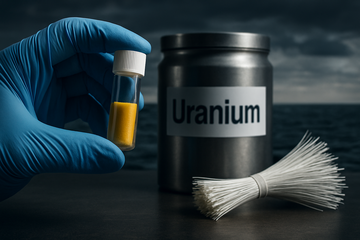
Fluxnium emerged from stealth on Sept. 16, 2026 with a TechCrunch exclusive and a $7M seed round led by Congruent Ventures. Founder and CEO Jeff Green is licensing polymer-fiber chemistry developed at U.S. Department of Energy national labs — work pioneered at Oak Ridge National Laboratory and Pacific Northwest National Laboratory since the 1960s and refined through 2016 — and braiding the fibers into long lines suspended from ocean buoys. Each line sits at sea for 30 to 60 days, then returns to shore to be eluted, with the captured uranium purified into yellowcake that Fluxnium sells into the existing nuclear fuel supply chain.
The headline number — 50,000 years of nuclear fuel — comes from the roughly 4 billion metric tons of uranium dissolved across the world's oceans. That resource dwarfs every conventional reserve on the planet. [Cameco]'s entire licensed production base, for instance, sits at \"more than 30 million pounds (our share) of uranium concentrates annually,\" per the company's uranium operations page, and [Cameco] produced 21.0 million pounds (its share) in 2025. Fluxnium's ocean resource equals that annual output multiplied by roughly 425,000.
The economics
$200 a Pound Is a 2027 Problem, Not a 2026 One
The economic story is the article. Spot uranium ended Aug. 2026 at $89.68/lb, per [Cameco]'s monthly U3O8 price table, up from $29.63/lb in Jan. 2021. The five-year move — roughly +75% — reflects Kazakh production shortfalls at [Kazatomprom] (2025 production of 25,839 tonnes U, per World Nuclear News) and surging demand from the AI data-center buildout. [Constellation Energy] alone signed 20-year power purchase agreements with Microsoft in 2024 and Meta in mid-2025; [Vistra] followed with a 2.6 GW Meta nuclear PPA on Jan. 9, 2026; [Talen Energy] earlier sold the Amazon Web Services co-located deal at Susquehanna.
| Period | Spot price | Change vs. Jan 2021 |
|---|---|---|
| Jan 2021 | $29.63 | — |
| Jan 2025 | $69.28 | +134% |
| Sep 2025 | $82.63 | +179% |
| Jan 2026 | $94.28 | +218% |
| Aug 2026 (latest month) | $89.68 | +203% |
| Fluxnium demo cost (mid-2026) | >$200.00 | +575%+ |
The data points to a 2.2× cost gap between seawater extraction and today's Western producer price — and that's the gap [Constellation Energy] is hedging. At $89.68/lb, [Cameco] is generating strong operating margins, but its Q3 2025 earnings collapse (EPS of -$0.0003, per [Cameco]'s Q3 2025 filing) exposed how a single supply disruption can swing the producer model. Constellation has a direct financial interest in capping the long-term ceiling: it is the buyer. If seawater extraction ever becomes sub-$90/lb, the embedded scarcity premium in the fuel contract rolls away from the producer.
The cap table
The Check That Tells You Everything Came From [Constellation Energy]
Of the $7M raised, Congruent Ventures (a sustainability-focused VC) anchored the round with an estimated $4.2M. The remaining $2.8M is split between Active Impact Investments ($1.4M) and [Constellation Energy] ($1.4M), per the Seedtable funding record dated Sept. 2026. The allocation is itself the signal: a strategic dollar from the largest U.S. nuclear operator — 32,400 MW of generation capacity — does not behave like a venture dollar. It behaves like a call option on fuel-cost optionality.
- [Constellation Energy] runs 32,400 MW of nuclear, gas, wind, solar and hydro capacity, with TTM revenue of $31.27B through Q2 2026 and $10.24 diluted EPS
- Its 32,400 MW fleet is anchored by nuclear and faces a 10–20 year fuel-procurement horizon, making it acutely sensitive to long-run uranium scarcity
- [Constellation Energy] trades at 24.87× trailing earnings and 18.48× forward earnings — pricing in AI demand but not yet pricing in a structural ceiling on its fuel costs
- [Cameco] trades at 157.97× trailing earnings on Q2 2026 EPS of just $0.058 — that ratio reflects how thin the producer model has become in a tight market
Downstream
The Buyers Are Already Lined Up — They Don't Need to Wait for Fluxnium to Work
The near-term investment case has nothing to do with seawater economics and everything to do with whether AI-driven nuclear demand absorbs existing fuel. [Vistra] signed a 2.6 GW Meta nuclear PPA on Jan. 9, 2026 (per Vistra's Jan. 9, 2026 release and Meta's Jan. 9, 2026 blog post), making it the single largest nuclear-AI deal on record. [Talen Energy] continues to monetize its 10.7 GW portfolio through co-located AWS capacity at Susquehanna. [Oklo] signed onto Meta's nuclear stack alongside [Vistra] and [TerraPower] (Jan. 9, 2026), even though its Aurora powerhouse is still pre-revenue — TTM revenue was just $1.21M through Q2 2026.
| Company | TTM revenue | Mkt cap | Fwd P/E | Catalyst |
|---|---|---|---|---|
| [Constellation Energy] | $31.27B | $91.5B | 18.5× | Strategic investor in Fluxnium |
| [Vistra] | $19.21B | $47.4B | 13.8× | 2.6 GW Meta nuclear PPA |
| [Talen Energy] | $3.74B | $13.3B | 9.7× | AWS co-locate at Susquehanna |
| [Oklo] | $1.21M | $6.6B | — | Pre-revenue SMR / Meta deal |
| [NuScale Power] | $10.7M | $2.46B | — | $1B liquidity, Standard Power 2-SMR deal Apr. 2026 |
[NuScale Power] remains the longest-duration play on this thesis — the only U.S.-listed pure SMR designer with regulatory approval, $1B in liquidity as of March 31, 2026, an exclusive April 2026 deal with Standard Power for two SMR facilities in Ohio, and Romanian LOI activity through Nuclearelectrica. The bet is that reactor demand outruns fuel scarcity; Fluxnium just makes the second half of that bet less frightening.
Supply chain impact
The Miners Most Exposed Are the Ones Already Struggling to Break Even
If seawater extraction ever crosses below $90/lb at scale, the marginal uranium miner is the first casualty — and the list of marginal miners is short and identifiable. [Energy Fuels]'s TTM operating margin through Q2 2026 was -88.8%, with revenue of $106M and a market cap of $2.92B. [Uranium Energy Corp], the largest U.S. ISR-focused developer, posted revenue of $20M and an operating margin of -630% over the same window. Both companies trade on optionality, not cash flow, and a credible seawater cost curve erases that optionality at the margin.
- [Cameco]'s Q3 2025 EPS of -$0.0003 shows the producer model is already vulnerable to supply swings, even before Fluxnium reaches commercial scale
- [Energy Fuels]'s -88.8% TTM operating margin makes it the most exposed U.S. producer to any structural ceiling on long-term uranium pricing
- [Uranium Energy Corp]'s $20M TTM revenue against a $4.85B market cap is essentially a long-dated call on higher U.S. prices — the thesis that fails first if seawater works
- Conversion and enrichment ([Centrus Energy]) are downstream of mining but upstream of fuel fabrication; their economics are tied to volume, not price, and survive a Fluxnium world
Horizons
Days vs. Years: Where the Signal Actually Lands
Short-term (days to quarters): the $7M seed round does not move any listed equity on its own. What it does is reframe the AI-nuclear thesis. [Constellation Energy]'s strategic participation puts a floor under the long-term fuel-cost ceiling — that matters for any utility trading on 20-year AI PPAs, which is [Constellation Energy], [Vistra], and [Talen Energy]. The data-center demand story is the catalyst; Fluxnium is the optionality attached to it.
Long-term (1–3 years): the milestones to watch are (1) Fluxnium's next funding round and any partnership disclosure with a reactor operator beyond [Constellation Energy], (2) whether the $200/lb cost drops below $130/lb (still 45% above spot) and then below $90/lb — that's the line where the equity story for marginal miners begins to break, and (3) any DOE demonstration of next-generation fiber surface area that compresses cycle economics. The structural risk is straightforward: a working Fluxnium caps [Cameco]'s long-term pricing power and turns the U.S. uranium-mining thesis into a stripping-and-closure story.
Stocks this event actually touches
- Strategic investor [Constellation Energy]'s $1.4M Fluxnium check caps the long-term uranium pricing ceiling — the variable [Cameco]'s scarcity premium depends on
- Q3 2025 EPS collapsed to -$0.0003, proving the producer model is volatile even before seawater extraction matures
- Forward P/E of 50.5× already prices in tight supply; any Fluxnium cost breakthrough compresses that multiple first
- The $1.4M Fluxnium participation is a direct hedge on its own 32,400 MW fuel bill — buying down the long-run uranium scarcity premium it currently absorbs
- 20-year PPAs with Microsoft (2024) and Meta (mid-2025) monetize AI demand while Fluxnium protects the input cost side of those contracts
- TTM revenue of $31.27B and forward P/E of 18.5× leave room for upside if seawater optionality compresses long-run fuel risk
- The 2.6 GW Meta nuclear PPA (Jan. 9, 2026) makes [Vistra] the largest single AI-nuclear off-taker; any fuel-cost ceiling reinforces the margin on that 20-year contract
- 38,700 MW fleet includes nuclear exposure that benefits from optionality on long-dated uranium supply
- TTM EPS of $5.94 and forward P/E of 13.8× are the cheapest among the AI-nuclear operators, leaving room for multiple expansion as the thesis matures
- AWS co-locate at Susquehanna is the proof-of-concept AI-nuclear deal that the [Constellation Energy]-Meta and [Vistra]-Meta structures followed
- 10.7 GW portfolio is heavily nuclear-weighted, so any seawater-fuel optionality supports long-run cost-of-goods-sold on existing PPAs
- Forward P/E of 9.7× is the lowest in the AI-nuclear operator cohort, pricing in little of the structural thesis
- On the Meta nuclear stack alongside [Vistra] and [TerraPower] (Jan. 9, 2026) — direct demand-side validation of the Aurora powerhouse
- Recycles used nuclear fuel into Aurora-compatible feed, making any low-cost primary uranium source a tailwind, not a threat
- $2.5B working capital and zero debt keep the multi-year build runway intact
- Standard Power exclusive for two SMR facilities in Ohio (Apr. 2026) and $1B liquidity at March 31, 2026 give it the longest independent runway of any pure SMR play
- Romanian Nuclearelectrica LOI in Feb. 2026 extends the demand-side thesis beyond U.S. data centers
- Optionality from low-cost fuel sources strengthens the levelized cost of electricity case for VOYGR plants
- -88.8% TTM operating margin makes it the highest-cost U.S. producer and the first equity to break if seawater extraction ever approaches parity
- $106M TTM revenue against a $2.92B market cap means the equity is priced on optionality, not cash flow — that optionality erodes first
- Mixed U.S./vanadium exposure softens the direct hit but does not eliminate the structural ceiling argument
- $20M TTM revenue against a $4.85B market cap is a long-dated call on higher U.S. prices — the most exposed equity if seawater costs fall below $90/lb
- U.S. ISR-only focus means no diversified cash flow to absorb a structural ceiling on long-run prices
- Pre-recovery status (FY ending July 2026) means the company needs higher spot prices to justify development capex — exactly what the Fluxnium thesis threatens