%22%2F%3E%0A%20%20%3Ccircle%20cx%3D%22220%22%20cy%3D%22150%22%20r%3D%22180%22%20fill%3D%22%2322d3ee%22%20fill-opacity%3D%220.12%22%2F%3E%0A%20%20%3Ccircle%20cx%3D%221010%22%20cy%3D%22130%22%20r%3D%22220%22%20fill%3D%22%2338bdf8%22%20fill-opacity%3D%220.08%22%2F%3E%0A%20%20%3Ccircle%20cx%3D%22920%22%20cy%3D%22520%22%20r%3D%22170%22%20fill%3D%22%2322d3ee%22%20fill-opacity%3D%220.06%22%2F%3E%0A%20%20%3Cpath%20d%3D%22M140%20430h920%22%20stroke%3D%22url(%23line)%22%20stroke-width%3D%2212%22%20stroke-linecap%3D%22round%22%2F%3E%0A%20%20%3Cpath%20d%3D%22M220%20360c120-150%20260-220%20380-220s260%2070%20380%20220%22%20fill%3D%22none%22%20stroke%3D%22%2367e8f9%22%20stroke-opacity%3D%220.5%22%20stroke-width%3D%2216%22%20stroke-linecap%3D%22round%22%20stroke-linejoin%3D%22round%22%2F%3E%0A%20%20%3Cpath%20d%3D%22M300%20398h600%22%20stroke%3D%22%2394a3b8%22%20stroke-opacity%3D%220.24%22%20stroke-width%3D%228%22%20stroke-linecap%3D%22round%22%2F%3E%0A%20%20%3Ctext%20x%3D%22220%22%20y%3D%22510%22%20fill%3D%22%23e2e8f0%22%20fill-opacity%3D%220.7%22%20font-family%3D%22Arial%2C%20Helvetica%2C%20sans-serif%22%20font-size%3D%2238%22%20letter-spacing%3D%228%22%3EINSIGHTS%3C%2Ftext%3E%0A%3C%2Fsvg%3E)
What investors are missing in the AI nuclear trade
Reactor orders move headlines; fuel-cycle constraints decide delivery dates
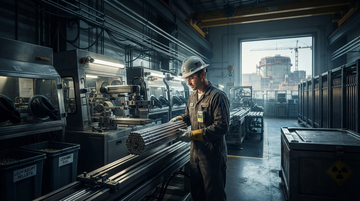
AI power demand may be pulling utilities and developers toward nuclear PPAs, but the gating item is not the reactor vessel procurement lead time. It is the ability to reliably produce the right enriched uranium into fuel assemblies before construction-schedule milestones become “late-stage, hard-stop” constraints. In practice, the fuel-cycle bottleneck shows up as longer contracting lead times, higher working-capital needs, and—when capacity is thin—reallocation of scarce enrichment and conversion services toward the projects that already have licensed fuel pathways.
- Uranium production must be secured far ahead because mine-to-yellowcake-to-conversion takes years to translate into usable reactor feedstock.
- Conversion and enrichment capacity determine how much uranium can reach reactor-grade enrichment without waiting for stand-in material or drawing down constrained stockpiles.
- Fuel fabrication is a throughput bottleneck: once utilities lock a reactor start window, they also lock a narrow set of qualified fuel assembly designs and fabrication schedules.
Verified supply-chain event and what it signals
Westinghouse’s IPO filing timing highlights how fuel fabrication capacity is becoming a capital-market bottleneck
On July 31, 2026, Westinghouse Electric Company disclosed that it confidentially submitted a draft registration statement on Form S-1 to the SEC for a proposed initial public offering. That matters for the AI-power thesis because it underscores how developers and utilities are increasingly reliant on specialized downstream nuclear infrastructure—especially where fuel-pathway execution must scale faster than the public market can fund.
Primary-source anchor: Westinghouse’s capital-raising step
Event
Confidentially filed a draft IPO registration statement (Form S-1)
Announced July 31, 2026; offering terms such as share count and price range were not set in the disclosure.
Why it connects to fuel-cycle capacity
Downstream fuel pathway execution requires upfront capital
Fabrication and fuel-program expansions sit on long lead-time manufacturing constraints—areas where cost of delay is high.
The full chain: where the bottleneck actually sits
Mine → conversion → enrichment → fuel fabrication → reactor: the binding constraints are front-end capacity and qualification
The nuclear fuel cycle is a multi-step throughput chain with qualification requirements at the back end. A concrete way to think about the AI “PPA wave” is as a demand pull that arrives faster than front-end capacity can be built, licensed, and operationalized. A recent supply-chain analysis from the Clean Air Task Force highlights that U.S. conversion capability and enrichment/HALEU infrastructure are structurally constrained—supporting the idea that supply cannot simply “speed up” because demand accelerates.
| Fuel-cycle step | What constrains output | Why AI PPAs amplify the issue | Common “failure mode” in project timelines |
|---|---|---|---|
| Uranium supply (mine → concentrate) | Long resource development lead times and contracting windows | Hyperscalers lock multi-year power timelines that assume fuel continuity | Utilities extend procurement lead times or shift to alternative sources |
| Conversion (yellowcake → UF6) | Limited domestic throughput and reliance on foreign services | Conversion capacity turns secured uranium into usable feedstock only on schedule | Projects face start-date slippage due to insufficient conversion slots |
| Enrichment (LEU/HALEU production) | Enrichment services concentration among a few providers | Once uranium needs a specific enrichment profile, substitute sourcing is limited | Reallocation to earlier-qualifying projects; more stringent contracting terms |
| Fuel fabrication (pellets/rods/assemblies) | Qualified design lanes and manufacturing schedules | Back-end manufacturing is the last mile before reactor loading | Qualified fuel delivery becomes the gate to commissioning windows |
Quantifying the margin hinge with public numbers
The market is paying for the ability to stand in the middle of the fuel cycle
Public-company financials won’t tell you the exact day when a specific AI PPA becomes loaded fuel, but they do show which parts of the chain have cash-flow durability during demand uncertainty. For example, Cameco reported FY2024 revenue of $3.14B (CAD-reported in its FY2024 income statement dataset) and generated FY2024 net cash provided by operating activities of CAD 905.3M. BWX Technologies reported FY2024 revenue of $3.51B and net cash provided by operating activities of $408.4M. These profiles align with the idea that mid- and downstream nuclear infrastructure can capture value when the fuel cycle must be executed reliably.
Cameco revenue
$3.14B
FY2024 (reported in CAD), filed Mar 21, 2025
Cameco operating cash flow
CAD 905.3M
FY2024, filed Mar 21, 2025
BWX Technologies revenue
$3.51B
FY2024, filed Feb 24, 2025
BWX Technologies operating cash flow
$408.4M
FY2024, filed Feb 24, 2025
Investor transmission: who benefits and who gets squeezed
Fuel-cycle tightness shifts value toward uranium, enrichment, and fuel qualification—while reactor orders face “late fuel” risk
This is the crux of the hyperscaler AI nuclear trade. The PPA announcement is the demand signal, but the fuel-cycle chain governs whether projects can actually sustain power. When conversion and enrichment capacity are constrained, the value migrates to firms that (1) control feedstock supply, (2) provide enrichment services (or access to them), and (3) can qualify and produce reactor fuel assemblies without slipping schedules. At the same time, reactor makers and early-stage SMR developers face the “late fuel” risk: they can win orders, but not all of those projects can be loaded on time if the fuel pathway can’t match the build-out horizon.
- Upstream uranium suppliers gain leverage when utilities need long-dated supply commitments that map to conversion schedules.
- Enrichment providers gain leverage when the enrichment profile required for a reactor cohort is non-substitutable in the near term.
- Fuel fabricators gain leverage when qualified fuel assembly throughput becomes the last-mile gate to commissioning.
Listed stocks with evidence-backed linkage to the nuclear fuel-cycle bottleneck
- FY2024 revenue was $3.14B and operating cash flow was CAD 905.3M, supporting cash generation that can fund long-dated uranium contracting while utilities secure conversion/enrichment timelines.
- When conversion/enrichment slots are constrained, utilities shift spend toward upstream of the bottleneck, which can stabilize utilization for uranium suppliers.
- Centrus is positioned around the enrichment step via LEU/SWU-related services, and HALEU constraints described in supply-chain research make enrichment capability the likely near-term gating variable for AI-linked builds.
- Near-term catalyst is project-specific contracting/production ramp; direction depends on whether enrichment services translate into secured customer load factors (timing not disclosed in sources opened here).
- FY2024 revenue was $3.51B and operating cash flow was $408.4M, showing financing capacity to support nuclear industrial throughput during supply-chain tightness.
- If fuel qualification and assembly manufacturing become schedule-sensitive, downstream components and nuclear equipment demand can concentrate into proven producers with execution depth.
- Even if SMR projects attract orders, long lead-time fuel-cycle constraints can delay the point at which reactors can load and commission, increasing financing and dilution risk.
- With FY2024 revenue shown as $10.69M, NuScale’s scale is small versus the capital intensity required to offset fuel-cycle delays, making schedule slippage more damaging than for integrated fuel-cycle firms.
- FY2024 revenue was $24.75B with FY2024 operating cash flow of $13.26B, suggesting NextEra can absorb some schedule volatility, but fuel-cycle bottlenecks can still cap the speed of PPA-backed nuclear delivery in practice.
- NextEra’s exposure is indirect: if fuel is delayed, the utility’s portfolio timing can shift, which can reduce the near-term match between AI-linked demand and dispatchable supply.