%22%2F%3E%0A%20%20%3Ccircle%20cx%3D%22220%22%20cy%3D%22150%22%20r%3D%22180%22%20fill%3D%22%2322d3ee%22%20fill-opacity%3D%220.12%22%2F%3E%0A%20%20%3Ccircle%20cx%3D%221010%22%20cy%3D%22130%22%20r%3D%22220%22%20fill%3D%22%2338bdf8%22%20fill-opacity%3D%220.08%22%2F%3E%0A%20%20%3Ccircle%20cx%3D%22920%22%20cy%3D%22520%22%20r%3D%22170%22%20fill%3D%22%2322d3ee%22%20fill-opacity%3D%220.06%22%2F%3E%0A%20%20%3Cpath%20d%3D%22M140%20430h920%22%20stroke%3D%22url(%23line)%22%20stroke-width%3D%2212%22%20stroke-linecap%3D%22round%22%2F%3E%0A%20%20%3Cpath%20d%3D%22M220%20360c120-150%20260-220%20380-220s260%2070%20380%20220%22%20fill%3D%22none%22%20stroke%3D%22%2367e8f9%22%20stroke-opacity%3D%220.5%22%20stroke-width%3D%2216%22%20stroke-linecap%3D%22round%22%20stroke-linejoin%3D%22round%22%2F%3E%0A%20%20%3Cpath%20d%3D%22M300%20398h600%22%20stroke%3D%22%2394a3b8%22%20stroke-opacity%3D%220.24%22%20stroke-width%3D%228%22%20stroke-linecap%3D%22round%22%2F%3E%0A%20%20%3Ctext%20x%3D%22220%22%20y%3D%22510%22%20fill%3D%22%23e2e8f0%22%20fill-opacity%3D%220.7%22%20font-family%3D%22Arial%2C%20Helvetica%2C%20sans-serif%22%20font-size%3D%2238%22%20letter-spacing%3D%228%22%3EINSIGHTS%3C%2Ftext%3E%0A%3C%2Fsvg%3E)
Verified event: where “uranium + AI” connects
The thesis starts with a repurposing play, but the constraint is interconnection + new generation delivery
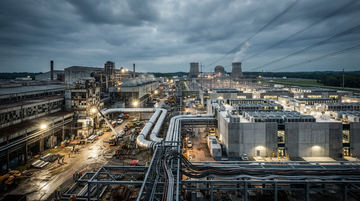
The newly reported plan is not a standard power plant rollout. It is a campus concept: a hyperscale, multi-gigawatt AI/data-center development built on (and drawing power from) a former Cold War-era uranium-enrichment site in Kentucky’s Paducah area—positioned as a combined compute + generation + infrastructure hub.
At the same time, DOE has already been soliciting proposals to build AI data centers and power projects at the Paducah site via an Office of Environmental Management RFO, with a Jan. 30, 2026 submission deadline. That matters because the “speed” component depends on how quickly a private consortium can secure permits and utility interconnection agreements at a federally managed site that was previously built for enrichment operations.
What happened and who is involved
What is being proposed at Paducah: data-center campus on an enriched-uranium site
| Item | Verified detail | Why it matters for timeline/value |
|---|---|---|
| Site origin (Paducah) | DOE states the Paducah Gaseous Diffusion Plant (PGDP) was constructed in 1952 to produce enriched uranium (later also used for nuclear fuel for commercial power plants). | Confirms the site is an existing, regulated legacy uranium footprint that can host reuse/redevelopment—reducing “greenfield” uncertainty but shifting constraints to remediation, permitting, and interconnection. |
| DOE RFO scope | DOE’s Office of Environmental Management issued an RFO seeking proposals to build and power AI data centers and energy projects at the Paducah site; proposals can request long-term leasing and must be solely funded by applicants. | Shows the federal process is set up for private execution—so “speed” hinges on applicants’ readiness and ability to close interconnection/permitting, not only on demand forecasts. |
| DOE RFO deadline | RFO submissions are due by Jan. 30, 2026. | Creates a near-term milestone window: projects that qualify early can lock in rights and planning lead times, which can materially affect delivery schedules. |
Supply chain logic
How a uranium-linked site model can accelerate grid delivery (or fail to)
- The model accelerates if interconnection agreements are secured in parallel with campus development—because hyperscale load additions stall when grid upgrades lag.
- It backfires if DOE/permit sequencing forces “power later” execution, turning the campus into a stranded permitting exercise instead of a power-first delivery plan.
- It improves bankability when revenue is structured around long-term data-center power demand, letting a utility-orchestrator underwrite generation and transmission work.
- It creates a second-order effect when nuclear-linked clean baseload reduces peaker dependence for load shapes, potentially stabilizing dispatch and capacity planning.
Nuclear is the lever—what “nuclear optionality” looks like for NextEra specifically
NextEra’s nuclear footprint gives it a credible “baseload-to-load” narrative, but cash flow discipline still rules
NextEra’s nuclear posture is important because the campus “speed” story implicitly needs dependable power delivery once construction gates clear. NextEra (through NextEra Energy Resources and affiliated entities) operates seven nuclear units across four locations and runs a fleet described by the company as producing “more than 6,000 megawatts” of reliable, emissions-free electricity.
For an AI campus, that matters in two ways: (1) nuclear can support firm capacity planning and reduce reliance on flexible peaking resources; and (2) the operator’s track record can make regulators and counterparties more comfortable with long-lived infrastructure commitments.
However, investors should not confuse operational capability with funding capacity. NextEra’s own financials show large ongoing capex needs: in the latest trailing period, it reported net cash provided by operating activities of $13.80B but free cash flow of -$10.18B, reflecting heavy investment. That’s not “bad” in isolation for utilities—but it means the market will likely scrutinize whether the Kentucky campus model improves project-level economics fast enough to offset execution risk.
NextEra revenue (TTM)
$29.0B
Trailing period net from tool data (snapshot date 2026-07-29).
NextEra net income (TTM)
$9.30B
Trailing period net income from tool data (snapshot date 2026-07-29).
NextEra operating cash flow (TTM)
$13.80B
Net cash provided by operating activities (tool data).
NextEra free cash flow (TTM)
-$10.18B
Free cash flow = operating cash flow minus capex (tool data).
Causal mechanism
The real value map: who gets paid when “compute demand” turns into “power-build certainty”
A data-center campus is not just a consumer of power; it can become a financing and scheduling anchor for upstream grid work. The “uranium-linked site” adds a layer: a pre-existing federal footprint can concentrate project risk around remediation/permitting and interconnection—not around acquiring entirely new land.
When that works, the payments flow chain often looks like this: (1) early rights + permitting milestones unlock (2) generation + transmission scope definition, which then (3) draws on grid-equipment manufacturers and EPC capacity, and (4) ultimately supports capacity payments or long-term offtake contracts tied to compute demand.
In other words: the investor-friendly version of this story is where load predictability accelerates power build commitments. The investor-danger version is where data-center schedules accelerate faster than transmission and generation delivery, causing delays, renegotiations, or demand phasing.
Near-term vs long-term
Horizons: what moves first, and what you should wait to see
- Short-term (days–quarters): watch for evidence that applicants can secure utility interconnection pathways before construction finalization, consistent with DOE RFO’s requirement that applicants obtain utility interconnection agreements.
- Short-term: track whether the plan tightens around a concrete “power stack” (generation mix + transmission approach) rather than remaining a campus vision.
- Long-term (1–3 years): the thesis hinges on whether NextEra can translate firm clean capacity strategy into contracted revenue tied to hyperscale load—which should show up as improved cash conversion versus heavy capex cycles.
How NextEra compares to nuclear-focused peers in this exact mechanism
NextEra’s differentiator is not owning nuclear alone—it is grid-scale orchestration under a demand anchor
Many nuclear operators can provide clean power. But this campus model is an execution test: it requires a power-development timeline compatible with AI load ramp and a credible path through permitting and interconnection.
NextEra’s financial profile and business shape matter here. In the latest trailing snapshot, it reported $29.0B revenue and $9.30B net income, but free cash flow is negative (-$10.18B TTM), highlighting how capital intensive utility-scale development remains.
That is why the investment question is tactical: does the Kentucky campus model reduce cycle time enough to improve project economics (and thus cash flow) relative to a traditional generation build path? If not, it’s “nuclear optionality” as an option—not as realized speed.
Listed-stock ways to express the “grid-speed via AI campus + nuclear optionality” transmission
- NextEra’s nuclear fleet and grid scale support faster firm-capacity planning for hyperscale load as a project power-orchestrator.
- Project execution stress is visible in cash: its latest TTM free cash flow is -$10.18B, so investors must see timeline compression show up in capital efficiency.
- If campus power contracts mature, it can improve the cash conversion gap over 1–3 years versus ongoing capex intensity.
- Constellation’s nuclear baseload positioning can benefit from AI-driven firm-capacity demand if the market rotates toward nuclear reliability.
- But NextEra-like orchestration is harder for a pure generator; the model is more about interconnection and build timelines than generation alone—raising “execution pass-through” uncertainty.
- In 1–3 years, the upside depends on contracting/dispatch rules that monetize capacity for new data-center loads.
- If the campus spurs transmission and grid upgrades, it can accelerate transformer/turbine and grid-equipment demand ahead of a typical generator-only build cycle.
- The mechanism is capacity delivery: earlier grid build schedules can pull equipment orders forward into quarters where backlog converts to revenue.
- Over 1–3 years, watch for execution velocity translating into cash flow, given GE Vernova’s growth-stage market expectations.
- Brookfield’s real-asset development capability can improve execution odds for a $100B-class campus-style buildout by bundling financing and development scope.
- But asset-management economics carry timing risk: it may face mark-to-market and carry volatility if power delivery lags compute ramp.
- In 1–3 years, the thesis works only if long-term power demand becomes bankable enough to lock returns.
- Campus construction implies heavy balance-of-plant steel demand; it can see order tailwinds if power and data-center construction schedules advance.
- However steel demand is cyclical and spread across infrastructure; the linkage may be diluted without specific project procurement disclosures.
- Next move to watch: announced capex sourcing volumes or regional construction contracts linked to the campus.