%22%2F%3E%0A%20%20%3Ccircle%20cx%3D%22220%22%20cy%3D%22150%22%20r%3D%22180%22%20fill%3D%22%2322d3ee%22%20fill-opacity%3D%220.12%22%2F%3E%0A%20%20%3Ccircle%20cx%3D%221010%22%20cy%3D%22130%22%20r%3D%22220%22%20fill%3D%22%2338bdf8%22%20fill-opacity%3D%220.08%22%2F%3E%0A%20%20%3Ccircle%20cx%3D%22920%22%20cy%3D%22520%22%20r%3D%22170%22%20fill%3D%22%2322d3ee%22%20fill-opacity%3D%220.06%22%2F%3E%0A%20%20%3Cpath%20d%3D%22M140%20430h920%22%20stroke%3D%22url(%23line)%22%20stroke-width%3D%2212%22%20stroke-linecap%3D%22round%22%2F%3E%0A%20%20%3Cpath%20d%3D%22M220%20360c120-150%20260-220%20380-220s260%2070%20380%20220%22%20fill%3D%22none%22%20stroke%3D%22%2367e8f9%22%20stroke-opacity%3D%220.5%22%20stroke-width%3D%2216%22%20stroke-linecap%3D%22round%22%20stroke-linejoin%3D%22round%22%2F%3E%0A%20%20%3Cpath%20d%3D%22M300%20398h600%22%20stroke%3D%22%2394a3b8%22%20stroke-opacity%3D%220.24%22%20stroke-width%3D%228%22%20stroke-linecap%3D%22round%22%2F%3E%0A%20%20%3Ctext%20x%3D%22220%22%20y%3D%22510%22%20fill%3D%22%23e2e8f0%22%20fill-opacity%3D%220.7%22%20font-family%3D%22Arial%2C%20Helvetica%2C%20sans-serif%22%20font-size%3D%2238%22%20letter-spacing%3D%228%22%3EINSIGHTS%3C%2Ftext%3E%0A%3C%2Fsvg%3E)
The Deal: 900 MW, Two Malaysian Factories, and a Buyer for Firmus's IPO
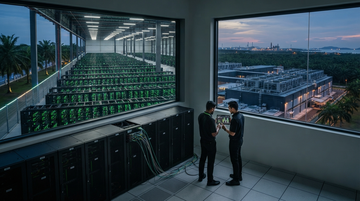
Firmus Technologies said on September 8, 2026 that OpenAI has signed a multi-year agreement to take dedicated AI compute from two of its AI factory sites in Malaysia, making the ChatGPT maker the company's first publicly named anchor customer. The deal lifts Firmus's total contracted capacity across customers to more than 900 MW — a 15× jump from the 18,400-GPU Melbourne deal it disclosed in March 2026 — and hands the unlisted Australian builder a marquee reference customer just as bankers price what could be one of Australia's largest IPOs in years.
Firmus contracted capacity
900+ MW
Across all customers, post-OpenAI deal; prior 18,400-GPU Melbourne deal disclosed March 2, 2026
Deal scope
2 Malaysian AI factory sites
Multi-year; OpenAI as anchor tenant, per Sept 8, 2026 announcement
Last private valuation
US$10.5B+
After US$2B August 2026 raise led by NVIDIA (A$720M), Coatue, Jane Street, Blackstone
Targeted ASX float valuation
Up to US$30B
Reported by The Australian, Sept 8, 2026; expected to price in coming weeks
Indonesia 360 MW AI factory GPUs
Up to 170,000
NVIDIA Grace-Blackwell, Vera-Rubin, Vera platforms, 2027–2028; NVIDIA compute partnership runs through 2034
Firmus-expected offtake revenue
US$25–30B
Committed contracts over first 6 years of NVIDIA partnership
The two Malaysia sites are part of a seven-factory portfolio across Australia, Singapore, Indonesia and Malaysia. Two sites are operational today (Australia and Singapore) and five — including the two earmarked for OpenAI — are slated to come online over the next 24 months. Firmus's factories will run NVIDIA's DSX AI Factory platform integrated with its HyperCube liquid-cooled modular system, which is prefabricated in regional New South Wales.
The Cost Arbitrage: Why Malaysia, Why Now
Two macro numbers do the work here. The first is electricity. Tenaga Nasional's medium-voltage industrial tariff for data-center-eligible customers in Peninsular Malaysia sits at roughly 29.83 sen/kWh — about 6.7 US¢/kWh at recent exchange rates. Northern Virginia, the world's largest data-center cluster, is at 8.99¢/kWh. For a 100 MW AI factory running at a 70% load factor, that 2.3¢/kWh spread is roughly $13M of operating-cost relief per year before any cooling, water or land savings.
| Market | Industrial rate (¢/kWh) | Capacity price (US$/MW-day) | Grid-wait time |
|---|---|---|---|
| Malaysia (TNB medium-voltage, RP4) | ~6.7 | n/a (utility tariff) | Site energisation inside 24 months |
| Northern Virginia (Dominion/PJM, 2026) | 8.99 | 329.17 (2026/27 auction) | ~7 years for new interconnect |
| PJM-wide, weighted average | ~9–10 | 269.92 (2025/26 auction) | Multi-year queues region-wide |
| US 2026 national average industrial (Gartner) | ~8.4 | — | Highly site-specific |
The second number is PJM's capacity market. The 2026/27 clearing price came in at $329.17/MW-day, almost 10× the $28.92/MW-day level of two auctions ago, and the U.S. Department of Energy had to issue emergency orders in July 2026 to let PJM curtail data-center load during a heat wave. PJM has now proposed a new rule that would force large data centers to fund their own power capacity or accept interruptible service. The message to hyperscalers is blunt: new US capacity will be slower, more expensive and less reliable than it looked two years ago.
Second-Order Hit: Why US Hypcalers Should Care More Than the Chips Story Suggests
The conventional read is that this is a NVIDIA win — more Vera Rubin systems shipping, more DSX factory slots filled. That is true but small relative to the NVIDIA order book. The bigger read is on the US hyperscaler build-out. Microsoft, Alphabet, Amazon and Meta collectively guided to roughly $725B of capex in 2026, up 77% year-on-year, and a large share of that spend is now being repriced by Asia-Pacific capacity that arrives in months rather than years.
- AI capex exposure to US grid: ~$725B of 2026 hyperscaler capex is being absorbed into a US grid that is running out of headroom in PJM and ERCOT, while 0.3 GW of Stargate Abilene is the only site that is operational today.
- OpenAI's anchor-tendency shift: OpenAI has now pulled out of Stargate Norway and the UK Stargate site within a single week in April 2026, with Microsoft taking over the Norway site for $6.2B; the Firmus deal is the first OpenAI anchor of a non-hyperscaler, non-Stargate build-out.
- Lease-rate implication: Equinix is trading at 10.4× trailing sales and a 27.7× EV/EBITDA on a 51.6% gross margin — a multiple that assumes power-constrained scarcity in US colo continues to push rents; Malaysian independent capacity at lower rates is a slow-moving ceiling on that pricing power.
- Grid-purchaser risk: Constellation Energy, which has structured PPAs tied to data-center demand, is most exposed to a world where hyperscalers quietly meet marginal new demand from outside PJM rather than buying more US megawatt-days.
- Equity-market float: Firmus's targeted US$30B valuation would be the largest Australian tech IPO on record; if priced, it creates a new listed vehicle for direct Asia-Pacific AI-infrastructure exposure that competes for capital with US data-center REITs like Digital Realty and Iron Mountain.
The Supply Chain on Both Sides of the Trade
Firmus's stack is a working model for what a US-anchored AI builder can do when it sources hardware, cooling and energy outside the US tariff net. Upstream, the chips, the rack-scale system and the factory blueprint all come from NVIDIA (DSX AI Factory + Vera Rubin NVL72 + up to 170,000 accelerators across Asia). Connectivity is being built out through the SUBCO Bernacchi-1 trans-Pacific cable announced June 2026 and a separate SUBCO subsea deal on September 3, 2026. Energy supply was locked in via a 600 MW South Australia agreement in June 2026 linked to 1.2 GW of new renewable generation and battery storage. The data hall itself is fabricated in regional New South Wales and shipped.
On the Malaysia side, the obvious local winner is YTL Power International, which has already completed a 500 MW Nvidia-powered data-center park in Kulai, Johor that hosts Microsoft's first Malaysian region, and is now doubling capacity to 2.4 GW by 2032. Grid power is supplied by Tenaga Nasional, the Peninsular Malaysia utility whose RP4 tariff structure sets the 6.7¢/kWh benchmark above. Downstream, the customer set is broadening: Fireworks signed on as a Firmus AI Cloud customer in August 2026, and Firmus has a separate Indonesian 360 MW AI factory with DayOne that pulls in sovereign-AI workloads.
| Layer | Counterparty | Status (Sept 2026) | Why it matters |
|---|---|---|---|
| Compute & factory blueprint | NVIDIA (DSX / Vera Rubin) | Compute partnership through 2034; 170,000 accelerators | Same chip roadmap as US hyperscalers; arbitrage is in the building, not the silicon |
| Subsea connectivity | SUBCO (Bernacchi-1 + new Sept 3, 2026 cable) | Trans-Pacific capacity build-out | Latency and sovereignty economics for Asia-Pacific inference |
| Energy supply | Firmus 600 MW SA PPA + 1.2 GW renewables | Locked in June 2026 | Behind-the-meter generation, not PJM-exposed |
| Local utility/operator | YTL Power (Johor, 500 MW + 1.2 GW expansion) | Operating, expanding to 2.4 GW by 2032 | Already-anchored hyperscaler footprint sets the Malaysian cost template |
| Grid operator | Tenaga Nasional (Peninsular Malaysia) | RP4 tariff through 2027 | Sets the 6.7¢/kWh baseline that underpins the trade |
| Indonesian co-developer | DayOne (Batam 360 MW) | JV with Firmus, online 2027 | Second SEA geography using the same NVIDIA blueprint |
| Software layer | VAST Data (Firmus AI OS) | Selected Feb 2026 | Anchors data unification for sovereign-AI tenants |
| Anchor customer | OpenAI (Malaysia sites) | Announced Sept 8, 2026 | First named hyperscale anchor for the platform |
Near-Term Catalysts vs. 1–3 Year Structural Risks
Days to quarters: the Firmus ASX float is expected to price within weeks of the OpenAI announcement, and the IPO valuation (reportedly up to US$30B) will be the first market-clearing test of how much equity capital is willing to underwrite an Asia-Pacific AI infrastructure play that is not a US hyperscaler. The next operational milestone is the energisation of the two Malaysia sites; the OpenAI deal is not yet a paid contract but a contracted-capacity reservation that becomes revenue as the sites come online. Watch for: (1) the ASX prospectus and any disclosure of contract tenor, dollar value and capacity reservations vs. take-or-pay; (2) Malaysia site naming (the announcement did not specify the two locations); and (3) the 2027/27 PJM capacity auction in mid-2026, which will show whether US capacity scarcity deepens or stabilises.
One to three years: the structural risk is concentration. Both Malaysia sites run on the same NVIDIA Vera Rubin platform that Stargate runs on; if NVIDIA's supply prioritises Stargate and direct hyperscaler buyers, Firmus could face allocation risk on its 170,000-accelerator pipeline. Sovereign-data rules in Malaysia, Indonesia and the EU are tightening; the September 2025 Stargate UK pause and the April 2026 Stargate Norway handover to Microsoft show that OpenAI has already lost two non-US build-outs to regulatory friction, and Malaysia is not exempt from this risk. The Firmus floating-datacenter cost advantage also depends on the Malaysian ringgit staying weak and Tenaga Nasional's RP4 tariff not being repriced upward for large industrial users.
What the Numbers Say About the Hyperscalers Being Priced for a World That Is Changing
The asymmetry the Firmus deal exposes shows up clearly in the multiples. Microsoft is on 11.2× trailing sales and a 27.8× P/E with TTM operating cash flow of $183B and capex of $116B (capex/operating cash flow of 63%) — a balance sheet that can absorb 24 months of Asian diversification without strain. Equinix, the most rate-sensitive US data-center landlord, trades on 27.7× EV/EBITDA with a 51.6% gross margin, a valuation that implicitly assumes the grid stays the binding constraint. Constellation Energy, the US nuclear-backed power generator most exposed to data-center PPAs, is on 4.2× EV/sales but on 423.9× EV/FCF — a market paying for growth in a single buyer category. None of these valuations break immediately, but the Firmus deal introduces a competing supply curve that none of them were modelling at scale two quarters ago.
| Ticker | TTM revenue | Gross margin | EV/EBITDA | Capex / OCF | Where the Firmus deal hits |
|---|---|---|---|---|---|
| NVIDIA (Q2 FY27) | US$303.0B | 74.7% | 23.9× | 5.5% | Vera Rubin allocation to non-Stargate build, slightly dilutes priority-customer narrative |
| Microsoft (Q4 FY26) | US$331.8B | 67.9% | 18.4× | 63.4% | Direct hit — OpenAI is a competitor for Microsoft's Azure OpenAI Service revenue |
| Oracle (Q4 FY26) | US$67.4B | 65.8% | — | — | Stargate 4.5 GW agreement still the anchor; Malaysian capacity is incremental competitive supply |
| Equinix (Q2 2026) | US$9.8B | 51.6% | 27.7× | 65.2% | Slow-moving ceiling on US colo lease-rate growth |
| Digital Realty (Q2 2026) | US$6.8B | 13.8% | — | — | Lease repricing risk in Northern Virginia and Texas |
| Constellation Energy (Q2 2026) | US$31.3B | 94.9% | 15.4× | 92.7% | Hyperscaler PPA growth assumptions now share the wallet with Asia |
| Iron Mountain (Q2 2026) | US$7.6B | 54.2% | 21.6× | 129.1% | Same US grid bottleneck, with higher financial leverage (89.3% debt/assets) |
| GDS Holdings (Q2 2026) | US$12.3B | 24.3% | 13.4× | 121.9% | China-listed; Asia-Pacific peer; cost-arbitrage playbook validates its model |
How the trade lands in listed names
- Vera Rubin allocation to a non-Stargate, non-hyperscaler buyer increments the 170,000-accelerator Asia pipeline by one named anchor, with US$25–30B of offtake revenue already guided over six years.
- Firmus is the third major anchor win in three months (Coatue/NVIDIA-led A$720M August raise, 170,000-GPU Indonesia deal, OpenAI Malaysia) — locks in compute-partnership share through 2034.
- OpenAI is the single largest counterparty risk: OpenAI contracting 900 MW outside Azure directly substitutes for Azure OpenAI Service revenue at the margin over 2027–2028.
- But Microsoft already absorbed Stargate Norway for $6.2B in April 2026 and retains Stargate as a structural counterweight — net impact over 12 months is neutral; over 3 years, more competitive supply on inference workloads.
- OpenAI's 4.5 GW Stargate agreement with Oracle is still the largest single OpenAI compute deal in existence; the Firmus 900 MW is < 5% of that on a like-for-like power basis — near-term not a Stargate substitute.
- Watch the next Stargate expansion announcement: if OpenAI quietly adds a third Asia-Pacific geography through Firmus, the 4.5 GW allocation becomes negotiable — binary catalyst expected before end-2026.
- PJM-driven lease-rate escalation is the single largest contributor to Equinix's 27.7× EV/EBITDA; Malaysian independent capacity at 6.7¢/kWh introduces a slow-moving ceiling on US colo renewals in 2027–2028.
- Equinix is also exposed to OpenAI-style AI-native customers preferring single-tenant DSX builds over multi-tenant colo — 10–15% multiple compression possible if hyperscalers rebalance a quarter of new US capacity to Asia.
- Every megawatt OpenAI buys from Firmus instead of a Microsoft/Amazon/Meta PPA directly reduces Constellation Energy's addressable pipeline at the PJM-cleared price.
- Cleansky nuclear PPAs are still scarce and long-dated, so the structural thesis holds — but the rate of incremental data-center PPA wins slows over 12–24 months as buyers add optionality in Asia.
- Digital Realty Q2 2026 gross margin is 13.8% (vs Equinix 51.6%), meaning the company is structurally more exposed to power-cost repricing in Northern Virginia and Texas — watch the next earnings call for evidence of any shift in hyperscaler demand toward Asia.
- The Stargate partnership with Oracle is the offset: 5+ GW of US capacity under development, including the Shackelford County and Lordstown sites — binary catalyst is the Stargate capacity commissioning schedule through 2027.
- GDS Holdings is the closest listed peer to Firmus — Chinese-anchored, 12.3% TTM revenue growth, 24.3% gross margin, 13.4× EV/EBITDA — and the Firmus model validates the Asia-Pacific independent-data-center thesis.
- A re-rating to 15–17× EV/EBITDA on the back of a credible cross-border template is plausible if the Firmus ASX float lands at the US$30B target — 20–30% multiple expansion over 12 months.
- YTL Power is the local incumbent on the same Johor corridor — 500 MW operating, 1.2 GW under development, 2.4 GW target by 2032 — and Microsoft is already a customer; the Firmus entry validates Johor as Malaysia's primary AI data-center cluster.
- Listed only via US OTC (YTLPF) with thin float, so the price discovery is limited; a Bursa Malaysia re-rating is more likely over 12–24 months as the corridor consolidates — directional tailwind, but liquidity-constrained.