%22%2F%3E%0A%20%20%3Ccircle%20cx%3D%22220%22%20cy%3D%22150%22%20r%3D%22180%22%20fill%3D%22%2322d3ee%22%20fill-opacity%3D%220.12%22%2F%3E%0A%20%20%3Ccircle%20cx%3D%221010%22%20cy%3D%22130%22%20r%3D%22220%22%20fill%3D%22%2338bdf8%22%20fill-opacity%3D%220.08%22%2F%3E%0A%20%20%3Ccircle%20cx%3D%22920%22%20cy%3D%22520%22%20r%3D%22170%22%20fill%3D%22%2322d3ee%22%20fill-opacity%3D%220.06%22%2F%3E%0A%20%20%3Cpath%20d%3D%22M140%20430h920%22%20stroke%3D%22url(%23line)%22%20stroke-width%3D%2212%22%20stroke-linecap%3D%22round%22%2F%3E%0A%20%20%3Cpath%20d%3D%22M220%20360c120-150%20260-220%20380-220s260%2070%20380%20220%22%20fill%3D%22none%22%20stroke%3D%22%2367e8f9%22%20stroke-opacity%3D%220.5%22%20stroke-width%3D%2216%22%20stroke-linecap%3D%22round%22%20stroke-linejoin%3D%22round%22%2F%3E%0A%20%20%3Cpath%20d%3D%22M300%20398h600%22%20stroke%3D%22%2394a3b8%22%20stroke-opacity%3D%220.24%22%20stroke-width%3D%228%22%20stroke-linecap%3D%22round%22%2F%3E%0A%20%20%3Ctext%20x%3D%22220%22%20y%3D%22510%22%20fill%3D%22%23e2e8f0%22%20fill-opacity%3D%220.7%22%20font-family%3D%22Arial%2C%20Helvetica%2C%20sans-serif%22%20font-size%3D%2238%22%20letter-spacing%3D%228%22%3EINSIGHTS%3C%2Ftext%3E%0A%3C%2Fsvg%3E)
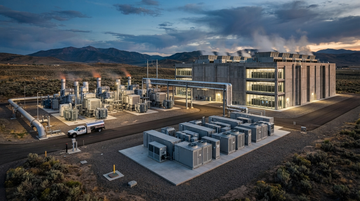
Private markets are pricing “power ownership,” not just computer space
The $30B valuation isn’t for renting racks—it’s for controlling the energy bottleneck
Crusoe is reportedly in talks to raise about $3B at a valuation around $30B, a jump described as roughly 3× versus its prior mark. The investable implication isn’t simply “more data centers.” It’s that investors are paying for a turnkey approach where on-site power architecture is part of delivering AI uptime—something scale-colo and AI cloud colocation models typically monetize through long-term leases rather than integrated power control.
Crucially, Crusoe’s publicly disclosed partnerships and hardware pipeline show two linked layers of control:
1) Generation/near-site supply (gas-turbine packages destined for Crusoe-powered data centers). 2) Power conditioning and ride-through (AI UPS technology deployed across hyperscale campuses to reduce grid-instability risk during AI load swings).
That combination helps explain why a “power-integrated” operator can command a higher private-market multiple than a pure landlord.
Verified facts establishing the power integration thesis
What Crusoe has disclosed that maps directly to “captive power” risk reduction
Reported new raise
$3B
Reported fundraising amount in a July 3, 2026 report
Reported valuation
$30B
Reported valuation range cited in the same July 3, 2026 report
Gas-turbine order
29 units
GE Vernova LM2500XPRESS aeroderivative packages expected to be in full operation in Q4 2025
AI UPS deployment plan
5 GW
ON.energy’s AI UPS technology deployment across multiple hyperscale campuses; commissioning starts in 2026 and extends into 2027
| Power layer | Disclosed input | What it controls in practice | Why it changes who captures value |
|---|---|---|---|
| Near-site generation | 29× GE Vernova LM2500XPRESS turbine packages (~nearly 1GW combined) | Provides firm power quickly enough for volatile AI demand profiles | Shifts bargaining power from utilities/landlords toward the operator designing the energy stack |
| Power conditioning / ride-through | ON.energy AI UPS validated to ERCOT Large Load Interconnection requirements; deployment planned at 5 GW | Smooths voltage faults and prevents GPU load swings from propagating to the grid | Reduces interconnection friction and curtailment risk—key to revenue certainty |
| Scale path for modular compute | 4.9 GW total power; first Stargate campus data center buildings on a 1.2 GW campus energized one year after breaking ground | Compresses time from site selection to usable AI capacity | Improves early cash conversion versus projects that wait on grid build-outs |
Supply-chain map: from turbines to UPS to rack-level operations
Full-stack read-through: where the “turbine-to-rack” model pushes incremental demand
In a traditional scale-colo build, a landlord contracts for power indirectly (through utilities, grid upgrades, and backup power that is often treated as insurance). Crusoe’s model moves the revenue-critical path closer to the power hardware and its control systems.
That matters because the incremental engineering effort and long-cycle procurement (turbines, switchgear/power management, UPS-like ride-through systems, and critical cooling/power distribution) become entangled with AI delivery timelines.
- Crusoe’s 29-turbine (LM2500XPRESS) pipeline implies recurring orders for aeroderivative gas turbine packages and emissions controls as new power blocks come online (Q4 2025 full operation guidance).
- Crusoe’s ON.energy 5 GW AI UPS deployment implies demand for medium-voltage UPS integration and power-conditioning systems sized to large AI load profiles (2026–2027 commissioning window).
- Crusoe’s emphasis on capacity energized quickly implies upstream planning advantages: faster energization compresses construction-to-revenue, which can support higher private valuation even before profitability.
Investor angle: equity vs debt and who owns power
What the $3B mark likely prices in: financing that “underwrites electrons,” not just capex
The reported coverage does not specify whether the $3B is equity, debt, or a hybrid. But the disclosed hardware stack suggests how capital structure could work: turbine procurement and power-conditioning rollouts are capital-heavy and benefit from long-term offtake/lease-like arrangements tied to AI uptime.
In other words, the financing debate is less about whether AI demand exists and more about whether the build-out can monetize uptime certainty through contracts with hyperscale customers—reducing the perceived risk that delays in grid interconnection or power quality degrade utilization.
Public-market linkage with sourced financial context
Why this matters for public markets: the winners are those selling power reliability and integration
Two public-market categories are directly relevant.
1) Digital infrastructure landlords: Equinix and Digital Realty are exposed to the broader AI colocation capex cycle, but their revenue model depends on leased space and interconnection success. A “power-integrated operator” can still buy interconnection and space from them, but it can also reduce some demand that would otherwise be captured as landlord power-related spend.
2) Power and critical infrastructure suppliers: GE Vernova, Vertiv, Eaton, and Schneider Electric are closer to the physical reliability layer. Crusoe’s disclosed turbine and AI UPS plans reinforce that the AI build-out increasingly behaves like power-system engineering—where vendors with grid-validated products and rapid delivery pipelines can capture share.
Horizon view
What to watch next (and what would falsify the thesis)
- Near-term: watch for disclosed turbine commissioning milestones and whether “full operation in Q4 2025” translates into realized AI delivery schedules for contracted campuses.
- Near-term: watch for whether AI UPS deployments scale beyond pilots into multi-campus rollouts during the 2026–2027 commissioning ramp.
- Long-term: watch if captive power operators expand from project-level integration into standard productized power blocks; that’s the structural move that competitors can copy slowly but not instantly.
- Long-term: monitor for policy/market changes that shift interconnection valuation from mitigation tools toward grid build-outs; that would weaken the pricing power of ride-through and onsite reliability stacks.
Public-market spillovers most consistent with Crusoe’s disclosed power stack
- AI colocation demand remains a tailwind, but power-integrated builds could shift some incremental spend away from landlord power mediation over 1–3 years.
- If power reliability becomes a bundled differentiator, Equinix may win on ecosystems—yet higher private operator leverage can cap near-term take-rate for “power as a service.”
- The bet is on scale and interconnection delivery; timing risk can still hit quarters if AI utilization ramps unevenly.
- Portfolio size supports AI demand capture, but a captive-power operator can reduce the landlord’s role in solving power uptime on newly built campuses (1–3 years).
- If customers value grid-validated ride-through more than traditional backup, Digital Realty could see mix shift toward interconnection and services rather than power infrastructure rent.
- In the near term, sentiment around AI capex can still move the stock, but execution depends on delivery timing in specific regions.
- Crusoe’s disclosed 29 LM2500XPRESS turbine packages supports continued demand for aeroderivative gas turbine power blocks into 2025–2026 commissioning windows.
- If the turbine-to-rack model expands, GE Vernova benefits from repeat orders tied to “firm power for AI,” not only utility merchant builds.
- Near-term upside depends on schedule fidelity: delays would push deliveries out of Q4 2025 full-operation expectations.
- AI data centers amplify demand for critical power distribution and thermal control; Crusoe’s power-first stance is consistent with higher unit content per megawatt over 1–3 years.
- If customers prioritize uptime guarantees, Vertiv can see stronger pull-through for power/thermal systems used in high-density racks and modular builds.
- Near-term: execution risk exists if the market rotates toward bespoke power-control designs, but the broader AI power spend remains supportive.
- Crusoe’s deployment of large-scale UPS/ride-through concepts supports secular demand for power quality and protection hardware; Eaton is positioned for that reliability layer.
- If hyperscalers keep asking for grid-compliant uptime, Eaton can capture incremental spend tied to medium-voltage and critical power architectures (1–3 years).
- Near-term: margin impact depends on mix and supply chain; slow turbine/UPS ordering can mute quarterly results.
- Crusoe’s model treats power orchestration as core infrastructure; Schneider Electric can benefit if customers standardize on energy-management and grid-ready integration tooling.
- If UPS-like ride-through expands beyond early deployments, Schneider Electric may gain incremental share in data-center electrical distribution and monitoring (2026–2028).
- Near-term downside risk is budget timing: if AI site approvals pause, orders can slip quarter to quarter.