%22%2F%3E%0A%20%20%3Ccircle%20cx%3D%22220%22%20cy%3D%22150%22%20r%3D%22180%22%20fill%3D%22%2322d3ee%22%20fill-opacity%3D%220.12%22%2F%3E%0A%20%20%3Ccircle%20cx%3D%221010%22%20cy%3D%22130%22%20r%3D%22220%22%20fill%3D%22%2338bdf8%22%20fill-opacity%3D%220.08%22%2F%3E%0A%20%20%3Ccircle%20cx%3D%22920%22%20cy%3D%22520%22%20r%3D%22170%22%20fill%3D%22%2322d3ee%22%20fill-opacity%3D%220.06%22%2F%3E%0A%20%20%3Cpath%20d%3D%22M140%20430h920%22%20stroke%3D%22url(%23line)%22%20stroke-width%3D%2212%22%20stroke-linecap%3D%22round%22%2F%3E%0A%20%20%3Cpath%20d%3D%22M220%20360c120-150%20260-220%20380-220s260%2070%20380%20220%22%20fill%3D%22none%22%20stroke%3D%22%2367e8f9%22%20stroke-opacity%3D%220.5%22%20stroke-width%3D%2216%22%20stroke-linecap%3D%22round%22%20stroke-linejoin%3D%22round%22%2F%3E%0A%20%20%3Cpath%20d%3D%22M300%20398h600%22%20stroke%3D%22%2394a3b8%22%20stroke-opacity%3D%220.24%22%20stroke-width%3D%228%22%20stroke-linecap%3D%22round%22%2F%3E%0A%20%20%3Ctext%20x%3D%22220%22%20y%3D%22510%22%20fill%3D%22%23e2e8f0%22%20fill-opacity%3D%220.7%22%20font-family%3D%22Arial%2C%20Helvetica%2C%20sans-serif%22%20font-size%3D%2238%22%20letter-spacing%3D%228%22%3EINSIGHTS%3C%2Ftext%3E%0A%3C%2Fsvg%3E)
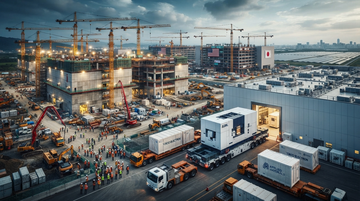
Fabs under simultaneous construction
~20
13 in Taiwan + 5-6 overseas, per TSMC executive at SEMICON Taiwan 2026, Sept 3
2026 capex guidance (midpoint)
$62B
Raised to $60-64B in July 2026 from $52-56B; up ~90% vs. 2024 actual of $29.76B
Equipment procurement demand
1.9x
TSMC's equipment need by July 2026 vs. end-2025 baseline, per Y.J. Hou remarks
Q2 2026 gross margin
67.7%
Record high, per TSMC Q2 2026 results reported Jul 16, 2026; +200bps YoY
NVIDIA CoWoS allocation, 2026
~60%
Estimated 595,000 wafers booked, ~half of all 2026-2027 capacity, per analyst tracking
The 20-fab figure is not a glut warning — it is a demand receipt
On Sept. 3, 2026, TSMC executive vice president Y.J. Hou told the SEMICON Taiwan CEO Summit in Taipei that the company is building 13 fabs in Taiwan and has broken ground at 5-6 overseas sites — roughly 20 simultaneous construction projects, running at 4-5x the historical pace. The framing in some headlines has been that this scale outruns AI demand. The numbers say the opposite: TSMC's Q2 2026 gross margin hit 67.7%, CoWoS advanced-packaging supply-demand gap is narrowing from 20% to 10% by year-end, and 2nm wafers are booked solid through 2028.
TSMC capex has nearly doubled in two years
Annual capex in USD billions. 2026 figure uses the midpoint of TSMC's $60-64B range, raised from $52-56B in July 2026.
Unit: $B
2024 actual
FY2024 actual
29.8
2025 actual
FY2025 actual, up 37% YoY
40.9
2026 guide
Midpoint of $60-64B range
62
- TSMC operates six 12-inch GIGAFABs in Taiwan and one 12-inch fab each at TSMC Arizona and JASM Kumamoto, producing more than 17 million 12-inch equivalent wafers in 2025.
- Of the 5-6 overseas sites under construction, three are Arizona Fab 21 phases (N4, N3, N2/A16), two are Kumamoto JASM fabs, and one is ESMC Dresden, which broke ground in February 2026.
- Equipment-procurement demand by July 2026 was 1.9x the level at end-2025, according to Hou, signaling that vendors — not customers — are now the bottleneck.
Capex is rising twice as fast as revenue, and free cash flow is paying the bill
Capex grew 37% in 2025 and is set to grow another 50% in 2026 to roughly $62B — yet TSMC's revenue in Q2 2026 alone was NT$1,270.4B (about $39.6B), up 36% year-over-year, with net income of NT$706.6B. The company is funding the build from operations: Q2 operating cash flow ran at 60% of revenue and capex absorbed 39% of revenue, leaving the gap manageable with net cash of NT$2.07T ($66B) on the balance sheet at June 30.
The 2026 capex step-up tracks the acceleration in advanced-node demand. Three-nanometer revenue rose to 30% of wafer sales in Q2 2026 from 23% a year earlier, while 2nm contributed 3% of revenue in its first full quarter of commercial production. Five-nanometer remains the workhorse at 33% of wafer revenue. Together, 7nm-and-below nodes now contribute 77% of wafer sales, up from 65% a year ago.
The real bottleneck sits upstream — the equipment vendors cannot keep pace
Hou's 1.9x equipment-demand figure is the most consequential number in the announcement. ASML, Tokyo Electron, Applied Materials, Lam Research and KLA all reported strong results in Q2 calendar 2026, but their order books and revenue mix point to a supply-constrained seller environment — not the surplus that TSMC's 20-fab buildout superficially suggests.
| Vendor | Latest period | Revenue | YoY growth | Gross margin |
|---|---|---|---|---|
| ASML | Q2 2026 (Jun 30) | €9.3B | +15% | 54.0% |
| Tokyo Electron | Q1 FY2027 (Jun 30) | ¥732.4B | +33% | 46.8% |
| Applied Materials | Q3 FY2026 (Jul 31) | $8.4B (est.) | +25% | 49% (est.) |
| Lam Research | Q4 FY2026 (Jun 30) | $5.4B (est.) | +30% | 50% (est.) |
| KLA | Q4 FY2026 (Jun 30) | $3.4B (est.) | +15% | 61% (est.) |
Tokyo Electron flagged the same dynamic: Taiwan's share of its Q1 FY2027 sales rose to 25.4%, up 18.9% sequentially, even as China's share slipped 3.6 points to 30.4%. Management has guided that AI-related equipment will reach 40% of total revenue by FY2026. Applied Materials and Lam Research are running with record backlogs and lead times stretching into 2027 — the kind of seller dynamics that follow when one customer is buying 1.9x more equipment than it did eight months ago.
Downstream, NVIDIA and Apple have already locked the next two years
The other half of the picture is that demand has been pre-sold. NVIDIA is estimated to hold roughly 60% of TSMC's CoWoS advanced-packaging output for 2026 — about 595,000 wafers — and has reportedly booked more than half of 2026-2027 capacity. Apple has secured a majority of the 2nm line, with iPhone 18 silicon in volume production at Hsinchu's Fab 20. Together the two customers account for roughly 40% of TSMC's revenue.
- NVIDIA TTM revenue reached $303B as of the July 2026 quarter, with quarterly earnings up 128% year-over-year — a scale that anchors TSMC's HPC platform, which already drove 55% of Q4 2025 revenue.
- Apple's Q3 FY2026 revenue grew 16.4% year-over-year to a TTM $467B; its multi-year 2nm commitment ties up TSMC capacity that competing fabless designers cannot access.
- Together NVIDIA and Apple plus AMD make up an estimated 85% of TSMC's leading-edge capacity allocation — concentration that limits pricing power for any new entrant.
Overseas fabs scale the build but lag Taiwan's economics
The 5-6 overseas fabs are the geopolitical hedge TSMC needs, but they are not the margin engine. Arizona's total commitment has grown to $165B (now $265B including the July 2026 expansion) for six logic fabs, two packaging plants and an R&D center, yet TSMC has not disclosed separate unit economics for the U.S. site. Kumamoto's first JASM fab swung to a profit in Q1 2026 at mature nodes (12-40nm), and the second Kumamoto fab — initially planned for 6/7nm — was upgraded to 3nm in February 2026, raising the per-wafer revenue base.
| Site | Process nodes | Status | Notable milestone |
|---|---|---|---|
| Arizona Fab 21 Phase 1 | N4 | In volume production | First U.S. leading-edge fab, since Q4 2024 |
| Arizona Fab 21 Phase 2 | N3 | Equipment install Q3 2026 | 3nm production targeted 2027 |
| Arizona Fab 21 Phase 3 | N2 / A16 | Construction (broke ground Apr 2025) | Most advanced node ever attempted in U.S. |
| JASM Kumamoto Fab 1 | 12/16/22/28/40nm | In production | Q1 2026: first quarterly profit |
| JASM Kumamoto Fab 2 | N3 (upgraded Feb 2026) | Under construction | 60% Japanese-sourced equipment and materials |
| ESMC Dresden | Mature/ specialty | Broke ground Feb 2026 | First European TSMC fab |
What moves first, and what the 1-3 year horizon looks like
Short-term (days to quarters): equipment-vendor order books and ASML's Taiwan-region mix will be the cleanest read on whether the 20-fab buildout is absorbing or straining supply. TSMC's Q3 2026 revenue guide of $44.6-45.8B and full-year USD growth above 40% leaves little room for a slowdown without breaking the capex case. Watch the December 2026 quarter for capacity-utilization signals.
Long-term (1-3 years): the binding constraint flips back toward demand only if NVIDIA's 60% CoWoS allocation outruns AI infrastructure deployment, or if 2nm yields at TSMC Hsinchu underperform the 70% threshold Apple is reportedly counting on for iPhone 18. The structural implication: foundry-level returns compress modestly as overseas fabs dilute blended margins, but equipment-vendor pricing power stays elevated through at least 2027 because TSMC is the marginal buyer of every advanced tool shipped.
- ASML's 2026 sales are tracking toward €43-45B with gross margin up to 56% — both numbers have been raised twice since January, signaling vendor pricing power has not yet peaked.
- Tokyo Electron's Taiwan share rising to 25.4% in a single quarter is the cleanest evidence that TSMC's ramp is pulling forward equipment deliveries ahead of fab completion.
- Applied Materials, Lam Research and KLA all show TTM revenue growth above 15% with operating margins north of 30% — operating leverage that has further to run if TSMC holds the 4-5x construction pace.
Where the trade sits
- Q2 2026 gross margin of 67.7% (record) on revenue of NT$1,270.4B shows demand is absorbing the 20-fab build, not straining it.
- 2026 capex midpoint of $62B is up ~90% versus 2024 actual of $29.76B, pulling $20B+ of supplier revenue forward into 2026-2027.
- 2nm wafers are booked through 2028 with Apple holding majority allocation, anchoring 2027-2028 pricing power at Hsinchu.
- Risk: overseas-fab ramp dilutes blended gross margin by an estimated 200-300 bps by 2028 as Arizona and Dresden reach scale.
- Q2 2026 sales of €9.3B with gross margin of 54.0% — both above guidance — and 2026 outlook raised to €43-45B.
- Taiwan's share of system revenue rose from 23% to 30% in a single quarter, the cleanest read that TSMC's 20-fab build is consuming advanced EUV capacity first.
- Each new TSMC GIGAFAB requires 30-40 EUV systems at ~$200M each; the 13 Taiwan fabs alone imply several years of locked-in backlog.
- Risk: China exports still ~20% of 2026 sales and any new restriction cuts a quarter of installed-base service revenue.
- Q1 FY2027 revenue of ¥732.4B grew 33.3% year-over-year with gross margin of 46.8%, driven by Taiwan sales rising 18.9% sequentially to a 25.4% mix.
- Management targets AI-related equipment at 40% of FY2026 sales — TSMC's 20-fab ramp is the single biggest driver of that mix shift.
- Holds ~91% global share of photoresist coater/developer tools, making every new TSMC fab a multi-billion-yen order regardless of node.
- Risk: China revenue still 30.4% of sales; a sharper-than-expected China slowdown would offset Taiwan share gains.
- Q3 FY2026 (Jul 31) quarterly revenue grew 24.8% year-over-year to ~$8.4B, with operating margin holding above 33%.
- Deposition and etch tools are at the heart of every TSMC 2nm and A16 module; the 13 new Taiwan fabs lift deposition demand proportionally more than lithography.
- TTM operating cash flow of ~$8.4B funds the R&D push into gate-all-around transistors that TSMC will need by 2028.
- Risk: any TSMC deferral of a U.S. fab to 2029 would hit Applied Materials harder than ASML, since deposition tools are easier to push out than EUV.
- FY2026 revenue of $23.2B grew 30% year-over-year with operating margin of 37.4% and ROE of 65% — among the highest in semiconductor capital equipment.
- Etch intensity rises sharply at 2nm and below, meaning each new TSMC fab ramps etch-tool content 20-30% above the prior node.
- TTM operating cash flow of $5.8B funds a buyback pace that shrinks share count ~2% annually, compounding per-share upside.
- Risk: TSMC Arizona Phase 2 equipment install slipping from Q3 2026 to Q1 2027 would push ~$1B of Lam Research revenue into FY2027.
- Has locked ~60% of TSMC's 2026 CoWoS output (595,000 wafers), de-risking supply for Rubin and Blackwell ramp through 2027.
- TSMC's 20-fab build specifically targets the HPC platform that drove 55% of Q4 2025 revenue and is the bulk of NVIDIA's $303B TTM.
- Counterweight: concentrating on a single foundry leaves NVIDIA exposed to [TSMC](tsm] pricing on advanced packaging, where CoWoS prices have risen 15-20% over 18 months.
- Long-term: as 2nm capacity at Hsinchu ramps in 2027, NVIDIA's per-wafer cost should ease 10-15% versus current 3nm/4nm pricing.
- Has secured majority of TSMC's 2nm capacity for iPhone 18 silicon, locking in 2026-2028 supply as the 20-fab buildout fills alternative nodes.
- TSMC's 2nm wafers are reportedly priced at ~$30,000 each — a 30%+ premium over 3nm that flows back to [Apple](aapl]'s gross margin if it can hold iPhone ASPs flat.
- FY2026 services revenue continues to compound at double-digit rates, partly insulated from foundry cost cycles.
- Risk: any 2nm yield miss below 70% at Hsinchu would delay the iPhone 18 ramp and force Apple to absorb fallback 3nm wafer costs.